
An interesting little chain of events this morning. It began with my reflecting on one of the new morning regulars on the beach as I walked. I’ve been aware of him a few weeks now. He’s late fifties, or sixty, I’d say, not old; a big man with a barrel chest; always shirtless, and wearing some pretty stylish baggies. He carries a small bucket and slowly works the tide line, occasionally stooping to pick something up and place it in his bucket. He isn’t out for exercise or meditation like most of the rest of us. He has another purpose. At first I thought he was picking up trash, but I don’t think so. This morning it hit me. He’s an old-fashioned Beachcomber.
Another blast from the past, I guess. Oh, there are innumerable beach bars called Beachcomber, but not too many real beachcombers anymore. A beachcomber is a special breed. They’re looking for something, and it’s not always the same thing. Don’t confuse a beachcomber with the guy sweeping a metal-detector, looking for lost engagement rings and Indian nickels. A beachcomber, as I see it, from a perspective skewed by both age and experience, is motivated by something deeper than monetary remuneration, although that may certainly play a part. They are looking for something of other value; value to them, specifically. Shells, shark teeth, sea glass, driftwood, which may or may not be turned into something someone else may value. Some make jewelry from what they find, some collect stuff in boxes, to gaze or not gaze at periodically, some do nothing with it. Sometimes just finding something odd or beautiful is enough. I get that.
The term beachcomber originated with British seamen who jumped ship in the Pacific islands, specifically Tahiti, with mutineers from the Bounty. It became a means of survival for them, picking through the flotsam and jetsam for their livelihood, and also became a not uncommon means of escaping what many saw as oppressive service aboard ships. Sometimes, sailors who’d had enough of beachcombing were traded for those wishing to jump ship, and often worked passage back home with no pay. The ones who stayed in the islands were assimilated into native culture.
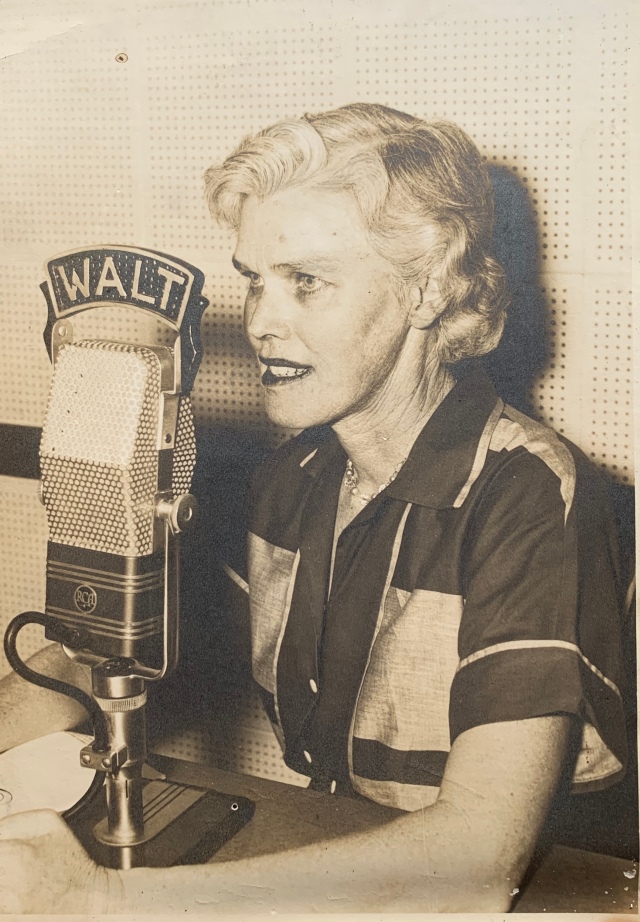
Reflecting on beachcombing as I walked home this morning, I though of my aunt Eva Byron, my mother’s older sister. She was the first beachcomber I knew. An odd duck by most standards, to me she was mysterious and intriguing. Never married, she went her own way in a time when that wasn’t normal or even acceptable for a woman. She was a singer, a poet, (she published in The Saturday Evening Post), and one of the first women in broadcasting in Florida, hired in 1952 by Tampa radio station WALT, a 1000 watt station, as Women’s Director.
But it was her love of the Gulf of Mexico and its beaches that resonated most with me, even before I could recognize or articulate it. A solitary presence, her reverence for the Gulf was felt, but mostly unspoken, though later found, by me, in what she had written. And she was a beachcomber, finding solace, I think, in culling through what the sea had discarded, or freely given. And in that solitary practice there was something I thought was sadness, but now recognize as kenosis, an emptying of self.
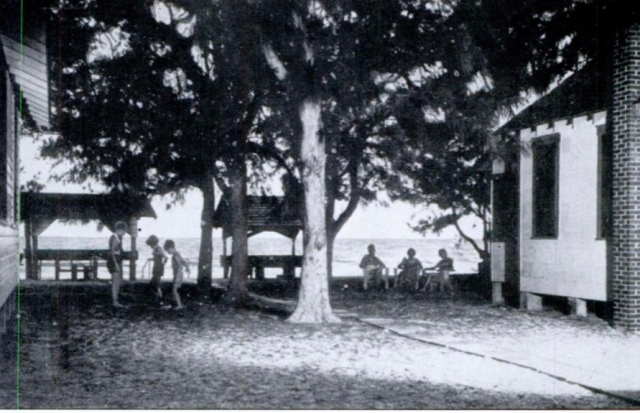
Returning home on the beach this morning I remembered that Aunt Eva would rent a cottage at Indian Rocks Beach north of St. Petersburg on occasion, and we would get to go and stay a few days. I say it was occasionally, though it may have only been once or twice while I was a child. In memory it seems boundless; long, languid days in the shallows; balcony sandwiches for lunch; the wind in the giant Australian Pines; painful, peeling sunburns on cots on the screen porch at night with the Gulf just yards away.
And I have remembered the name of the cottages all these years: the Nicodemus Cottages. When I got home this morning I Googled Nicodemus in Indian Rocks and found a reference to a book published by the Indian Rocks Historical Society. Along with a brief description of the cottages there was a photograph, a scene exactly as I remember it. But more remarkably, to the left of the sunlit Australian pine at center, three children are playing. There is no date accompanying the photograph; no names. But let’s just say it was 1955, about the time of the cottages in their heyday, about the time Aunt Eva would have rented there. I was eight, my sister Susan ten, and sister Anne thirteen. And the three seated on the right? Well, that’s the posture of Aunt Eva on the far right, and that would be my mother on the left, and my grandmother Josie, their mother, in the middle. It’s still pretty early in the morning; the sun is still low in the east, lighting the bottom of the tree, throwing shade toward the Gulf. I think Aunt Eva has just come up from the beach.

 The Skinny Island Post
Remarkable and lovely. Thank you. I remember Aunt Eva. I wish I’d know her longer.