
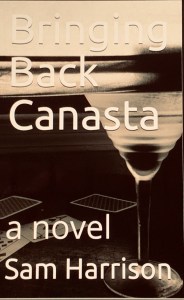
Well, it’s been 27 years since the publication of my second novel, “Birdsong Ascending,” so I guess it’s time for another. “Bringing Back Canasta” is available on Amazon today in paperback and Kindle formats. Here’s a little description:
After Witnessing the liberation of Dachau in the closing days of WWII a disillusioned American journalist drifts to Montevideo, Uruguay, where he takes a job with the English language newspaper. While covering a routine story about the sale of the British-owned rail system back to the Uruguayans, he falls for the beautiful, duplicitous wife of the rail manager and into a web of international intrigue, murder, and conspiracy. “Bringing Back Canasta” is a thoughtful, intelligent narrative that is part thriller and part love story, with a healthy dose of Noir.
Now, it hasn’t taken 27 years to write this, only about 20, and in an exclusive for readers of The Post, I’ll tell you all about it. Around 1998 or 1999, only a few years after moving into The Little Hacienda, I got interested in martinis, which led to thinking about life in Florida in the 50s. No, I wasn’t a martini drinker in the 50s, just a cigar smoker- it was Tampa, after all- and I recalled my folks and most other adults at the time playing canasta. I started looking into the game, including the origin, and low and behold stumbled on a great story. I won’t give away the plot of the book by going into detail, but my research led me to Montevideo, Uruguay, in the mid-40s. One thing led to another, and I was able, over quite a few years, to craft this story, all based in fact, about a series of fascinating events in Montevideo, all witnessed and involving a character I invented, a journalist from Tampa, who quite accidentally ends up there after witnessing the liberation of Dachau concentration camp in the closing days of WWII. It’s definitely a period piece, a Noir, if you will, but uncannily contemporary as well. I hope you will get it, read it, and let me know what you think. We’re publishing independently this time around, so word-of-mouth is paramount. Visit my author page @ amazon.com/author/sharrison3.

 The Skinny Island Post
July 11, 2019
My review of BRINGING BACK CANASTA by Sam Harrison
Sam Harrison has this wonderful ability as a writer; he is able to take an enormous amount of research and period history, and then blend it quite seamlessly into his dialogue continuity. He brings up a subject in the course of his narration, holds it out before the reader in a tantalizing fashion, and then proceeds to tell us exactly as much as we would wish to know about that subject, and no more. He does this with the various aspects of World War II, the liberation of the KZ camp at Dachau, the technical aspects of sailing on a modern sailboat, fishing for massive tuna from the seat of a fighting chair, and traveling through southern Florida in 1947, with all of the actual signs and sights and period people along the way.
Whether sitting down to an expensive meal in South America, or riding in a period locomotive along the decaying rail lines of an ancient set of train tracks, you feel it; it’s like Sam is right there, and is reporting back exactly what he is experiencing.
This is the story that Humphrey Bogart, Peter Lorre, and Edward G. Robinson deserved, with ‘Baby’ Bacall playing Jane, and Ingrid Bergman as Annabel. This is what To Have and Have Not and Key Largo might have been. If any of us has ever seen this world of the 1940’s, it was surely in black and white. Not any longer. Sam Harrison literally films a completely color movie with the artful interweaving of his narration and dialogue.
Tom Mayfield is a product of World War II; one of the post-war New Men, as his dying friend, Martinez, informs him. A man who learns to live within a world that no longer makes any sense as to right and wrong, but a world which should be enjoyed notwithstanding, simply because of the approach of those lavish and unbelievable conveniences of the modern age; of an end to the black and white 35 MM battlefields, and the beginning of the era of mankind’s greatest marvels and achievements. A man who will do what he must in order to overcome the horrors of the recent past, and look to whatever else may be possible because, thanks to the allies, we will always have Paris.
Yet, Tom is seemingly still stuck in transition. While he is a product of the Southern gentleman, his spiritual adultery with the sexually powerful beauty named Jane is worth the full ride, in and of itself.
Don’t bother asking for explanations; she’ll just tell you that she came, in the Year of the Cat.
Sam takes the full barrel proof of sexual attraction, and then makes us savor each and every stinging swallow, causing us to carefully identify within ourselves all of those various forbidden notes and flavorings.
It’s eerily familiar; we’ve all been there before.
By the time we are a little over halfway through the novel, we feel the story changing gears. In an instant, Tom becomes the legitimate heir to a very valid, and successful life, economically. Then, he is thrust into the role of literally playing God with the terrifying omniscience that certain information now provides him.
And what a moral conundrum into which Tom is cast! Either bringing down the demons of Dachau, or else overlooking certain players of the worst crime in history just to protect his own lustful and morally-bankrupt interests. Sam yet again ramps up the stakes, and moves us ever closer to a most necessarily-explosive ending.
Were we promised noir? Well, we get it. The French word for black, or darkness. But the effect is so very subtle that you may probably miss it, at first, only to have it chillingly dawn on you, later. That sudden revelation of oh my god; that’s what happened!
The novel morphs from one set of superb interests to another; each fully loaded with period facts and reference points. An enormous amount of information is cleverly sewn throughout the entire fabric of this book, and it is only later that you realize just how much factual knowledge that you have actually learned, just by following along. And Sam makes the trip so very enjoyable, at the same time, that you really do not want it to end.
As to Sam Harrison, the author, there is just one thing which is of a paramount consideration. Sam is one of the absolute last of his kind; a writer who lived more of his life without the internet than with it.
After Sam’s era has passed, the next generation will not know what it was like to live without the world wide web. They can never accurately write about what it was like to live in the 20th century. One must write about that which one actually knows, and has experienced.
It would be like any of us trying to accurately capture a time prior to 1894, and a world yet powered by horses and oxen.
Sam’s era is the last to not be completely recorded online; thus, only first person accounts from much of that time will ever do; much like actual diaries from the Civil War. If for no other reason, Sam Harrison matters very much; he is the last connection to such a dual reality. He lived it, most thoroughly, and in such a work as Bringing Back Canasta, it definitely shows.
I hope to see much more of this sort of work coming from his pen in the future; it will be our collective loss if it does not. He is truly in the zone, now, and has at last found a writing voice that causes the reader to blink, and to ask, “when was the last time I was ever this engaged with a storyline, or with any other set of characters?”
The characters will stay with you after you finish the book.
This is so much more than a period piece. It clearly took twenty years of research to have this sort of a passing knowledge of the various topics presented; from the first death of rail to the freedom of the personal automobile, and the ghostly predictions of Eisenhower’s coming interstate system.
It would not surprise me to learn that, in the future, Bringing Back Canasta becomes required reading in the social studies classes simply for its thought-provoking forays into that period of time, and a glance back at what that obscure time period was really like.
You will at the very least enjoy this book. At most, you may find that it completely changes your expectations as a reader.
Well, hello, Sam. Greetings from Buckfield. Guess who? My grandmother went to Los Angeles in the 50’s and came back with a new card game called Canasta. I became an enthusiastic player and would be able to play today if anyone else could.
I don’t maneuver through the computer world very well but will give it a try. I hope all is well with you and your family. Love to you all. — Peter
Geeze, so good to hear from you man! Wow. Yeah, I hope you can get hold of the book. It’s pretty good, and there’s even a little about the card game in it. Love back to you. -Sam
I just picked up the eBook, so Alex could read it to me on my Mac desktop!
I will also get the paperback version so I can add it to my new floor-to-ceiling shelves I had commissioned and built just this last year! WALLS is up there now, in my small library area of ‘authors I actually know’!
I have to say, your opening got me right away. I am absolutely buried in this thing, already!
I read very little fiction, any more; mostly American history and actual period writings, but this book does have that ‘feel’ of being quite historically correct.
I had five years of German, and I taught German One full time at Staunton River High School in 2013 as a full time long term sub. During our second year, our 1978 German class tourgroup went to Dachau, and it was a most sobering event for everyone. We were in the 10th grade, at the time.
I was in Israel in 1995, and I went to YAD VASHEM, which was very much eye opening.
Glad to see that you are publishing once again!
Geo
Yes! Got it!! Can’t wait to read it!
Good luck…hope it sells a million!
Thanks! We hope so, too.