
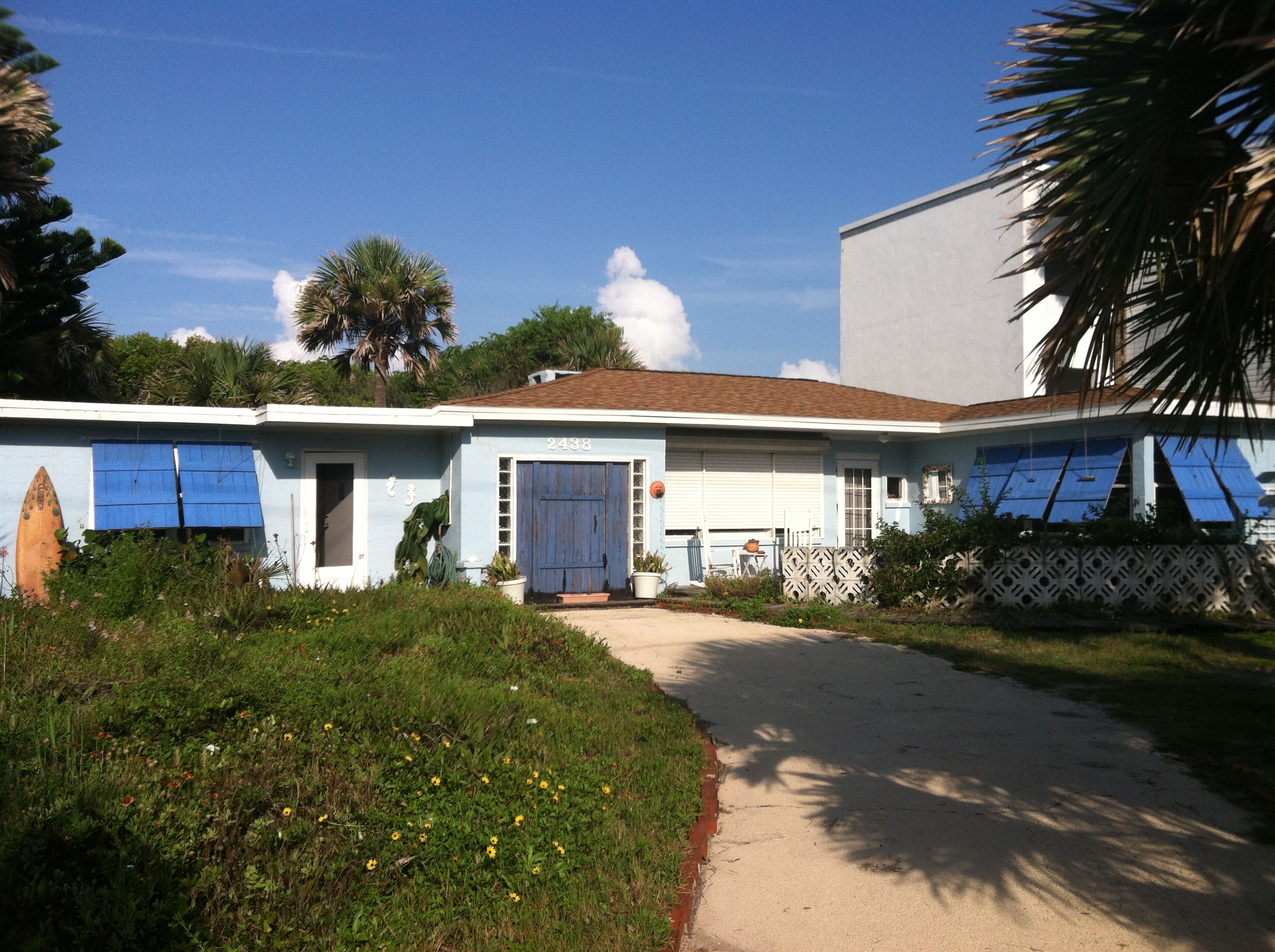
The Little Hacienda
Some of this will be familiar to long-time readers of the SIP, but time, reflection, and conditions beyond our control have urged a reappraisal and consequent renewed appreciation of the venerable house in which we have lived for seventeen years, affectionately known as The Little Hacienda. The older we get the more we appreciate older things, I guess. Anyway, if we’re not careful, there could be a book in this.
And there is a story to be told about this place, just as there is for any structure of advancing years. Some of that story can be gleaned from property, sales, and tax records, but some of it, maybe most, you piece together in other, less empirical ways. For example, this place has faced the Atlantic Ocean head-on for several decades. That’s a lot of heavy weather that builds character. You just have to know where to look to appreciate what that means. You have to live through enough seasonal changes, nor’easters, dry summers, rainy summers, the occasional freeze, tropical storms and hurricanes, not to mention the daily, relentless incursion of salt air, to get it. Over time you begin to understand and feel something of the cyclical nature of things that resonates in a place. All this forms a kind of narrative floor for the story of The Little Hacienda, but imagination and speculation, informed by some extraordinary encounters, personally, anecdotally and in artifacts, with the prior owner, are the walls and windows.
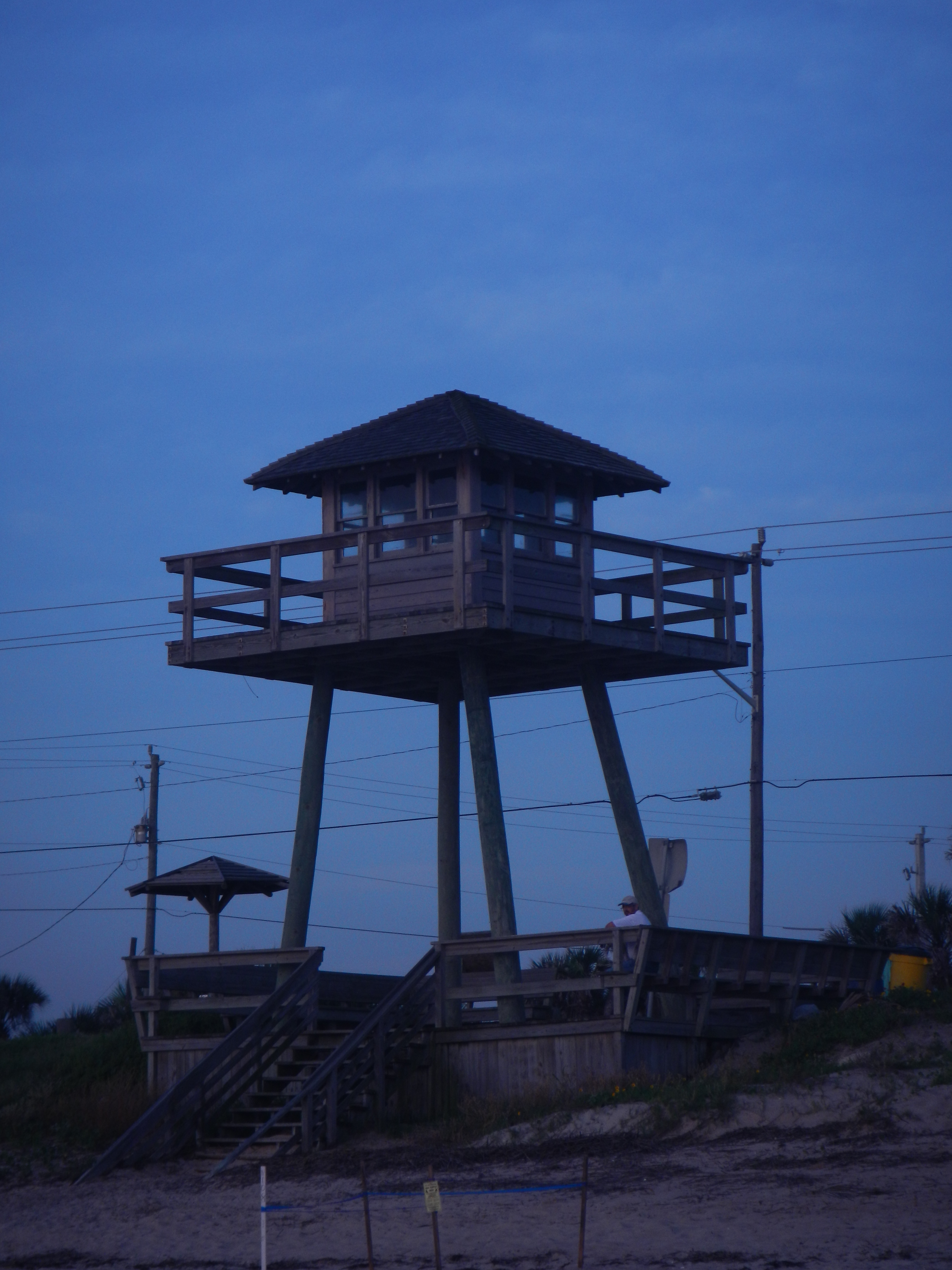
Watch Tower
Records indicate the house was built in 1949. I was two years old, probably just beginning to toddle out from under a table at the Columbia Restaurant across the state in Tampa. We have friends who lived for several years in a 200 year-old farmhouse in western Massachusetts, so compared to that 64 years is nothing. But this is Florida, and most everything is a lot newer. There couldn’t have been much up here, five miles north of Ormond Beach, in ’49. The place next door was built sometime in the 50s, so there were neighbors, but none of the condos existed then, and the little two-bedroom, tile-roofed places on the streets between the ocean and the Intracoastal weren’t built until the mid to late fifties and sixties. I haven’t been able to determine whether there were any other houses at the time, or before, along the beach road, that have long since been torn down or blown away, but I suspect there were. I know there are none on this stretch of Skinny Island that are older. The only war-time structure still standing is the watch-tower a half-mile south of us that was one of a series on the coast used to watch for German submarines. Legend has it, by the way, that a four-man expedition from just such a sub made it ashore somewhere in Ormond and disappeared, so I guess the folks in the towers that day (or night,) were napping, and perhaps the descendants of those mariners are living nearby, their fathers or grandfathers having made a decision favoring sand and surf over goose-stepping and great beer. A woman in her 80s with a decidedly German accent is a regular walker on the beach. I say I suspect some earlier inhabitants because, after Hurricane Charlie in 2004 scoured out tons of beach sand, a long section of hewn timber with evidence of nails and pilings, could be seen jutting ocean-ward just south of us, looking for all the world like the remnants of a pier. It was covered again in a couple of weeks.
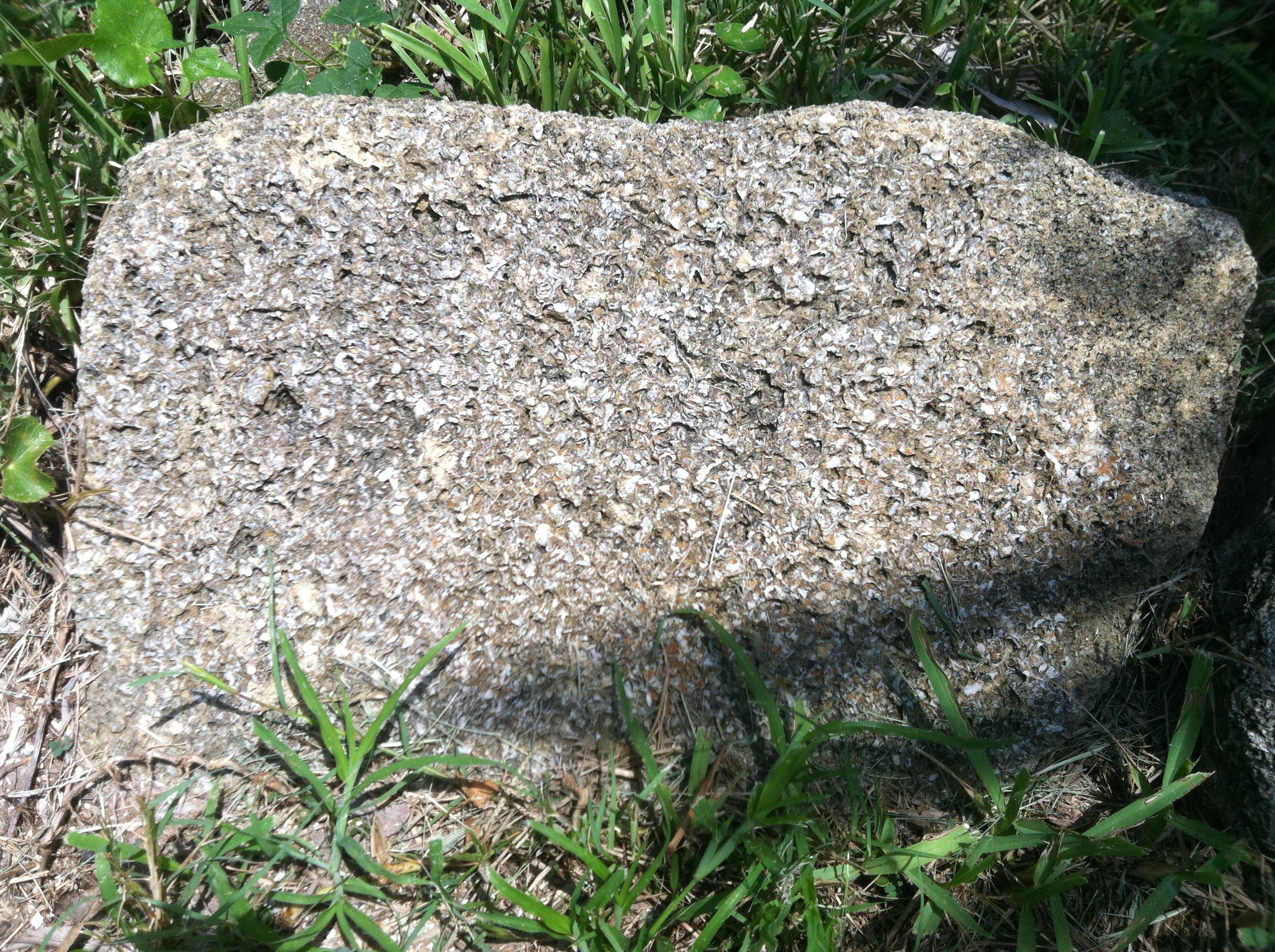
Coquina Slab
Anyway, I like to think about how nearly desolate it was here in those days. A1A ran out front, but there couldn’t have been much traffic. By ’49 A1A had become pretty much what you find today, a more or less continuous highway from Key West to Mayport, although there have been changes and realignments as recently as the 80s. There was a significant, state-long realignment in 1945 that connected all the many pieces. Prior to ’45 the highway was a loose confederation of county roads, not all of which connected, of various surfaces, from asphalt to shell midden to just sand. One of the interesting artifacts we have in evidence here at The Little Hacienda, are some 50 coquina slabs marking borders and walkways, and put in place by the prior owner. They have clearly been cut to offer a flat surface, and my research indicates that rock like this was used to form the roadbed of A1A in this area. I believe when a resurfacing occurred, our intrepid owner, (whom we will get to shortly) acquired a significant number, and used them in landscaping. As to the highway itself, though iconic, it is our only impediment to beach access, and while we have noticed a significant increase in traffic in the years we have been here, (we sometimes have to wait several minutes to cross,) it is not hard to imagine, with some 18-million fewer people in the state, how it must have been little more than a scorcher of bare feet in the 50s and 60s. I fantasize about living here in the 60s, around the time I was making my first forays into the surf up at Jax and Neptune Beaches, after a brutal drive from Tallahassee. To just walk across the road at 16 with a nine-six Dewy Weber tucked under my arm? ‘Nuff said. It’s still perfect.
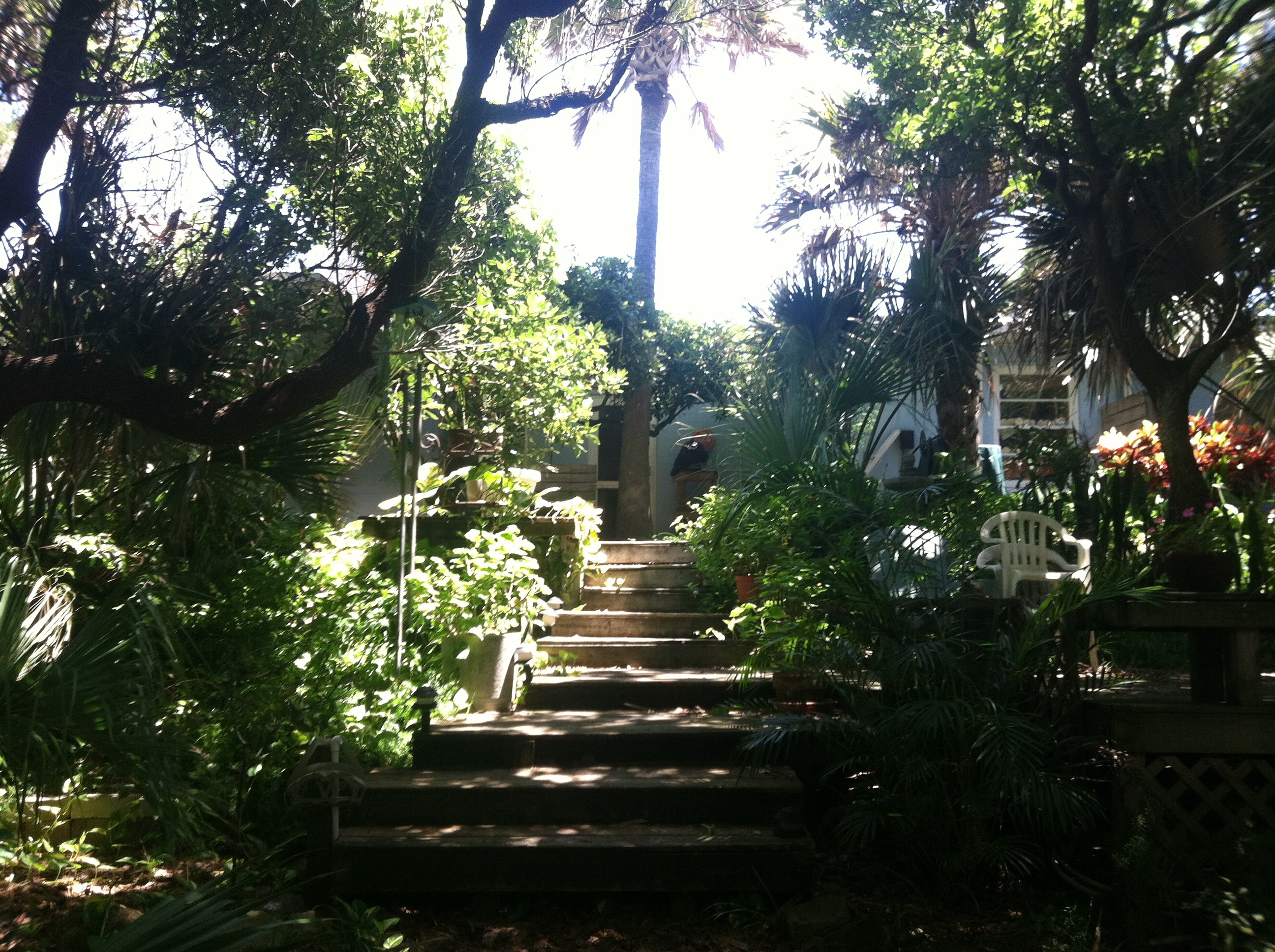
From the Hammock
As I have related before in these pages, we pretty much fell into this place. We had been riding with a realtor and on our own for weeks, searching for places we could afford on the streets perpendicular to the ocean, and had passed this house many times. It was empty and for sale, but being on A1A facing the ocean, we assumed we couldn’t afford it. One day Barbara was with the realtor and he pulled in. She said something like, “Oh, we can’t afford this,” to which he replied, “Oh, I think you can.” She gave it a good look, and was sold by the view from the back woods up to the house. The house sits atop what was the second dune from the ocean, before the highway construction, and the terrain falls off some 12 feet right behind the house, to a thick Florida Hammock of palmettos, Florida Bays and such. It was all like this once, but almost every other lot had been bulldozed level. The catch, as was clear when I first saw the place, was that it needed extensive work, having been abandoned for some time. Turns out the day the realtor showed it to Barbara he’d had a closing on the place, the buyers being a couple in their eighties, but the old lady bailed at the table, citing the vast work that had to be done to make the place livable. Being much younger, (than them, and what we are now,) we jumped on it and struck a ridiculous deal. The owner had died in a nursing home in Ft. Myers, (interesting, as we shall see,) and her brother wanted to unload the place. Closing was contingent on an official inspection of the integrity of the place, and our own inspection indicated some old evidence of termites in one of the rafters in the attic. In addition the flooring throughout most of the house was old asphalt tile, and it was broken and loose in several places, a definite environmental hazard. Somehow, we acquired the keys even before we owned the place, and I moved in, alone, to make some repairs. Interesting, and at times spooky.
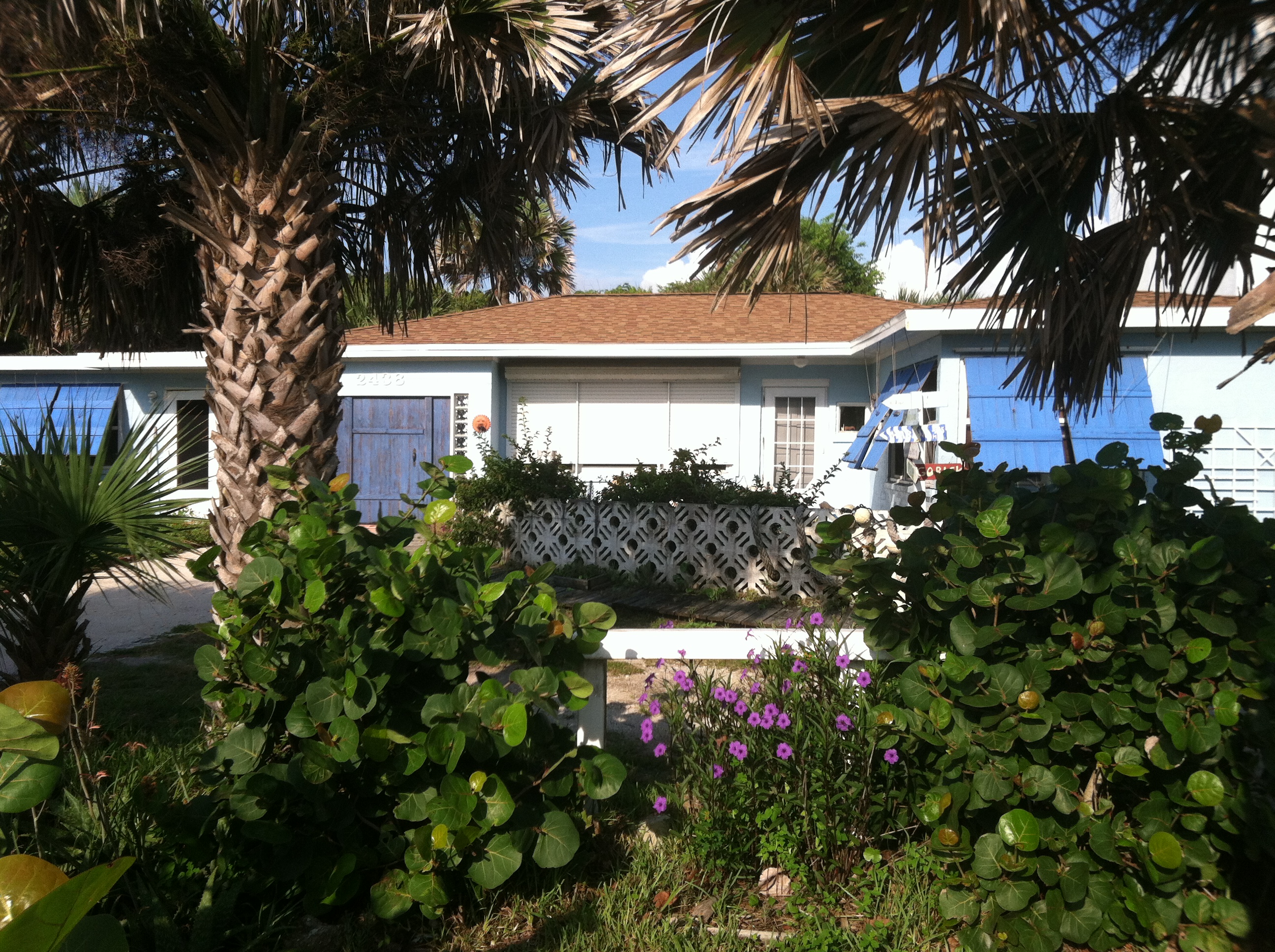
TLH
Here I will close this installment in the same fashion as every chapter of my favorite book when I was a wee lad, Uncle Wiggly’s Adventures, given to me for Christmas in 1951 by my Aunt Eva. Uncle Wiggly, if you don’t know, was a gentleman rabbit who always found a way to get into some kind of jam, and every chapter ended with a cliff-hanger of sorts, and read something like this: “And in the next story, providing our wash lady doesn’t put my new straw hat in the soap suds and take all the color out of the ribbon, I’ll tell you about Uncle Wiggly and Fido Flip-Flop.” Got me every time. So . . . unless the palmetto bugs finally unionize and begin making demands we can’t in good conscience grant, in our next installment of The Little Hacienda, I will tell you all about the several years of back-breaking labor that turned this place from a haunted dope den into the sweet little blue-shuttered place it is now. Thank you.

 The Skinny Island Post
Sam…thanks for Part 1 of The Little Hacienda. Dean would read out loud your first Skinny Island blogs. We would savor the words and the images that emerged. Uncle Wiggly’s Adventures Game was one we received under the Christmas tree one year, most likely, early fifties. Fun memory. I really enjoy and look forward to future Chapters! Frannie
Love it! Can’t wait for the next installment.