
Old readers of The Post will recall that it was a daily at one time, then a sporadic journal about life on our barrier island, and finally something of a trip log. We are continuing that designation with this account of our recent trip to Cuba. When and where The Post appears again will be determined by events.
My interest in Cuba is long and deep and probably genetic. My first Florida ancestors established a Sea Island cotton plantation on Amelia Island in 1791. British sympathizers during the American Revolution, they received a Spanish Land Grant when Florida was returned to Spanish hands after the brief British rule, and were Spanish subjects. The seat of their local government was St. Augustine, their capital, Havana. My great-great-grandmother, Julia Anna Cooper Harrison, was born in Havana in 1825 when her father was assigned there as one of the early American envoys. I was born in Tampa, a sixth-generation Florida native, and grew up in a strong Cuban presence, years before the large, post-revolution immigration. Some of my earliest memories are of Cuban music and food in Ybor City, and Cuban dishes were the first things I learned to cook. Black beans and rice, arroz con polla, Spanish Bean Soup, Cuban sandwiches, and paella are comfort foods in The Little Hacienda. And then, of course, there is the coffee and cigars. More on that later. Up until the revolution, of course, there were frequent flights to Havana from Miami, and a ferry from Key West. You could drive your car onto the ferry, enjoy a nightclub atmosphere on the way over, and drive off in Havana. It was an easily accessible American playground. More on that later, as well. With the embargo all that went away, of course, but not my desire to visit this tantalizingly close, but oh so distant place. Barbara was born in Miami and has also long wanted to visit Cuba. We have talked for years about finding a way to get there, and then an opportunity presented itself. With certain relaxations of elements of the travel embargo on both sides, carefully composed tours have become available, beyond the few possibilities, such as church missions and educational and research trips. In July we saw an ad in the local paper touting a week-long trip to Cuba billed as a “People to People” tour. The itinerary was intriguing, and we quickly signed up. We were finally going to Cuba.

Miami Airport Hilton
Our journey began in the Miami Airport Hilton, an overnight there included in the package, before the flight to Havana the next morning. We checked into our lovely room, and then, as always, hit the pool under threatening skies. The schedule called for a meeting with tour representatives at 7, where we would also see our tour companions for the first time. This meeting turned out to be so bizarre and negative that, had a refund been possible, a good half of the group would have cancelled! We were greeted by a very pleasant young woman, who handed out envelopes containing a detailed itinerary, our plane tickets and travel documents. So far, so good. But then the meeting was high-jacked, for lack of a better term, by a second woman, also representing the tour agency, who proceeded, in the most grating, caustic New York accent, to seriously rain on the parade. In a most combative fashion, she denigrated our expectations for the trip, gave terribly condescending responses to questions about discrepancies between what she was saying and what was in our initial brochure, and then essentially scared the shit out of everyone with a completely negative harangue about Cuba, its dangers, and “Third World” character. As I will relate, everything she said was later proven to be completely untrue, but as we were leaving, a heavy pall consumed our group of 33, and an anxious night was spent by all.
Landfall
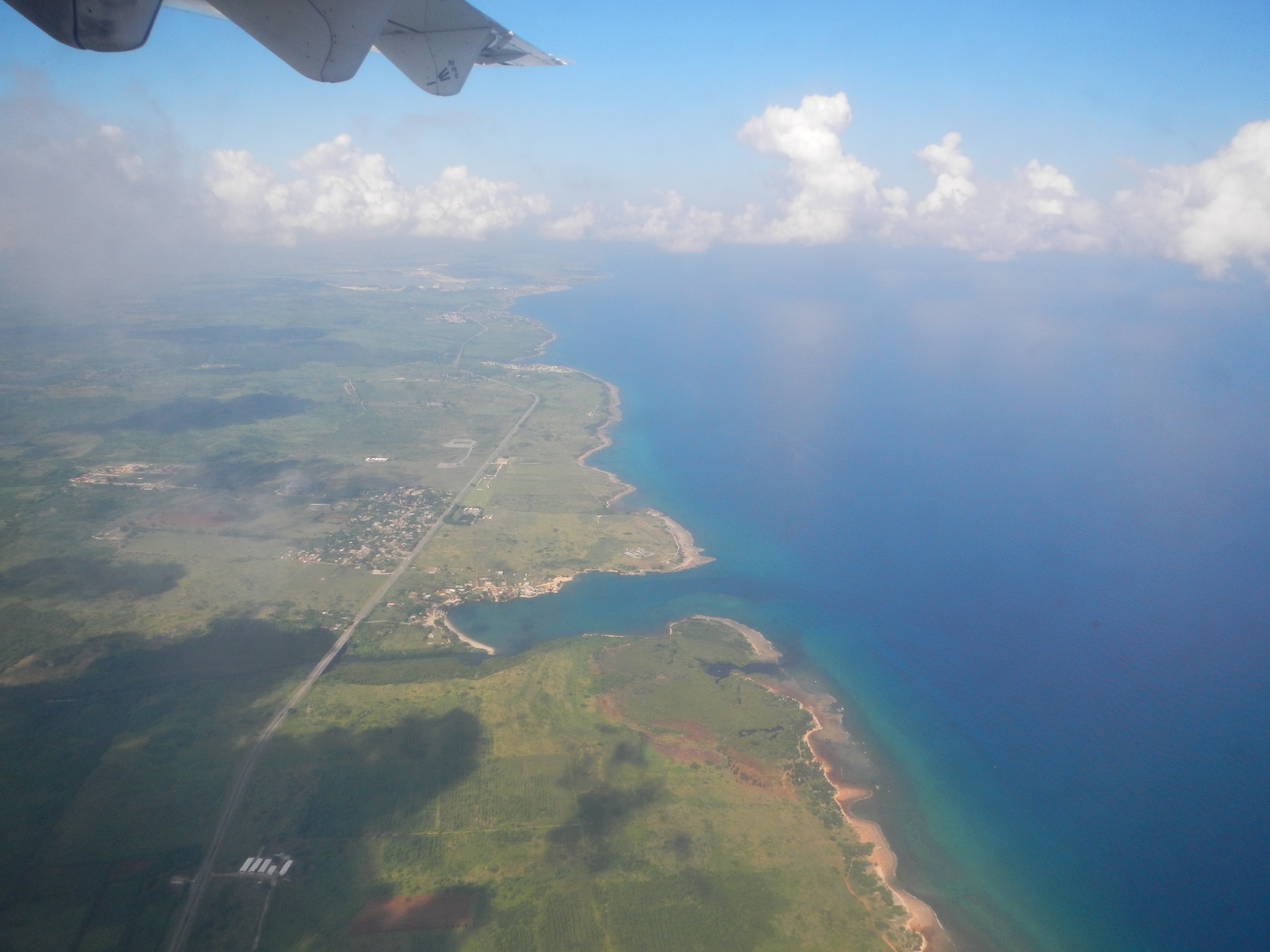
We left the hotel as a group at 6 and were taken via shuttle to the airport. Finding our departure terminal after a half-mile walk, we settled in with a latte and waited. At 9 we departed in a twin-engine prop charter and, following the Keys, were soon over the Straits, and not long after, we got our first look at the coast of the island of Cuba. We landed at the very small Jose Marti airport, Havana, at about 10:45 and entered the terminal, where we found . . . no one. Officials inside seemed completely surprised by our presence. One of the first off the plane, I tried to answer, in my poor Spanish, what we were doing there, and how many we were. I guess it was enough. There were about six little cubicles with a narrow passage between, the customs booths, and were told to pass through one at a time. Inside the one I chose were two very serious uniformed young men. Barbara went through ahead of me, spent a few minutes answering questions, and was sent back out to the room in which we had started. I entered the same booth. Examining my passport, visa and ticket, they did not appear welcoming at all, and emitted a sinister vibe, but after a photograph, I was gestured into the next room, where the security scanner was. Barbara was still out in the ante-room, and for an agonizing five minutes, I waited, certain she had triggered some alarm and was off to a Cuban jail. Everything said the night before seemed to be coming true, and we were all alone. Still no guide. Barbara finally came out, we breathed a sigh of relief, and, with no explanation as to why she was briefly detained and no other choice, we cleared the scanner, and waited for our bags. They quickly arrived, we collected them, and then there she was! Our Cuban guide, smiling and waving and directing us to bus 437 parked outside. We exited the terminal into brilliant sunshine and heavy humidity and got our first look at a visual phenomenon that would become both a familiar comfort and a bittersweet irony, the American Cars.

A Sweet Bel-aire
Everyone has heard about the 1950s American cars in Cuba, their preservation forced by the embargo, which curtailed all imports, but until you see them, you really have no concept of their numbers and condition. They are literally everywhere in the country, the majority in Havana, but out in the countryside, as well. With a number of other conditions in the country, they create the impression of a time-warp. It is an extraordinary thing to see. Outside the terminal were perhaps twenty-five of these cars lined up along the curb– Chevies, Fords, Plymouths, Cadillacs, Studebakers– in models ranging from the mid-forties to late fifties, mostly in pristine condition. With a recent relaxation in the rules for self-employment, instituted by Raul Castro, individuals can go into any business they want, and many owners of these cars, and there are many, have become taxi drivers! They are used extensively by the Cuban people, and visitors, as well. More on transportation and general getting about in a later post.
Havana Buildings
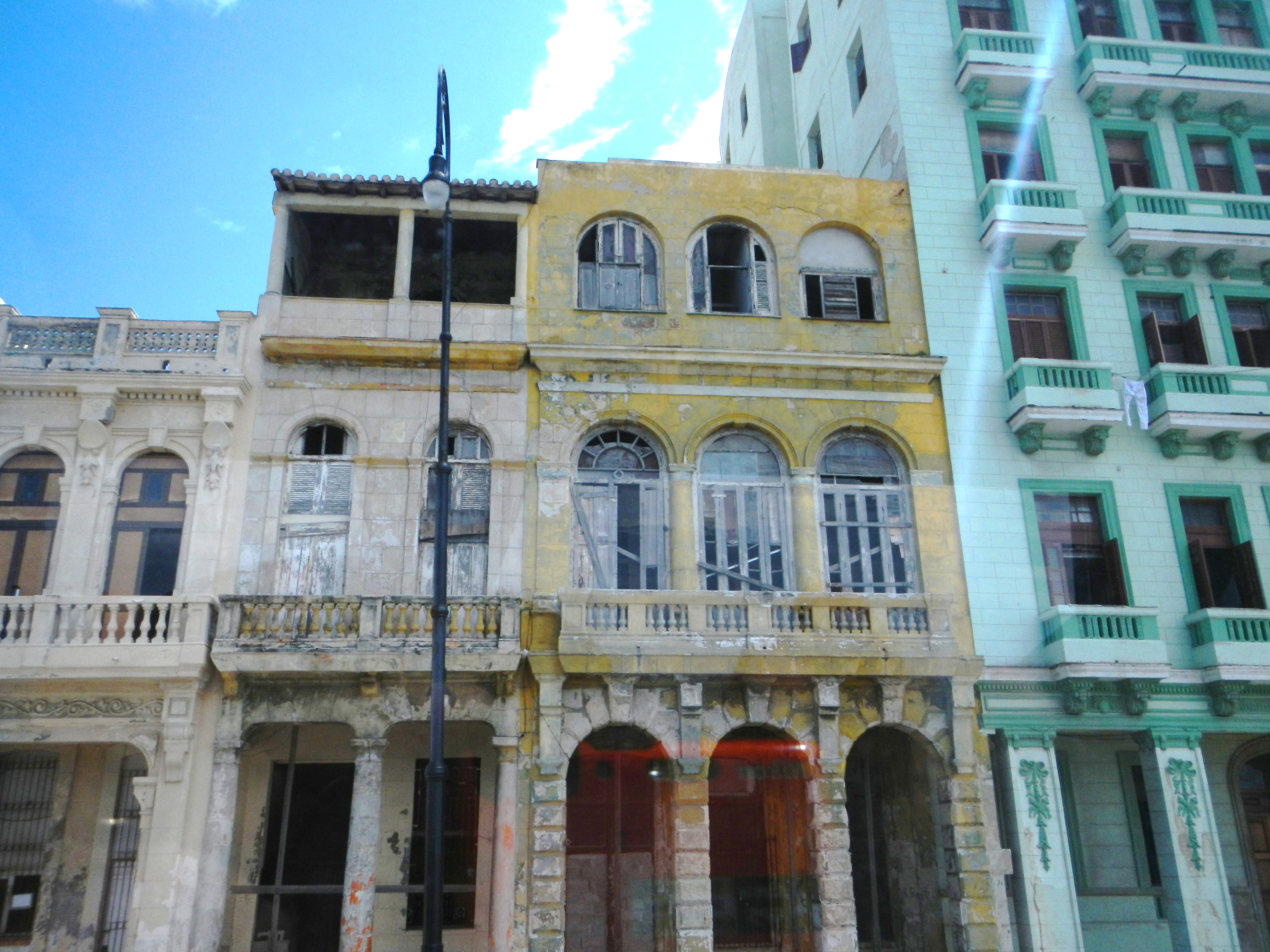
Our guide, a lovely, petite, mixed-race woman of 40, introduced herself as Enedis, and with our driver Miguel at the wheel of our handsome, comfortable, air-conditioned, Chinese-made tour bus, we were off into the city. The economic plight of the country is revealed everywhere in the buildings. They are almost all run-down and needing serious renovation, and that is taking place, but very slowly. People in downtown Havana, which consists of the Old City and the rest of Havana city, live in buildings dating back to the 17th century, many of them in sad disrepair. It is a sad sight at first, but the people have made and are making the best of it, and are an incredibly resilient and resourceful people.

Marti Monument
We were taken first to the Plaza de Revolucion, a large open area in the Socialist Nation style, dominated by a monument dedicated to Jose Marti, the pre-eminent national hero, where Fidel gave many of his long speeches. While Fidel is the Father of the Revolution, Marti is the Father of an Independent Cuba, having been the leader of the war for independence from Spain in the 1890s, and is known as the “Apostle of Cuban Independence.” A poet, journalist and philosopher, and an eloquent, charismatic speaker, Marti raised considerable money and support for the cause in Florida, specifically Ybor City, where Cubans were the owners and workers in the new cigar industry. He left Florida in April, 1895, to join rebels fighting the Spanish in Cuba, and was killed in battle on May 19, 1895, a distinct target in his black jacket on a white horse. The United States intervened, of course, when the Maine exploded in Havana harbor in 1898, ensuring a Cuban victory and a line of dictators extending to Batista.

Che
Around the square the images of other Cuban heroes appear in huge scale on the buildings, including Ernesto “Che” Guevara, for whom sentiment among the people appears to run strong and deep. We will discuss Che at some length later. Following our walking tour of the square we were driven to the Hotel National, another Havana landmark, built by American interests in 1930. It is very reminiscent of the Vinoy Hotel in St. Petersburg, with the same old elegant

Hotel National
architecture and style, and offers a grand view of the Malacon, the long walkway and road along Havana’s Atlantic waterfront. Traditional musicians, like we would find everywhere, played on a shaded portico at the rear of the hotel overlooking the Atlantic. A brief look around the well-kept grounds (many foreign visitors) and we were off to Old Havana for a short walking tour of some of the oldest remains of the wall that once surrounded the city. As we said, many of the buildings in this part of town are several hundred years old. An extensive government project is underway, we would learn, to renovate and preserve these historical treasures. Walking around this part of Havana is like being in many ancient cities of Europe, particularly Spain, of course. Our initial tour of Old Havana led us, under Enedis’ capable, informative direction, to our first meal, lunch at a restaurant called Dominica.
Mojito
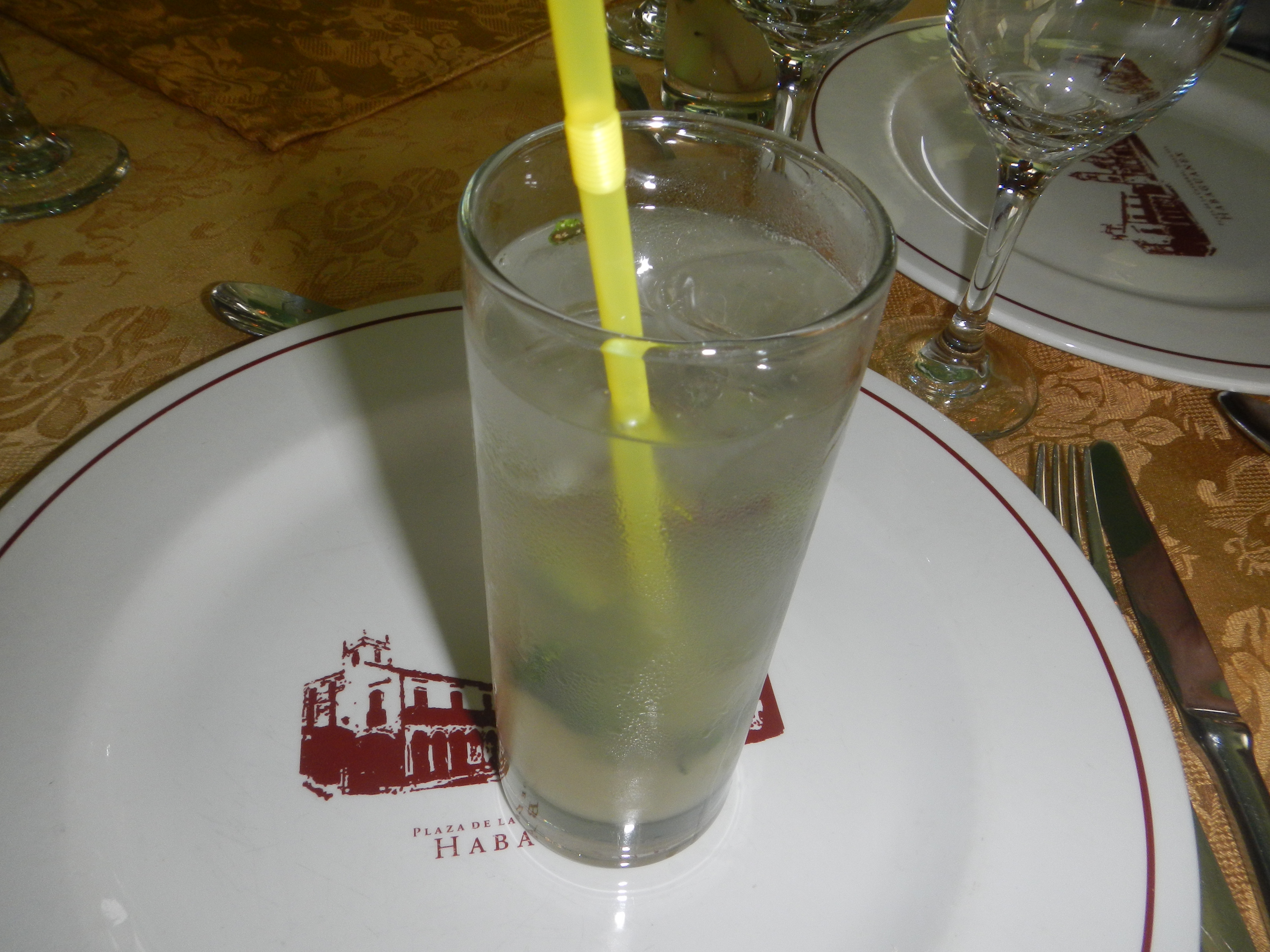
A friendly, enthusiastic staff showed our group to our tables, and immediately brought out our first Mojito, the Cuban national drink. For the uninitiated, uninformed, or just plain slow, a Mojito contains muddled mint, lime juice, rum, a pinch of sugar, and club soda. These were wonderful. The meal consisted of salad, pasta, a delicious, thin-crust pizza, and was accompanied by an exceptional Cuban beer, Cristal, which we would have with virtually every meal from then on, or its cousin, Buccanero, both of which were stocked in every hotel room fridge.

Cristal
A musical group consisting of two guitars, conga, and a female singer entertained us with traditional Cuban music. It was a delightful first meal, in a welcoming, congenial atmosphere. Two Cuban gentlemen seated near one of our tables asked where we were from, and on learning it was the U.S. jubilantly offered words of welcome and their desire that the walls would come down between us and we would become the best of friends. It was a sentiment we would hear expressed throughout the rest of the trip. Coffee, desert, I bought a Montecristo cigar, and we were back on the bus for the drive to our hotel.
We drove along the length of the Malacon, lined with buildings that have suffered from not only the lack of upkeep, but the salt air of the waterfront, from Old Havana to where the road turns inland into the district of Miramar, a formerly elegant neighborhood that was home to the well-to-do middle class before the revolution. It consists of lovely tree-lined boulevards and beautiful small villas built in the 19th and early 20th centuries. Most are now in bad shape, but retain their simple elegance beneath the rough facade, and it is easy to see what a beautiful place it was in its heyday. It is said Miramar is the district in which Fidel lives, but no one knows the exact location. Because they were essentially the privileged class and did not support the revolution, many of the owners of these houses fled for the United States when Fidel took control. People of all walks of life now occupy them.
Hotel Quinta Avienda
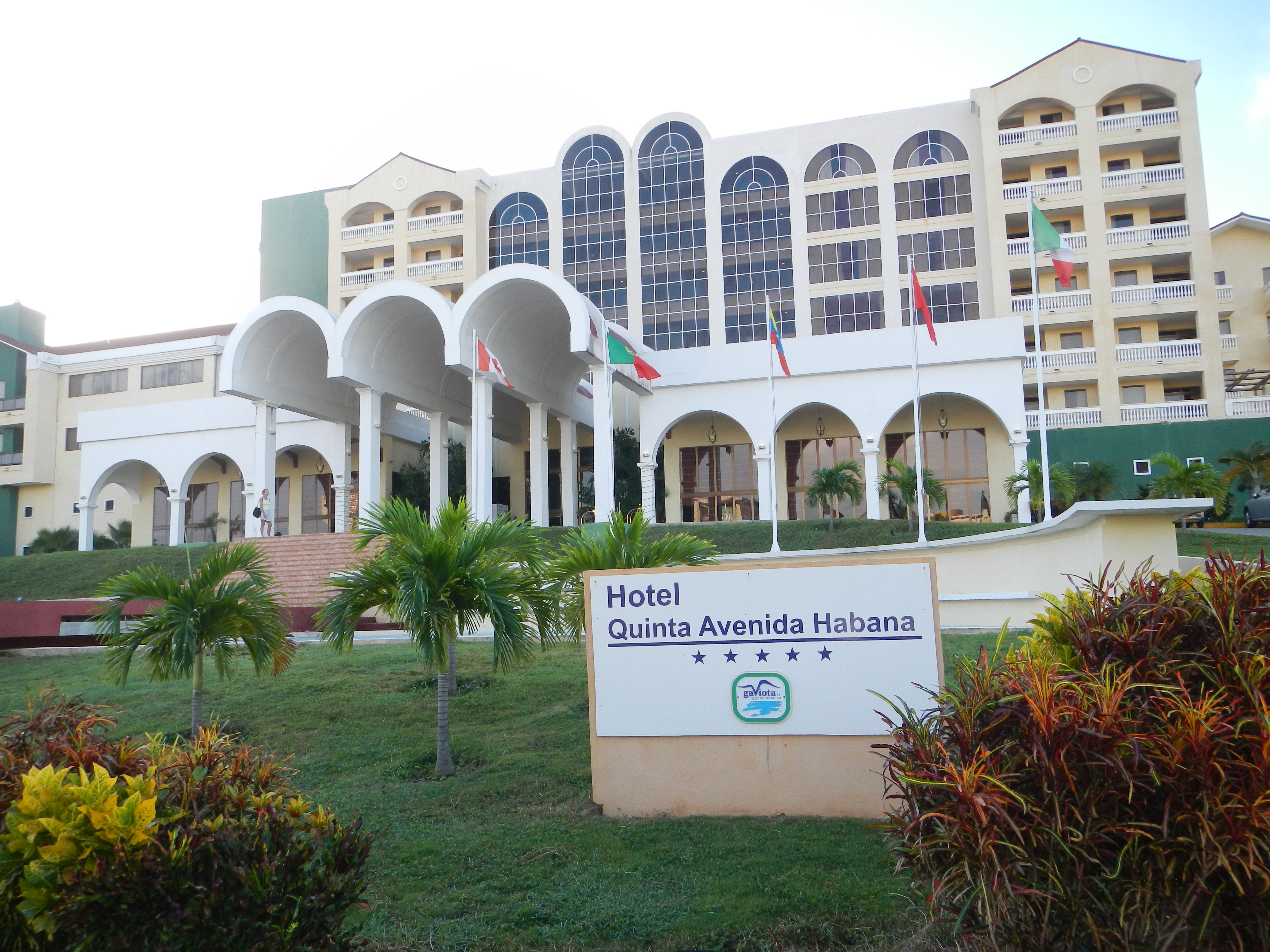
Our Hotel for our stay in Havana was the Government-owned Quinta Avienda, a four-star, relatively new place within walking distance of the Atlantic. On entering we were greeted by staff offering a complimentary Mimosa, and then we were given our keys. Our room on the second floor was spacious and, for those of you who have visited The Little Hacienda here on Skinny Island, done in colors with which we are familiar, and you will recognize.
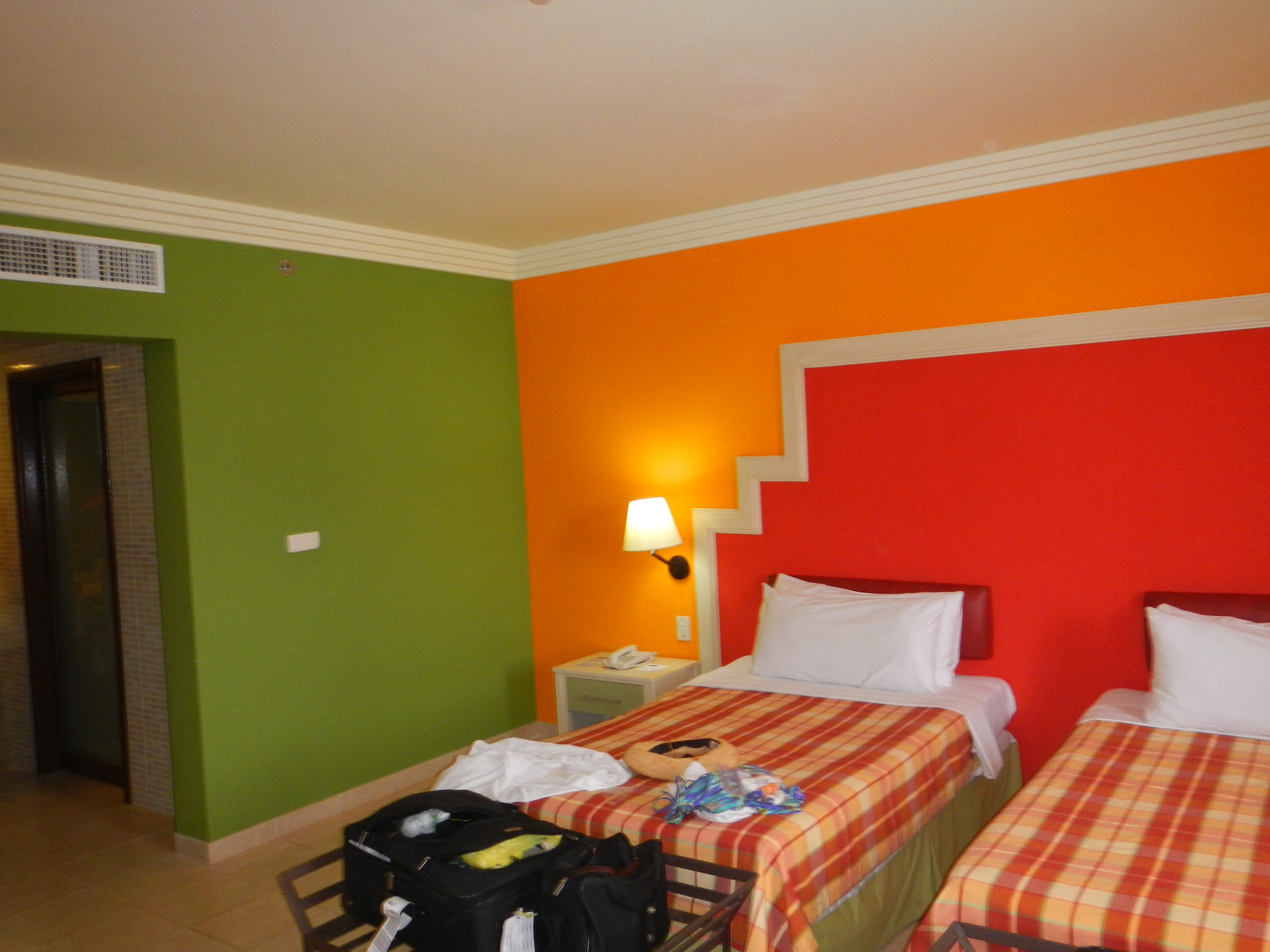
Our Room
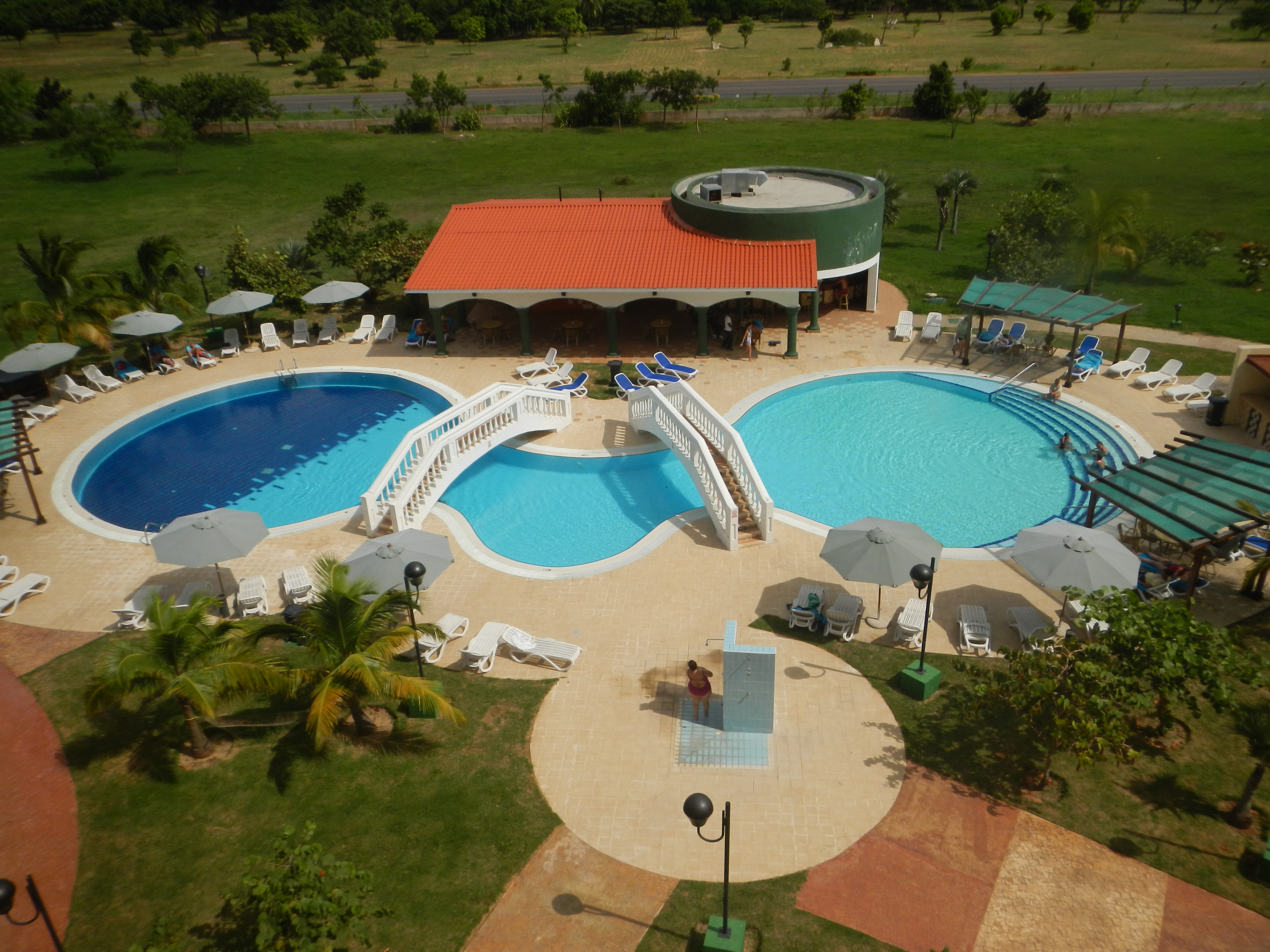
Our View
The view of the very large pool was spectacular and inviting, so we quickly donned our swim wear and headed down. The regular afternoon thunderstorm was moving in, but we managed to get in a swim, then went back up to watch the rain and take a short rest before starting the evening’s festivities.
Our dinner was in Miramar, not far from the hotel, in a thatched-roof, open air, Government-owned restaurant called El Ajibe. We arrived in a light rain and were ushered to several large tables, where we would dine family style. A large, happy place, with a beautiful bar to one side, our arrival filled the place.
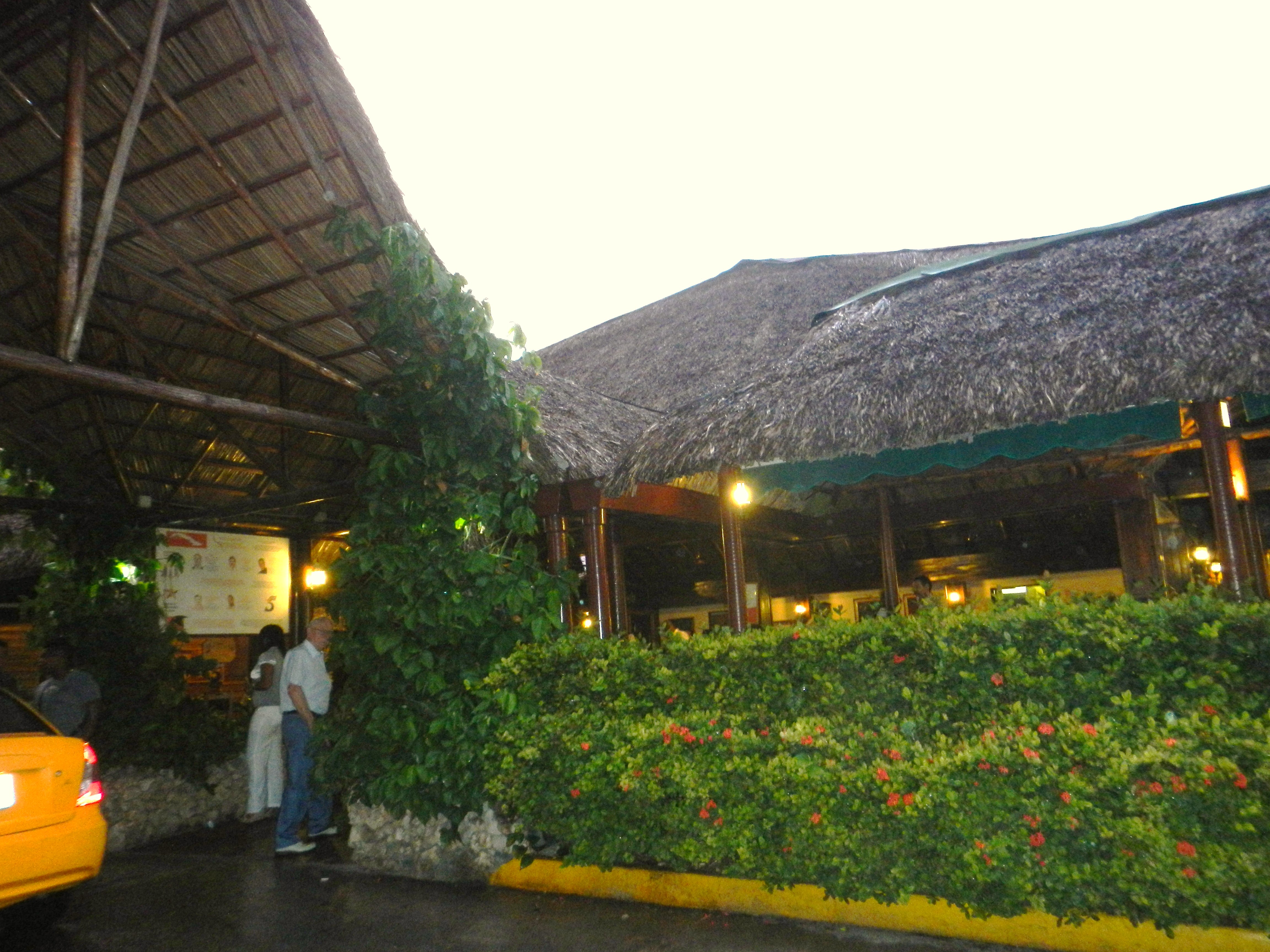
El Ajibe
Upon being seated we were brought sangria, which was fantastic, then bread, fried plantains and salad, black beans and rice, roast chicken, and Cristal. We started getting to know some of our traveling companions, and quite a diverse group it was. There were several folks from Florida, a couple from Sonoma, others from Alabama, New Jersey, Chicago, and Buffalo. By the end of the meal, and our first day in Cuba, it was clear that virtually everything our caustic company representative had said the night before was the complete opposite in reality. Our government-employed guide was personable and open, the restaurant managers and staff welcoming and congenial, the people cheerful and eager to make our acquaintance. The place was not in the least threatening or remote. I smoked the Montecristo poolside, and we retired, beat but very pleased by our first day, and eagerly anticipating a more thorough walking tour the next day of old Havana, including a meeting with the architect in charge of restoration.
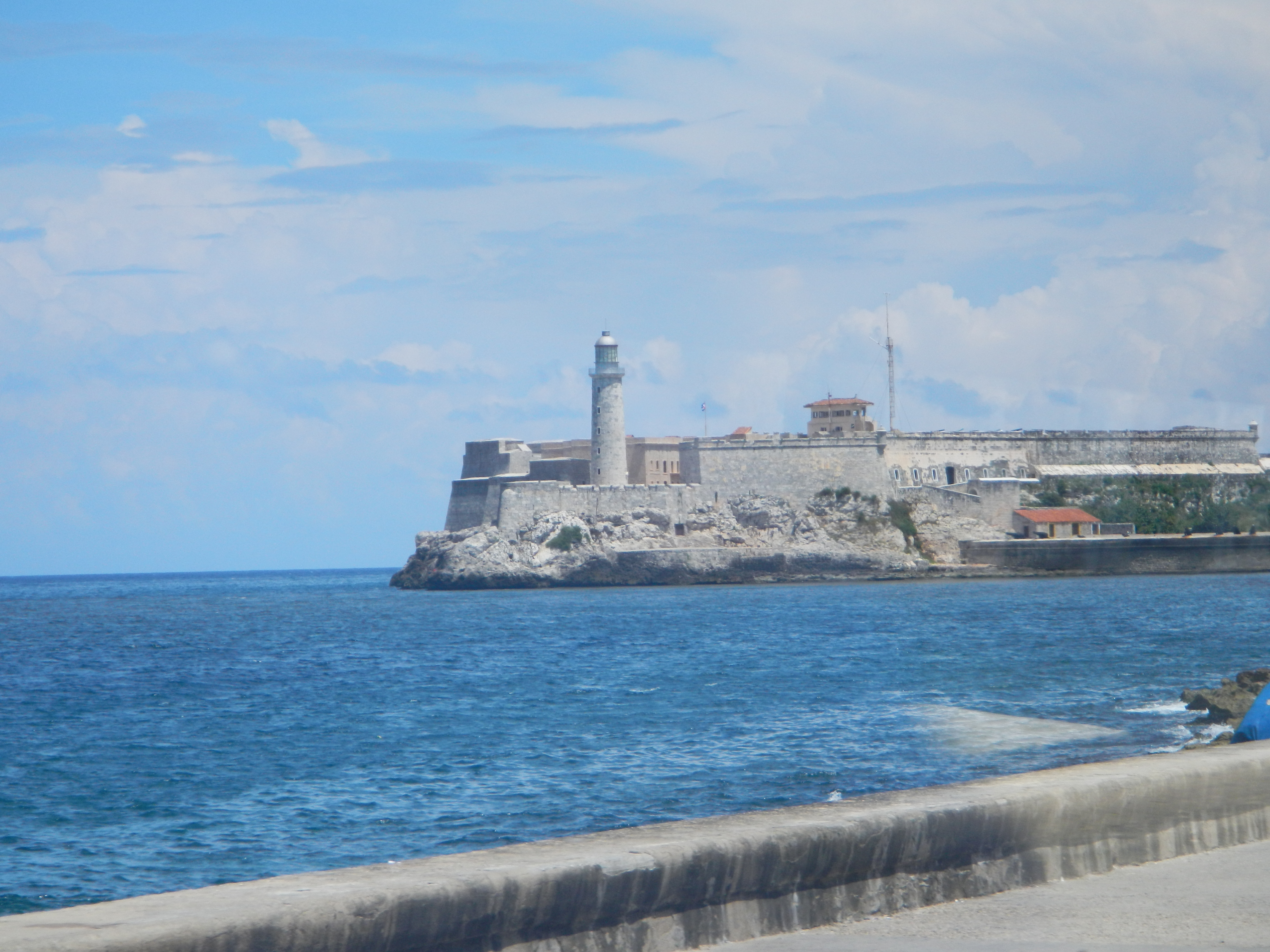
El Morro

 The Skinny Island Post
Wow! I have always wanted to visit Cuba. When the restrictions were eased, I thought I might finally have my chance. I had heard whisperings along the lines of that New York woman, that the atmosphere was less than friendly there, so I feared that my trip might never happen. But now, thanks to you, I am looking forward to one day being able to “step back in time” to this beautiful place. Thank you, Sam, for giving me renewed hope! I’m really looking forward to future installments…
It is a wonderful place.
Beautiful!
Thanks, Don.
Terrific journal. I look forward to a nightly visit and a virtual cigar.
Thanks, Bob.
Wonderfully amazing! I am anxiously awaiting the next installment. Thanks, Sam!
Thank you, Shirley.