The Cuba Diaries: Day 2

Breakfast Table

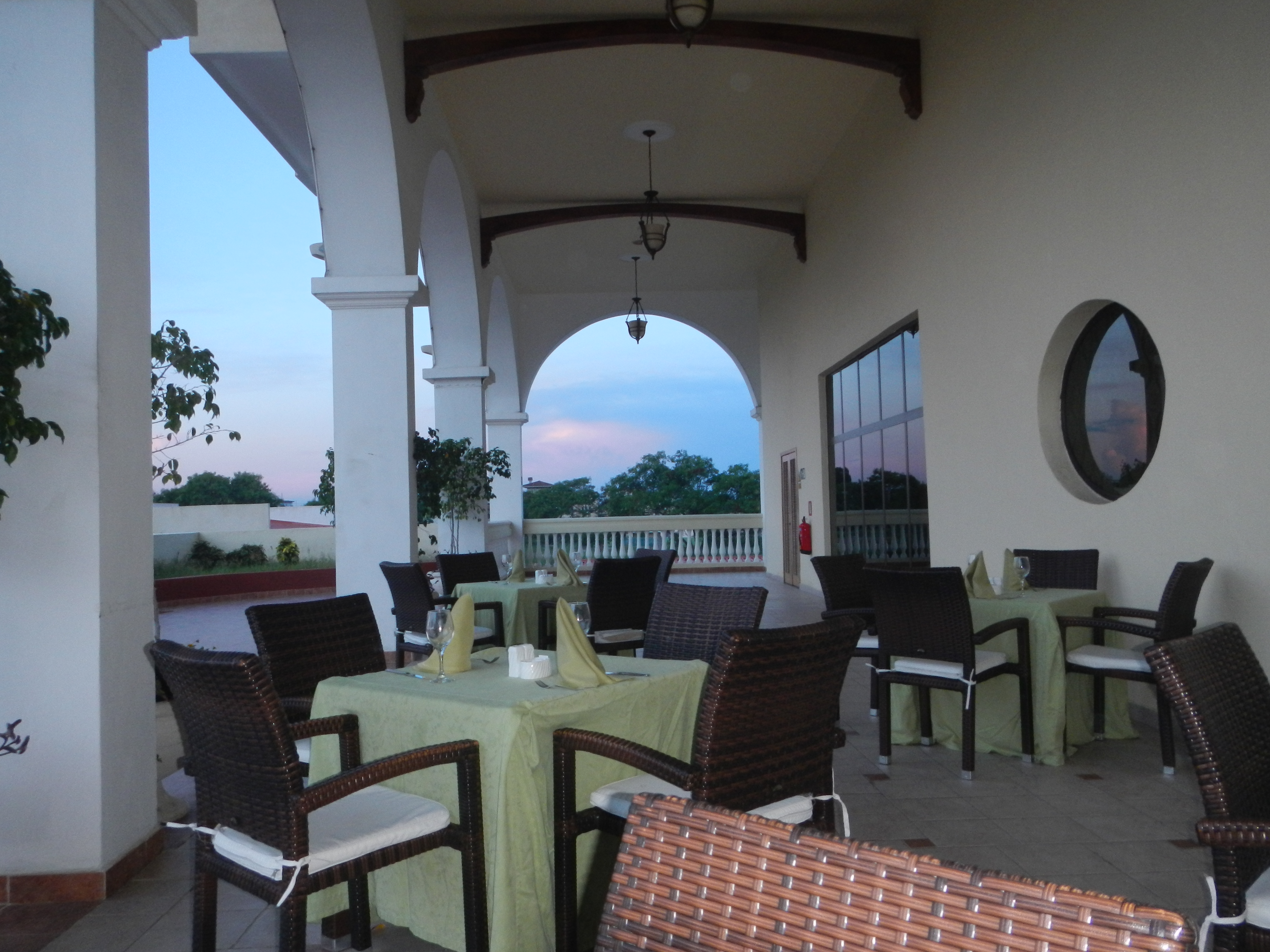
Breakfast was included in the package every day, and we are never ones to miss breakfast.  We opened the place every morning at 7, and established ourselves at a table on the patio, having a leisurely coffee first, then ranging through the buffet.  The eggs were generally cold, but there was a wonderful variety of foods from which to choose, including pancakes, chorizo, bacon, cereals, pastries, potatoes, croquettes, fish, several breads, and orange, papaya, and guava juice.

Of all the admonitions thrown our way our night in Miami, the only one that really seemed

Elephant Walk

to have teeth concerned water.  We were told to not ever drink the water, and while she tried to soft-peddle it a little, our guide Enedis concurred, saying there were some problems with filtration in the water supply throughout the country.  We were told to only drink bottled water.  We had some in our room fridge, but we thought it best to try and round up some more, so after breakfast we hiked a short distance from the hotel to a little shopping square near the ocean.  We found a small store, but it wasn’t open yet, so we took a walk around the square.  These elephants were passing through at the same time.  This appeared to be a fairly upscale shopping area, especially compared to what we’d seen of downtown Havana, probably owing to the fact that there were several hotels nearby.  Hotels near the ocean are fairly swanky, and cater pretty much exclusively to foreigners.  A lot of locals were in the square at that hour, and we appeared to be the only tourists.  The shop guy arrived and opened the door to a man who was standing nearby.  We followed him in.  The patron made a purchase and left, but the shop guy indicated he wasn’t opened and ushered us out before we could even ask for water.  Not sure what to make of that yet, but it was one of the only incidents where we didn’t feel welcome.
Church Next Door

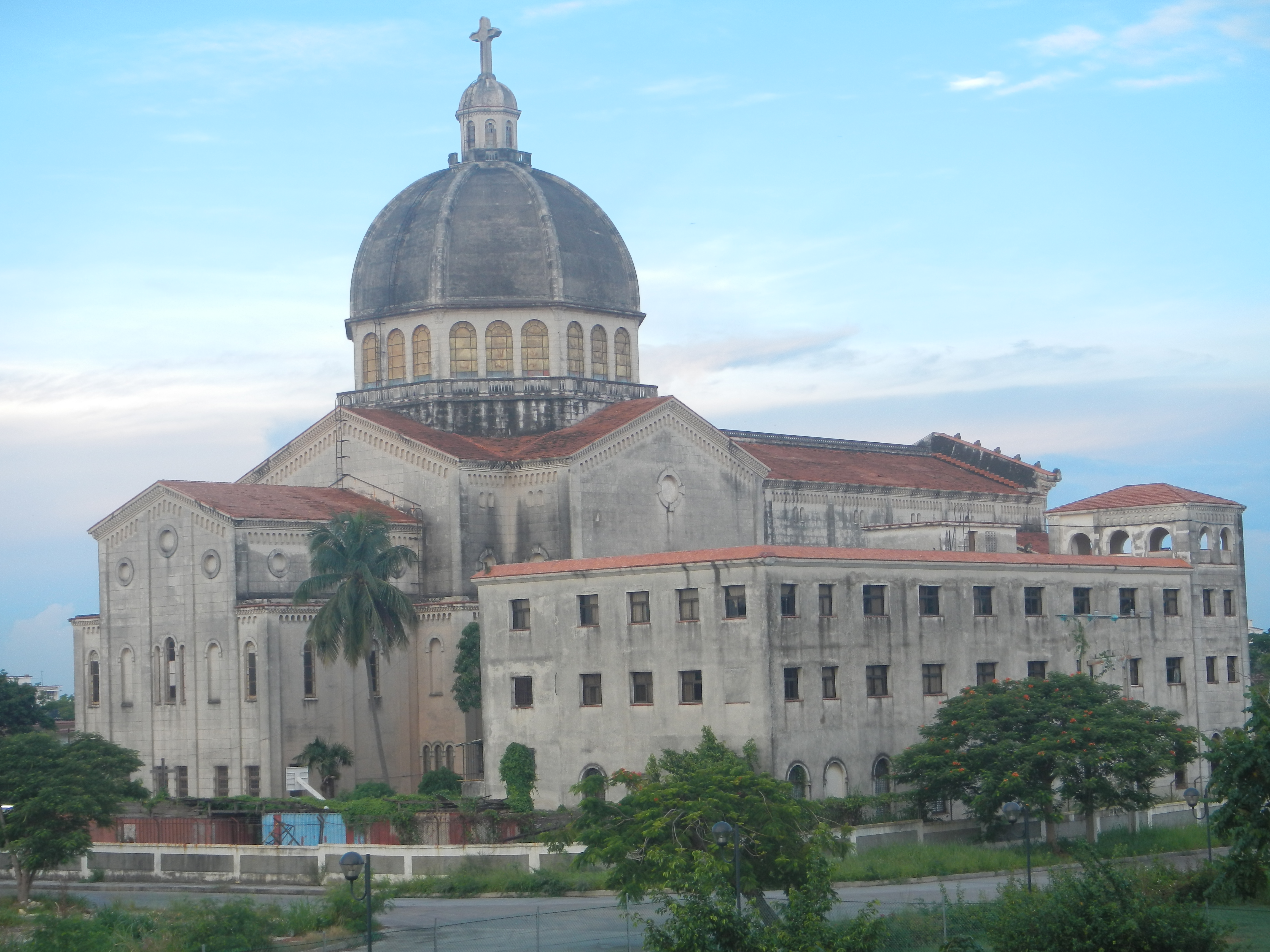
There was an old and rather substantial church right next to the hotel, so on the way back up we stopped for a look, hoping to see inside.  A sign on the gate said Mass was celebrated Saturdays and Sundays, so we knew it was in use.  We walked around trying all doors but couldn’t get in.  Part of the building resembled a dormitory, so I think it may have housed a monastery or convent at one time.  Over our stay we saw quite a few locals wearing crosses, and we learned that restrictions on expression of religion have been relaxed significantly over the past few years.
Plaza de Armas

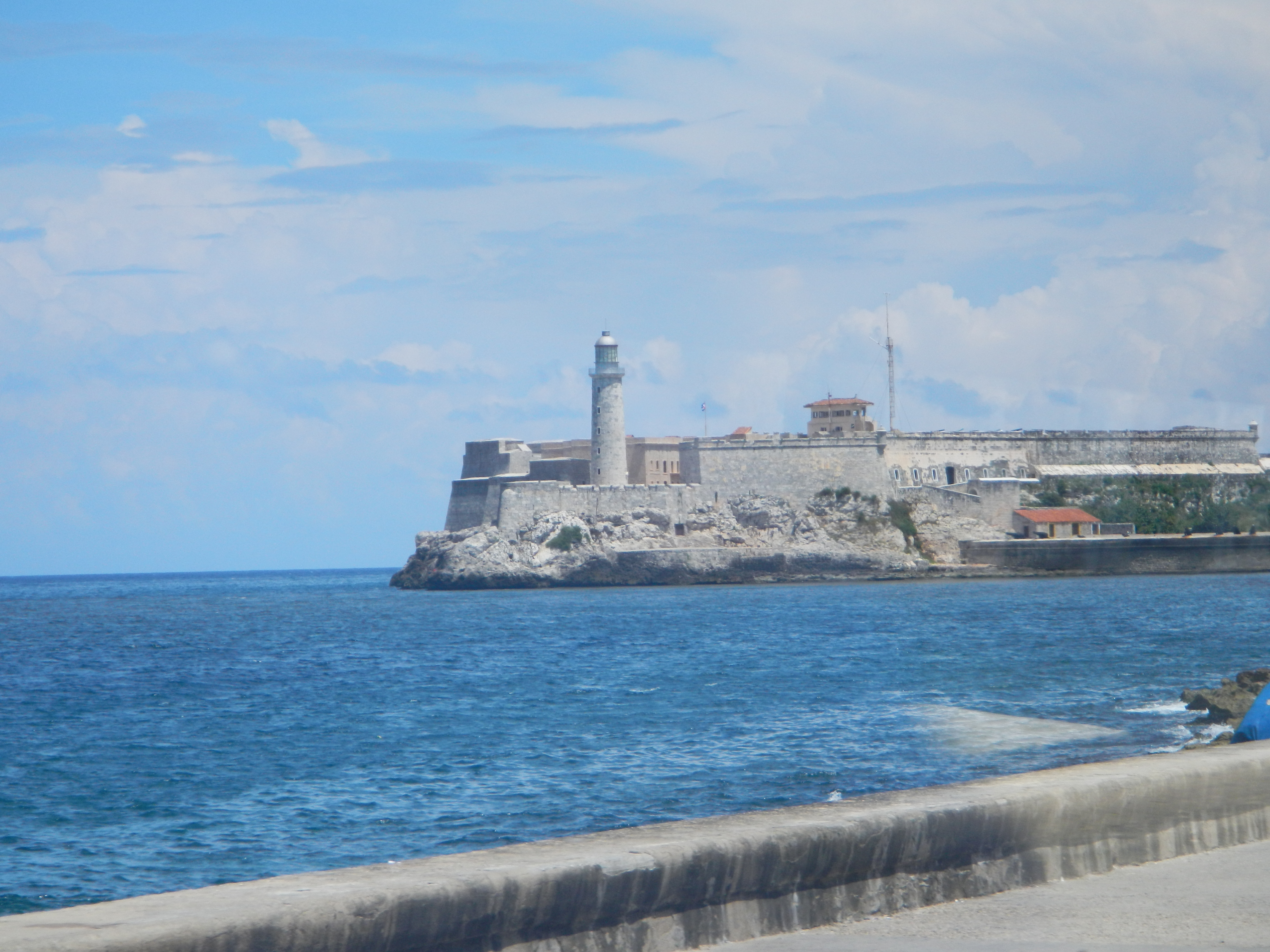
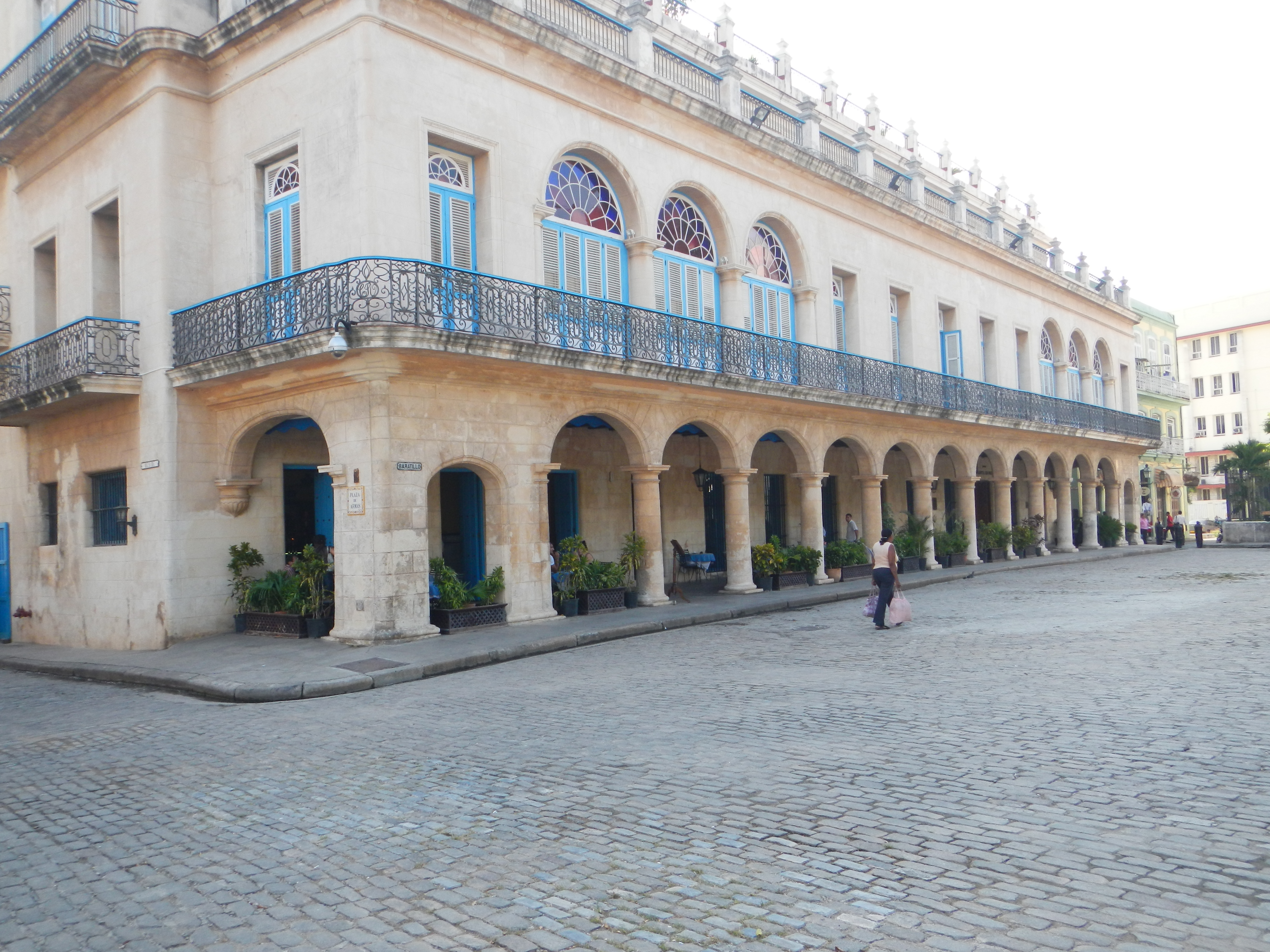
The bus left the hotel promptly at 9 and we rode back into the city along the beautiful Malacon.  The road turns away from the ocean just across from the old Morro Castle, and follows the narrow inlet into the Havana Bay.  Across the inlet is a fort from the 17th century, and a large statue of Jesus, commissioned by Mrs. Batista in gratitude for her husband surviving a coup attempt in the 40s.  We were let off near one of the old gate to the city and strolled behind Enedis into Plaza de Armas, one of Old Havana’s four main squares.  They all resemble squares in the major cities of Spain, on a slightly smaller scale, and are in various states of renovation.  The purpose of our tour today was to learn about this renovation, a huge project, and to meet with the architect in charge of the project.
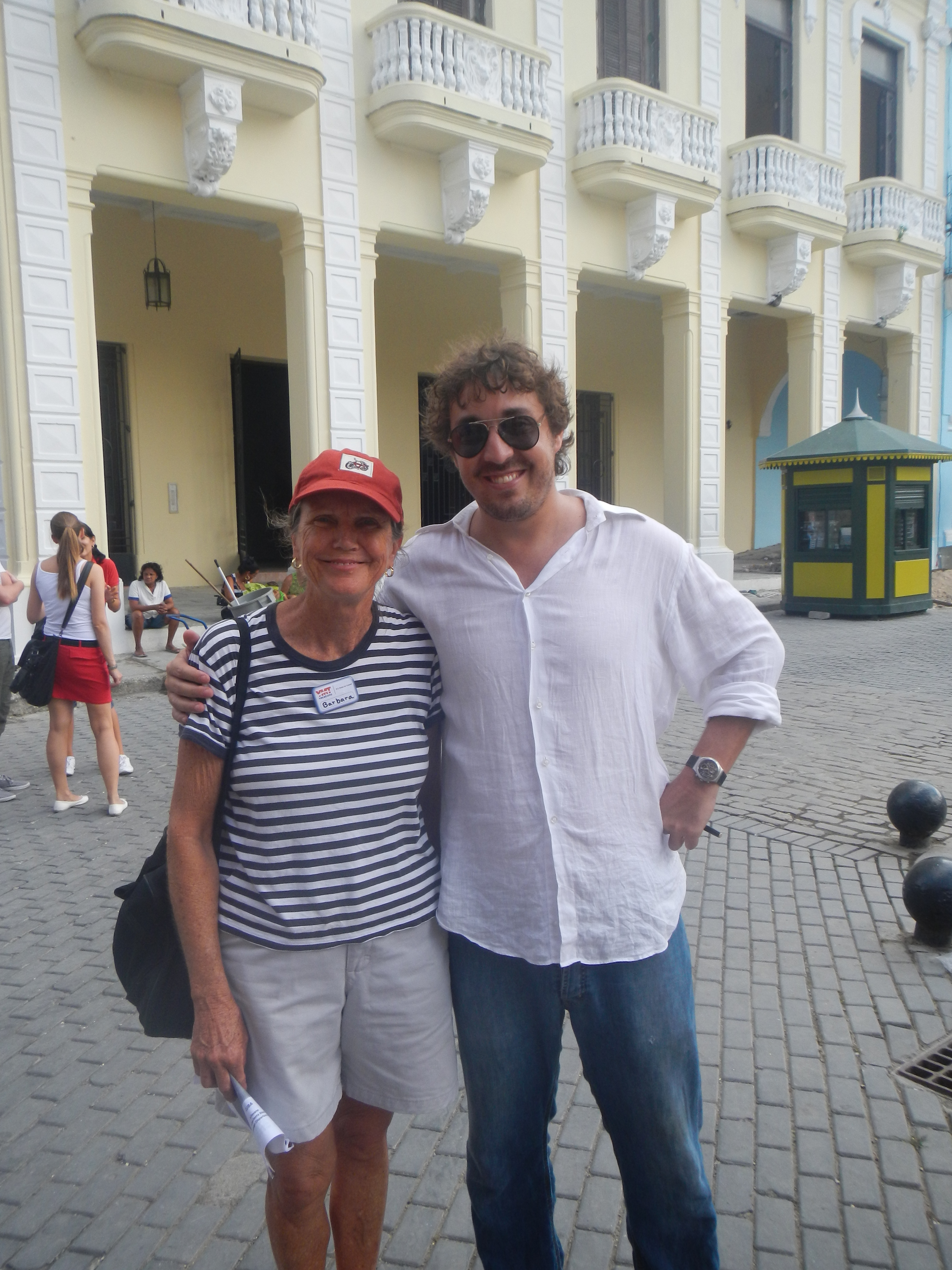
Barbara and Daniel

We met Daniel just off Plaza de Armas.  A handsome, gregarious young man who spoke very good English, he explained that we would be going first to a building that housed an elaborate scale model of Old Havana, where we would learn some of the history of significant buildings, and how the project was proceeding.  We would then continue our walking tour of the squares, ending at Plaza Viejas, where some of the renovations had been completed.  As we walked to the model Daniel pointed out that people lived in these very old buildings, but that they had to move out in order for the work to take place.  There was a unit of Social Workers, he said, assigned to convince people of the necessity of that move.  The government had constructed, and was continuing to build, apartments on the outskirts of the city, to house these people while the renovations took place.  In the buildings where work had been completed, some had moved back and some had decided not to.

The scale model was incredible, but unfortunately, no photographs were allowed.  It was approximately 20 x 20 feet, and depicted Old Havana in minute detail, down to arched doorways and Baroque facades.  I asked Daniel who had done the work and he told me a family of artists in Havana.  Using a laser pointer Daniel, and often, Enedis as well, pointed out significant structures and gave something of the history.  As stated, Havana is a very, very old city, and many of the building dating back to the early days of the capital remain.  There are buildings from the 1560s still standing.  The Spaniards knew how to construct solid buildings in hurricane-prone places, but, as we would learn, there had nevertheless been significant storm damage to some of the buildings over the years.  A good many hurricanes have hit the island in the past 400 years or so.

Mural in Old Havana

We continued our walking tour of the squares of Old Havana, which is pedestrian only, and passed this mural on a wall that depicted an array of national heroes.  It was done in sand, mixed with an adhesive, and was quite extraordinary.  We continued on to an old church called San  Francisco de Asis, originally constructed in the early 1600s, the building was seriously damaged by storms in 1680 and 1692, eventually losing its bell tower to a hurricane.  It then was the site of a convent for many years, was a popular burial site for Spanish elite, and remains a coveted internment site.  Mother Teresa visited the convent at one time, and there is a small statue of her in the lovely garden behind the church.
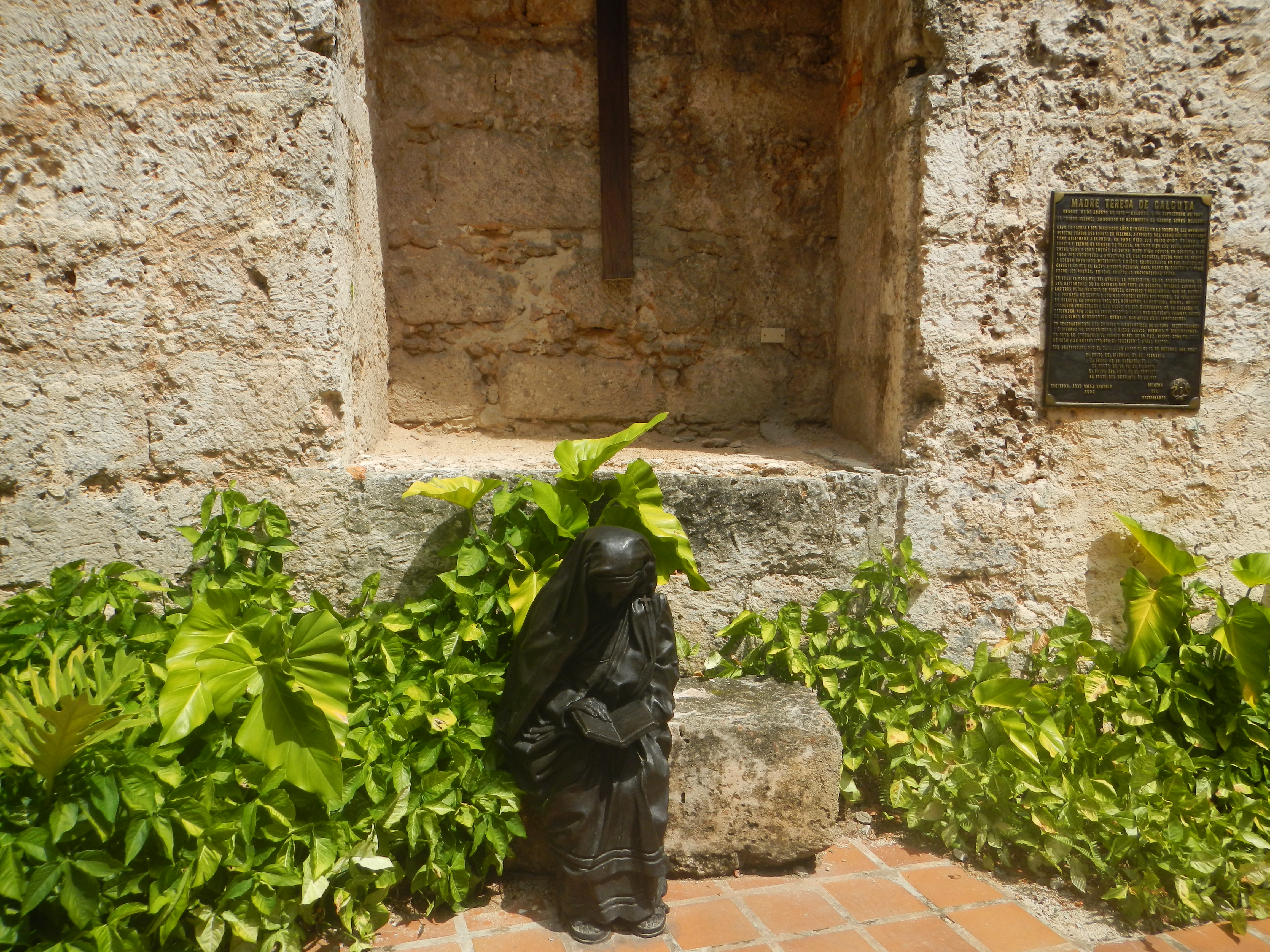
Mother Teresa

Havana Cathedral

We then went to Cathedral Square, dominated at one end by the Cathedral of the Virgin Mary of the Immaculate Conception, started in 1748 and finished in 1777.  Daniel explained that it is done in Cuban Baroque, meaning it followed Baroque style, but without much of the elaborate ornamentation of European Baroque, owing to the nature of native stone, which, being softer, would not allow detailed carving.  Plaza Viejas was spectacular.  Much of the renovation had
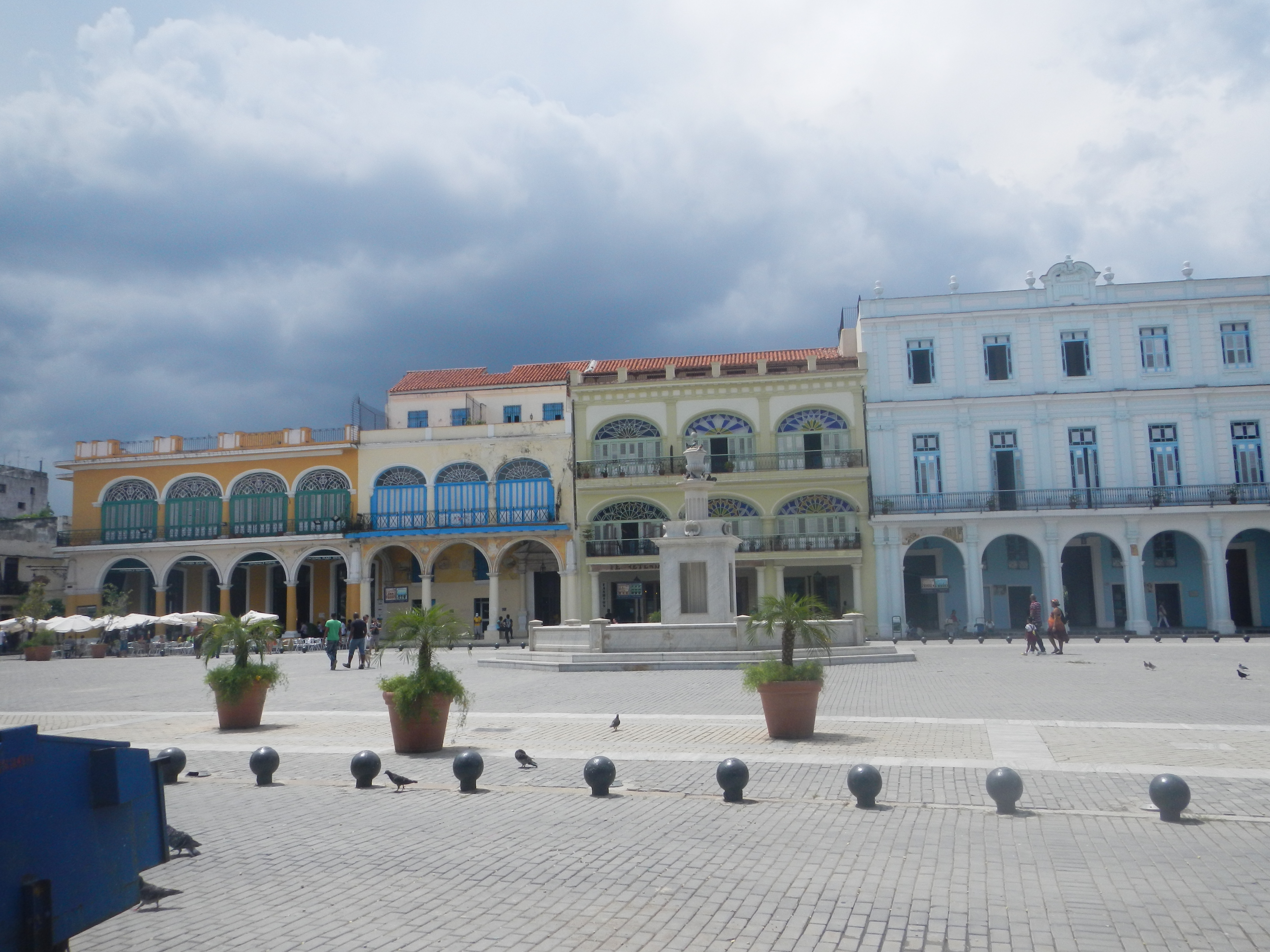
Plaza Vieja

been completed here, and Daniel was justifiably proud of the results.  I remarked that the square looked very much like Plaza Major in Madrid, and he agreed, but I don’t know whether he had been there or not.  Travel abroad for most Cubans is restricted.  At one corner of the square was a completed restoration that really stood out.  Finished in bright yellow paint, with blue trim, it stood in stark, but happy contrast to all the old, crumbling, grey buildings you see everywhere else in Havana.
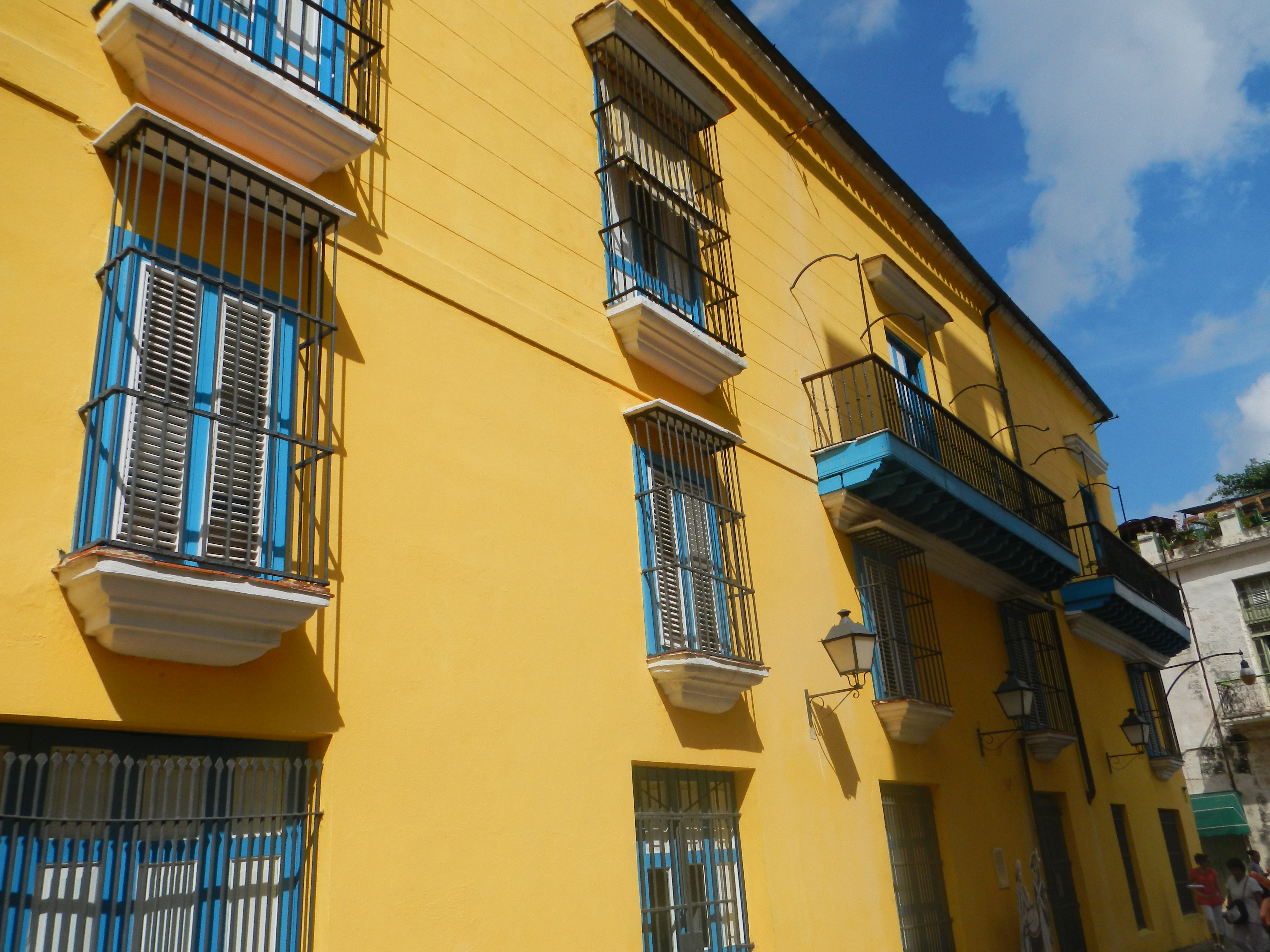
Restoration Success

Barbara asked Daniel if the goal of the restoration was not only the preservation of these exceptional buildings for national pride, but to lure tourism as well, and he quickly responded that the main goal was tourism.  We saw and heard this refrain many times.  As Enedis had put it on our ride in that morning, as we passed more dilapidated buildings, “We are trying.  Our problems are economic, not political.” An argument can no doubt be made that the economic problems are due to the politics, but we were struck by the sincerity expressed in hope for a better future, (including more interaction with the U.S.,) that we heard, not only from government employees, like Enedis and Daniel, but artists, musicians, waiters and housekeeping folk we later met.  In our second day in country, we were becoming aware of what a complex, not easily defined place Cuba is, a place of dichotomy, irony, and delicate balance, a conflicted place really, where desire for integration with the modern world often clashes with a true socialist mind-set.  Enedis may have expressed it best on the bus one day early in the week.  “”I want to go to McDonald’s and Wal-Mart,” she said, and in virtually the next breath was telling us how a certain percentage of her earnings as a guide went for support of the Children’s Cancer Hospital, and that she was happy to do it.  State rhetoric?  Maybe, but as we got to know this remarkable, intelligent, and happy woman, and she us, her frankness and willingness to answer increasingly delicate questions about life in Cuba, and at times, to poke a little fun at the State, led us to believe she was shooting straight, and from the heart.

Lunch on Plaza Vieja

Lunch was not included that day, so Barbara and I made for a cafe/brewery at one corner of the square, in search of an authentic Cuban Sandwich.  We were joined by the couple from California, and enjoyed the sandwich, which was delicious, and a Buccanero.  Of course, a four-piece combo playing Salsa and Afro-Cuban music was part of the scene.  After a set, someone from the band, and this was true everywhere, came around with a CD asking if we wanted to buy.  Watching our money, we never did, but I would liked to have come back with an arm-load.  The music was incredible everywhere, with at least one guitarist in each group absolutely phenomenal.

A bit about currency before we move on to the afternoon’s activities.  Cuba has two currencies, essentially one for foreigners and one for the Cuban people.  There is the Cuban convertible peso (CUC, pronounced by everyone as Kook,) and the Cuban Peso.  Foreigners can exchange their money for CUCs in the country in hotels and banks, and the rate is fixed at about 13%.  You cant spend foreign currency in Cuba, only CUCs, and the Cuban people can only spend Cuban pesos, with a few exceptions.  They are trying to get to a single currency, but in the meantime, it is a good way to keep track of what foreigners are spending in country.  No American dollars can be spent; no credit card purchases.  Most things, including food in restaurants, was quite reasonable, if not downright cheap.  Wages are very low in Cuba, across the board.  Doctors make about 50 Cuban Pesos a month, and many of them hitch-hike to work.  More on transportation later.  We could purchase just about anything we wanted in country, but there are restrictions on what you can bring back into the U.S.  You can only bring back books, works of art, posters, CDs and photographs.  No cigars, kids.  Bummer.

After lunch we reconvened as a group and followed Enedis off the square to a silk screen studio, run by a half-dozen young people.  A little sprite of a girl, who again spoke good English, showed us around and had one of the men demonstrate a technique developed by the artist who actually owned the business.  They screened his art work there, and also movie posters and advertisements.  It was kind of hot in the space, and we were beginning to lose some of the older and disinterested members of our group, the first inkling of a trend that would become a little irritating, and lead me to question just why they had come on this trip in the first place.  No strangers to heat and humidity, and still retaining something of a childlike curiosity and naivety, Barbara and I were always the first off the bus and within a few feet of whatever guide we had, while an increasing number of folks found a bench on which to sit, or stood about and groused.   Anyway, the kids in the studio were enthusiastic and pleasant and eager to show their stuff.  It was delightful.

While inside a thunderstorm had rolled in, but raining only lightly at that point, so we made
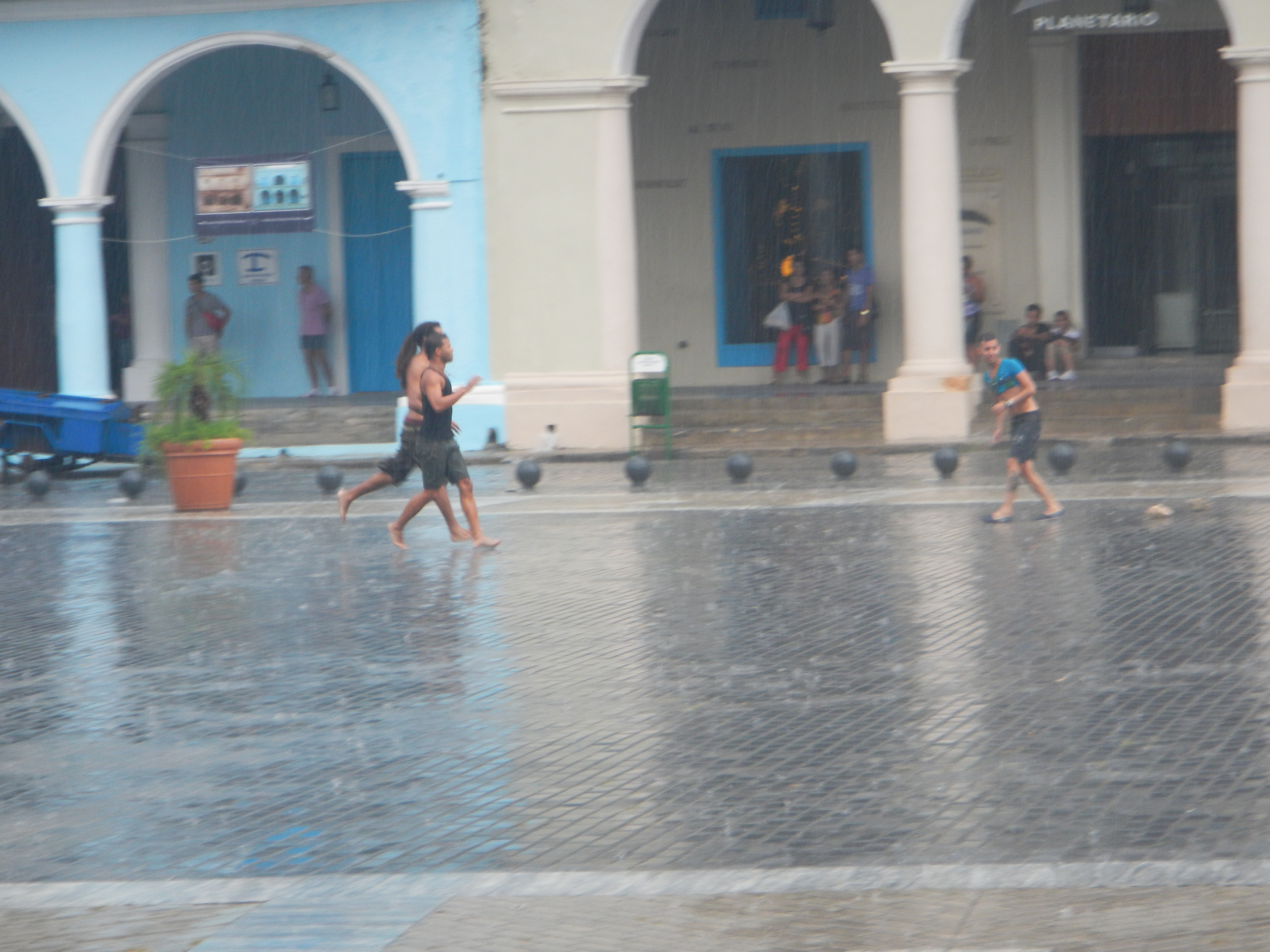
Football in the Rain

our way down the narrow street and around the corner with the purpose of going to another cultural presentation.  A downpour ensued, so we all ducked inside a tiny shop, all 33 of us, more or less, graciously invited in by the shopkeeper.  It was a curious little place that specialized in lead figurine miniatures of the War of Independence (including Teddy and the Rough Riders,) some scarves, and other knick-knacks.  Several purchases were made, so I think it was worth it to her.  We expected the rain to let up soon, but it continued for a half-hour.  We stood in the doorway and watched the uninhibited play of some kids in the downpour.  At length Enedis decided we should make our way back to Plaza Viejas, and then to the bus.  We made it to the square, but the rain picked up again and we couldn’t forge on to the bus, since most were without an umbrella.   We watched an impromptu soccer game take place out in the square, complete with young men who took turns playing and acting as referee.  It rained almost every afternoon we were there, and we got used to seeing young people get out and play in it with beautiful abandon.  It was as regular as the rain.  A few days later, trapped again by an afternoon thunderstorm on one of the porticos of Cathedral square, we saw a skinny black dog joyously tear up and down one of the side streets, so it wasn’t just kids.
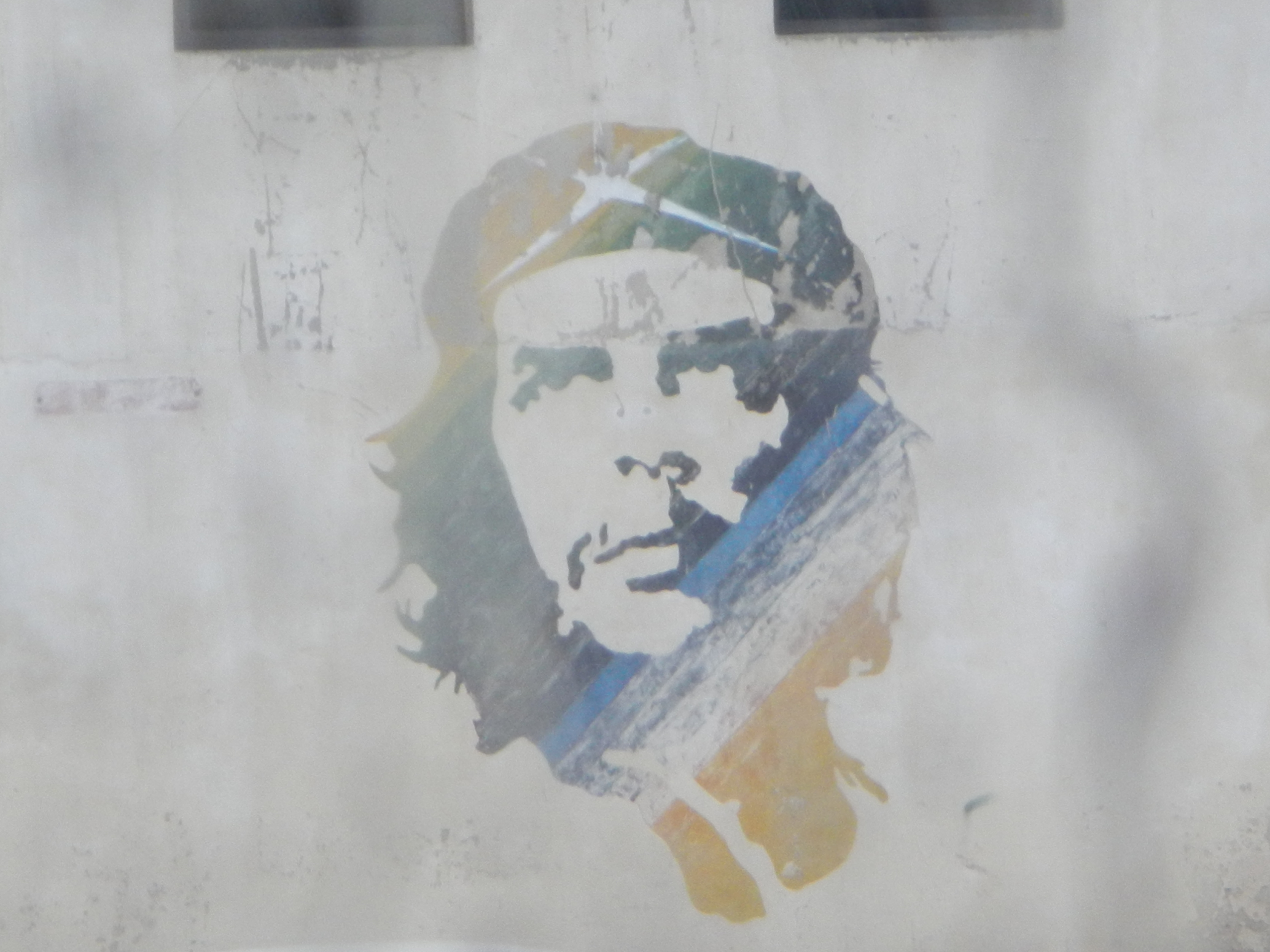
Che on Wall

We finally said the hell with it, and employing our little umbrella, Barbara and I struck out for the bus, which was waiting some three blocks away.  We got completely soaked but made it fine and climbed aboard.  A few minutes later more members of the group arrived in the ubiquitous bicycle powered pedicabs, equipped with canvas covers.  It was quite a sight.  This painting of Che adorned a wall opposite the bus.

Back at the hotel we had a hot shower and got dressed for dinner.  It was also not included this day, but 18 of us, at the suggestion of Enedis, had decided to go back into town to try a highly recommended Palador, a privately owned restaurant, usually in someone’s home.  Since we were a good number we could use the bus.  Paladors have become quite common since the relaxation in self-employment restrictions, and some of the best food in Cuba can be had in these places.

View from La Moneda Cubana

Ours was called La Moneda Cubana, and was back down in the edge of Old Havana, near the inlet to the bay across from the old fort.  We had to climb up some fifty stair steps inside, with three turns then were led out to a beautiful open area with covering overlooking the water.  It was still raining lightly.  Enedis made sure we were all accounted for, then left, saying she would be back around nine to escort us back to the hotel.  We all sat at one long table, had a drink and ordered from a menu with four main entrees.  Barbara and I ordered the fish combination.  It was lobster, a huge chunk of fish, (which I could not identify,) vegetables, and bread, all perfectly prepared.  At 9 we were witness to a very old Havana tradition, the firing of a cannon from the fort.  It was originally done to signal that the gates of the walled city were closing, but now it is a custom.  One shot, boom, that’s it.  It was a very lovely meal.

Enedis arrived shortly after the cannon-shot, we descended the stairs without injury, and boarded the bus for a wonderful drive back home along the Malacon, which by then was thick with people.  Havana folks love to come out at night to converse, argue, and play and listen to music on the Malacon.  We turned back up into Miramar, and were soon at the hotel.  When we passed the old church next door I saw a light in one of the windows high up in the dormitory.
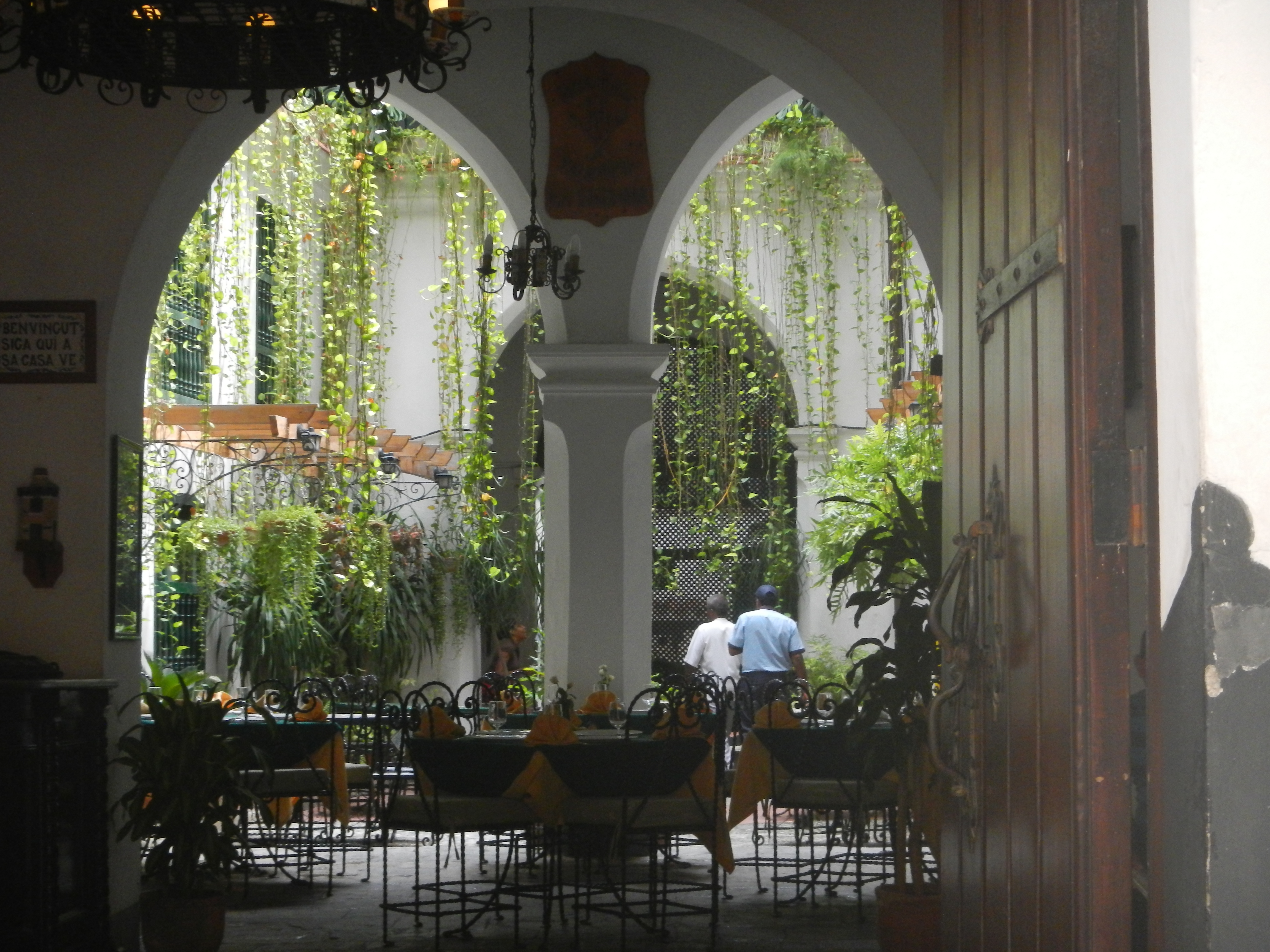
A Restaurant on Plaza Vieja

Posted in Travel, Uncategorized | Tagged | 4 Comments

The Cuba Diaries: Day 1
Old readers of The Post will recall that it was a daily at one time, then a sporadic journal about life on our barrier island, and finally something of a trip log.  We are continuing that designation with this account of our recent trip to Cuba.  When and where The Post appears again will be determined by events.

My interest in Cuba is long and deep and probably genetic.  My first Florida ancestors established a Sea Island cotton plantation on Amelia Island in 1791.  British sympathizers during the American Revolution, they received a Spanish Land Grant when Florida was returned to Spanish hands after the brief British rule, and were Spanish subjects.  The seat of their local government was  St. Augustine, their capital, Havana.  My great-great-grandmother, Julia Anna Cooper Harrison, was born in Havana in 1825 when her father was assigned there as one of the early American envoys.  I was born in Tampa, a sixth-generation Florida native, and grew up in a strong Cuban presence, years before the large, post-revolution immigration.  Some of my earliest memories are of Cuban music and food in Ybor City, and Cuban dishes were the first things I learned to cook.  Black beans and rice, arroz con polla, Spanish Bean Soup, Cuban sandwiches, and paella are comfort foods in The Little Hacienda.  And then, of course, there is the coffee and cigars.  More on that later.    Up until the revolution, of course, there were frequent flights to Havana from Miami, and a ferry from Key West.  You could drive your car onto the ferry, enjoy a nightclub atmosphere on the way over, and drive off in Havana.  It was an easily accessible American playground.  More on that later, as well.  With the embargo all that went away, of course, but not my desire to visit this tantalizingly close, but oh so distant place.  Barbara was born in Miami and has also long wanted to visit Cuba.  We have talked for years about finding a way to get there, and then an opportunity presented itself.  With certain relaxations of elements of the travel embargo on both sides, carefully composed tours have become available, beyond the few possibilities, such as church missions and educational and research trips.  In July we saw an ad in the local paper touting a week-long trip to Cuba billed as a “People to People” tour.  The itinerary was intriguing, and we quickly signed up.  We were finally going to Cuba.

Miami Airport Hilton

Our journey began in the Miami Airport Hilton, an overnight there included in the package, before the flight to Havana the next morning.  We checked into our lovely room, and then, as always, hit the pool under threatening skies.  The schedule called for a meeting with tour representatives at 7, where we would also see our tour companions for the first time.  This meeting turned out to be so bizarre and negative that, had a refund been possible, a good half of the group would have cancelled!  We were greeted by a very pleasant young woman, who handed out envelopes containing a detailed itinerary, our plane tickets and travel documents.  So far, so good.  But then the meeting was high-jacked, for lack of a better term, by a second woman, also representing the tour agency, who proceeded, in the most grating, caustic New York accent, to seriously rain on the parade.  In a most combative fashion, she denigrated our expectations for the trip, gave terribly condescending responses to questions about discrepancies between what she was saying and what was in our initial brochure, and then essentially scared the shit out of everyone with a completely negative harangue about Cuba, its dangers, and “Third World” character.  As I will relate, everything she said was later proven to be completely untrue, but as we were leaving, a heavy pall consumed our group of 33, and an anxious night was spent by all.

Landfall

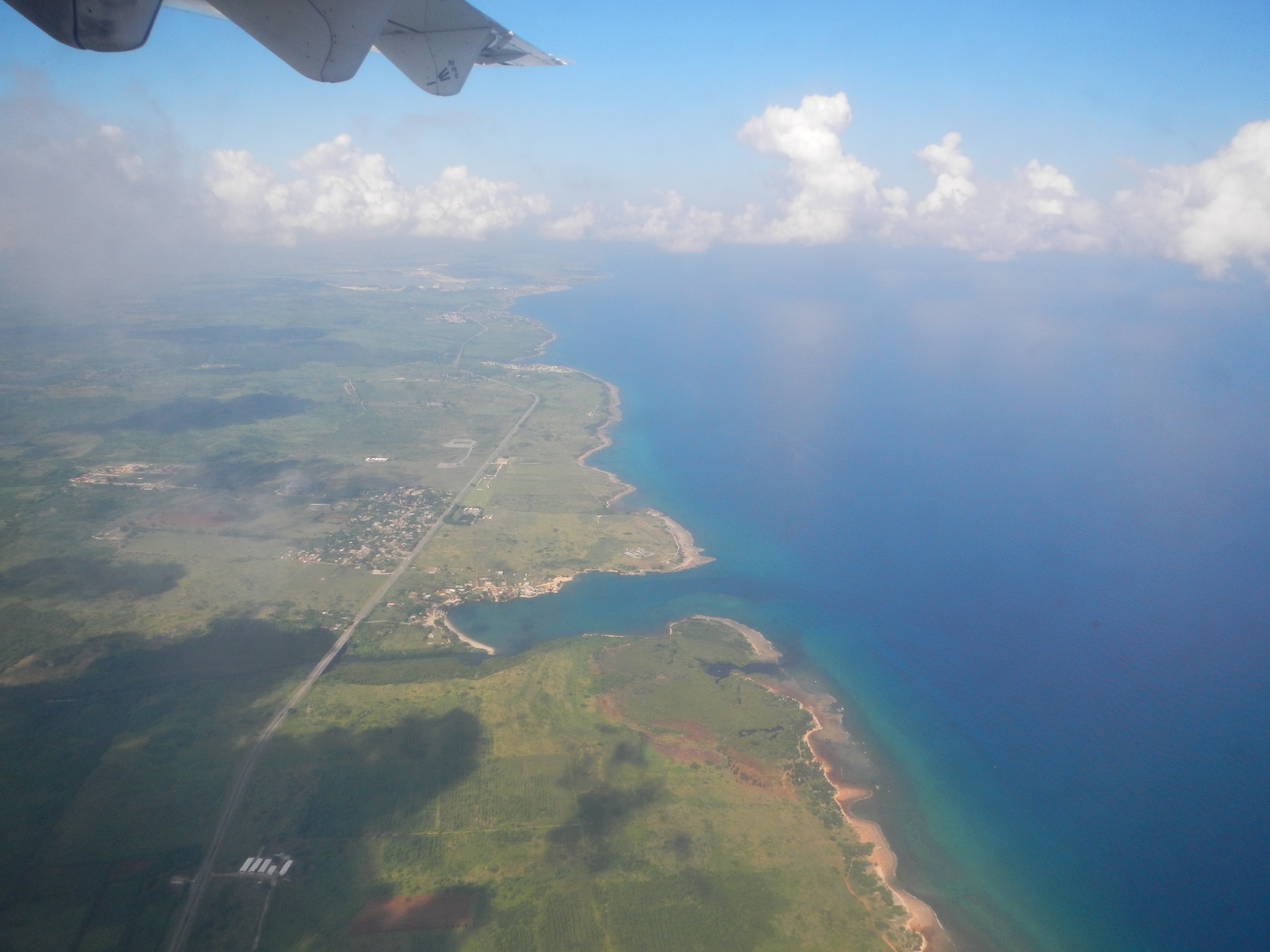
We left the hotel as a group at 6 and were taken via shuttle to the airport.  Finding our departure terminal after a half-mile walk, we settled in with a latte and waited.  At 9 we departed in a twin-engine prop charter and, following the Keys, were soon over the Straits, and not long after, we got our first look at the coast of the island of Cuba. We landed at the very small Jose Marti airport, Havana, at about 10:45 and entered the terminal, where we found . . . no one.  Officials inside seemed completely surprised by our presence.  One of the first off the plane, I tried to answer, in my poor Spanish, what we were doing there, and how many we were.  I guess it was enough.  There were about six little cubicles with a narrow passage between, the customs booths, and were told to pass through one at a time.  Inside the one I chose were two very serious uniformed young men.  Barbara went through ahead of me, spent a few minutes answering questions, and was sent back out to the room in which we had started.  I entered the same booth.  Examining my passport, visa and ticket, they did not appear welcoming at all, and emitted a sinister vibe, but after a photograph, I was gestured into the next room, where the security scanner was.  Barbara was still out in the ante-room, and for an agonizing five minutes, I waited, certain she had triggered some alarm and was off to a Cuban jail.  Everything said the night before seemed to be coming true, and we were all alone.  Still no guide.  Barbara finally came out, we breathed a sigh of relief, and, with no explanation as to why she was briefly detained and no other choice, we cleared the scanner, and waited for our bags.  They quickly arrived, we collected them, and then there she was!  Our Cuban guide, smiling and waving and directing us to bus 437 parked outside.  We exited the terminal into brilliant sunshine and heavy humidity and got our first look at a visual phenomenon that would become both a familiar comfort and a bittersweet irony, the American Cars.

A Sweet Bel-aire

Everyone has heard about the 1950s American cars in Cuba, their preservation forced by the embargo, which curtailed all imports, but until you see them, you really have no concept of their numbers and condition.  They are literally everywhere in the country, the majority in Havana, but out in the countryside, as well.  With a number of other conditions in the country, they create the impression of a time-warp.  It is an extraordinary thing to see.  Outside the terminal were perhaps twenty-five of these cars lined up along the curb– Chevies, Fords, Plymouths, Cadillacs, Studebakers– in models ranging from the mid-forties to late fifties, mostly in pristine condition.  With a recent relaxation in the rules for self-employment, instituted by Raul Castro, individuals can go into any business they want, and many owners of these cars, and there are many, have become taxi drivers!  They are used extensively by the Cuban people, and visitors, as well.  More on transportation and general getting about in a later post.

Havana Buildings

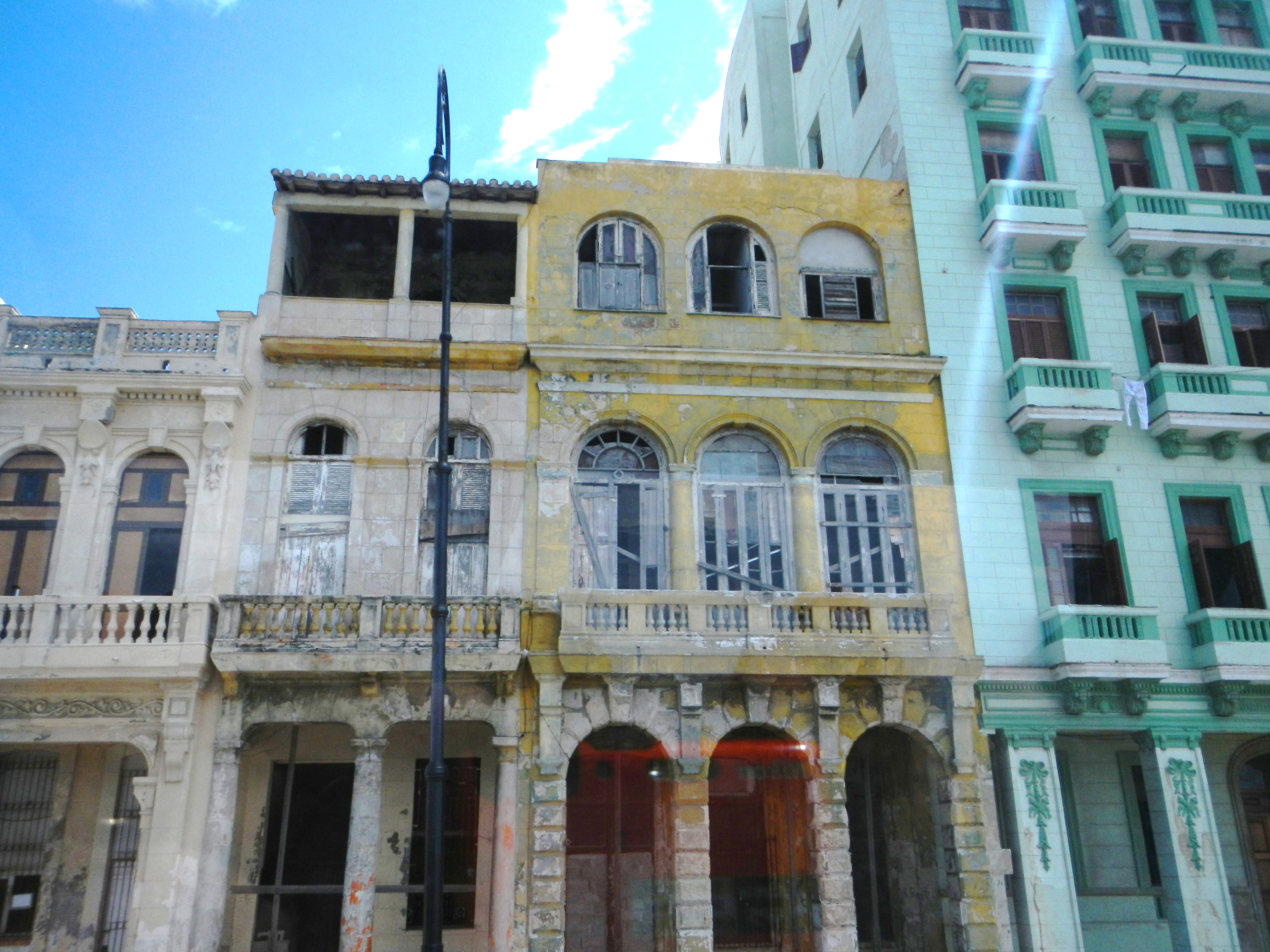
Our guide, a lovely, petite, mixed-race woman of 40, introduced herself as Enedis, and with our driver Miguel at the wheel of our handsome, comfortable, air-conditioned, Chinese-made tour bus, we were off into the city.  The economic plight of the country is revealed everywhere in the buildings.  They are almost all run-down and needing serious renovation, and that is taking place, but very slowly.  People in downtown Havana, which consists of the Old City and the rest of Havana city, live in buildings dating back to the 17th century, many of them in sad disrepair.  It is a sad sight at first, but the people have made and are making the best of it, and are an incredibly resilient and resourceful people.

Marti Monument

We were taken first to the Plaza de Revolucion, a large open area in the Socialist Nation style, dominated by a monument dedicated to Jose Marti, the pre-eminent national hero, where Fidel gave many of his long speeches.  While Fidel is the Father of the Revolution, Marti is the Father of an Independent Cuba, having been the leader of the war for independence from Spain in the 1890s, and is known as the “Apostle of Cuban Independence.”  A poet, journalist and philosopher, and an eloquent, charismatic speaker, Marti raised considerable money and support for the cause in Florida, specifically Ybor City, where Cubans were the owners and workers in the new cigar industry.  He left Florida in April, 1895, to join rebels fighting the Spanish in Cuba, and was killed in battle on May 19, 1895, a distinct target in his black jacket on a white horse.  The United States intervened, of course, when the Maine exploded in Havana harbor in 1898, ensuring a Cuban victory and a line of dictators extending to Batista.

Che

Around the square the images of other Cuban heroes appear in huge scale on the buildings, including Ernesto “Che” Guevara, for whom sentiment among the people appears to run strong and deep.  We will discuss Che at some length later.  Following our walking tour of the square we were driven to the Hotel National, another Havana landmark, built by American interests in 1930.  It is very reminiscent of the Vinoy Hotel in St. Petersburg, with the same old elegant

Hotel National

architecture and style, and offers a grand view of the Malacon, the long walkway and road along Havana’s Atlantic waterfront.  Traditional musicians, like we would find everywhere, played on a shaded portico at the rear of the hotel overlooking the Atlantic. A brief look around the well-kept grounds (many foreign visitors) and we were off to Old Havana for a short walking tour of some of the oldest remains of the wall that once surrounded the city.  As we said, many of the buildings in this part of town are several hundred years old.  An extensive government project is underway, we would learn, to renovate and preserve these historical treasures.  Walking around this part of Havana is like being in many ancient cities of Europe, particularly Spain, of course.  Our initial tour of Old Havana led us, under Enedis’ capable, informative direction, to our first meal, lunch at a restaurant called Dominica.

Mojito

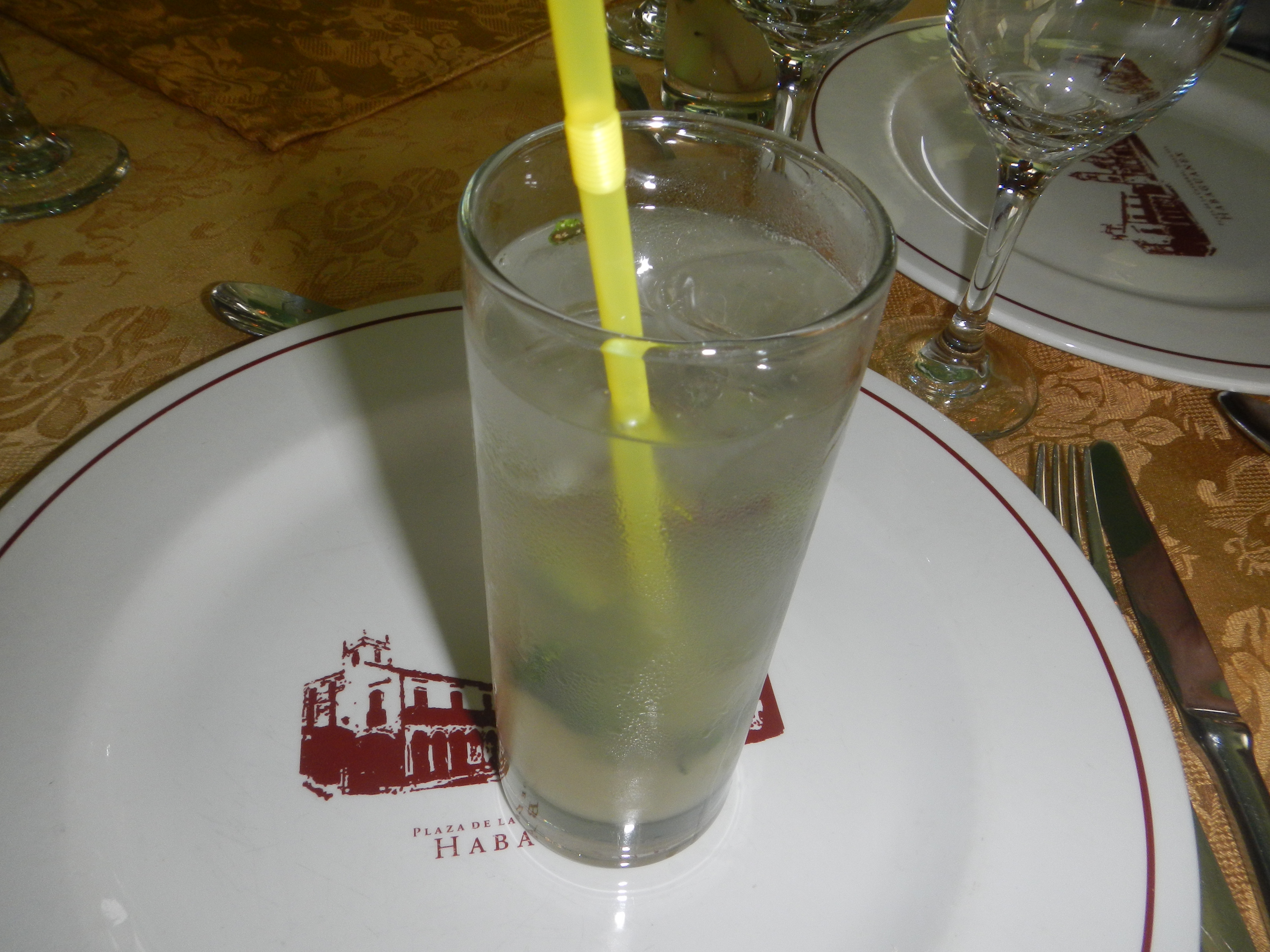
A friendly, enthusiastic staff showed our group to our tables, and immediately brought out our first Mojito, the Cuban national drink.  For the uninitiated, uninformed, or just plain slow, a Mojito contains muddled mint, lime juice, rum, a pinch of sugar, and club soda.  These were wonderful.  The meal consisted of salad, pasta, a delicious, thin-crust pizza, and was accompanied by an exceptional Cuban beer, Cristal, which we would have with virtually every meal from then on, or its cousin, Buccanero, both of which were stocked in every hotel room fridge.

Cristal

A musical group consisting of two guitars, conga, and a female singer entertained us with traditional Cuban music.  It was a delightful first meal, in a welcoming, congenial atmosphere.  Two Cuban gentlemen seated near one of our tables asked where we were from, and on learning it was the U.S. jubilantly offered words of welcome and their desire that the walls would come down between us and we would become the best of friends.  It was a sentiment we would hear expressed throughout the rest of the trip.  Coffee, desert, I bought a Montecristo cigar, and we were back on the bus for the drive to our hotel.

We drove along the length of the Malacon, lined with buildings that have suffered from not only the lack of upkeep, but the salt air of the waterfront, from Old Havana to where the road turns inland into the district of Miramar, a formerly elegant neighborhood that was home to the well-to-do middle class before the revolution.  It consists of lovely tree-lined boulevards and beautiful small villas built in the 19th and early 20th centuries.  Most are now in bad shape, but retain their simple elegance beneath the rough facade, and it is easy to see what a beautiful place it was in its heyday.  It is said Miramar is the district in which Fidel lives, but no one knows the exact location.  Because they were essentially the privileged class and did not support the revolution, many of the owners of these houses fled for the United States when Fidel took control.  People of all walks of life now occupy them.

Hotel Quinta Avienda

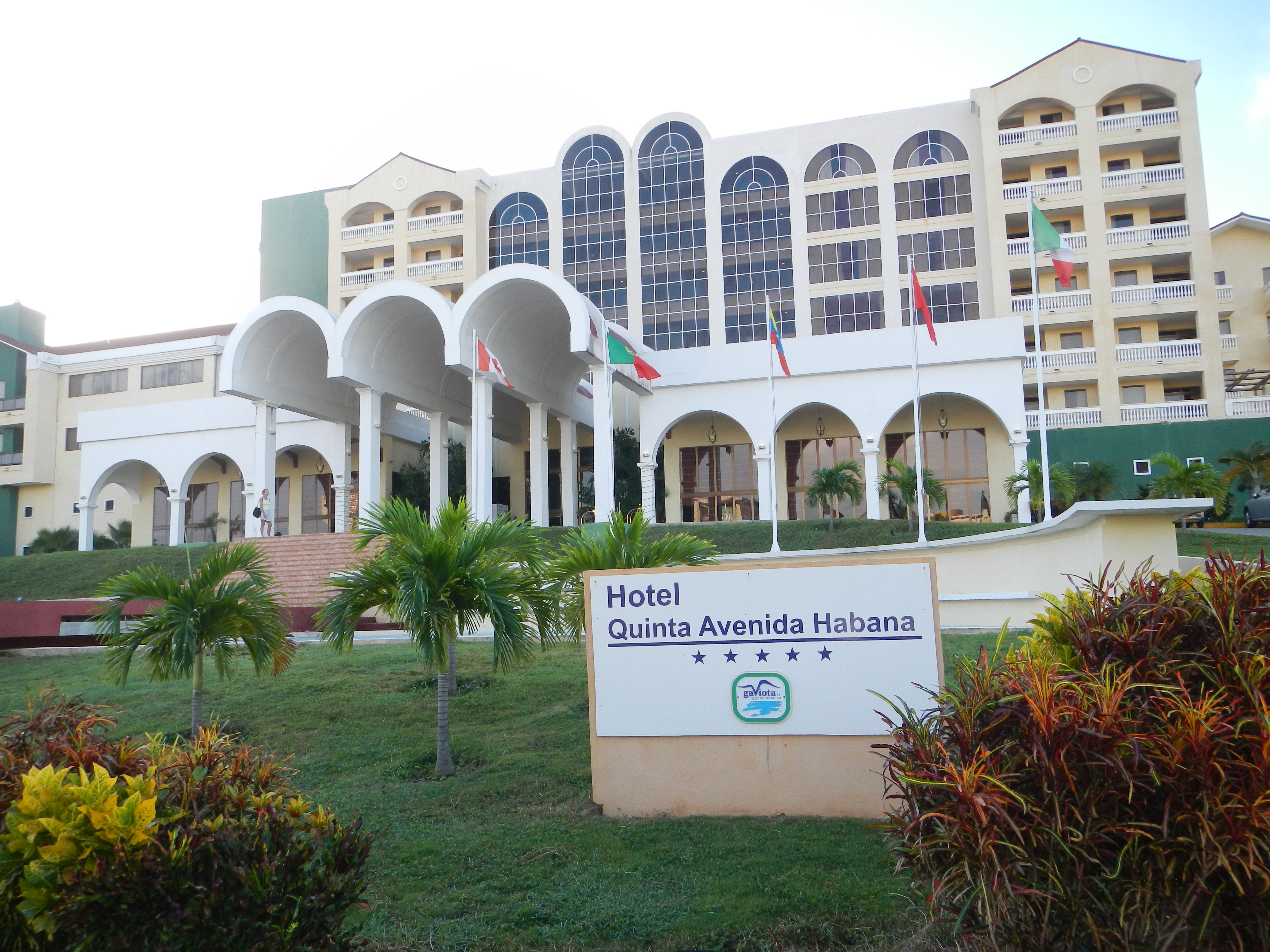
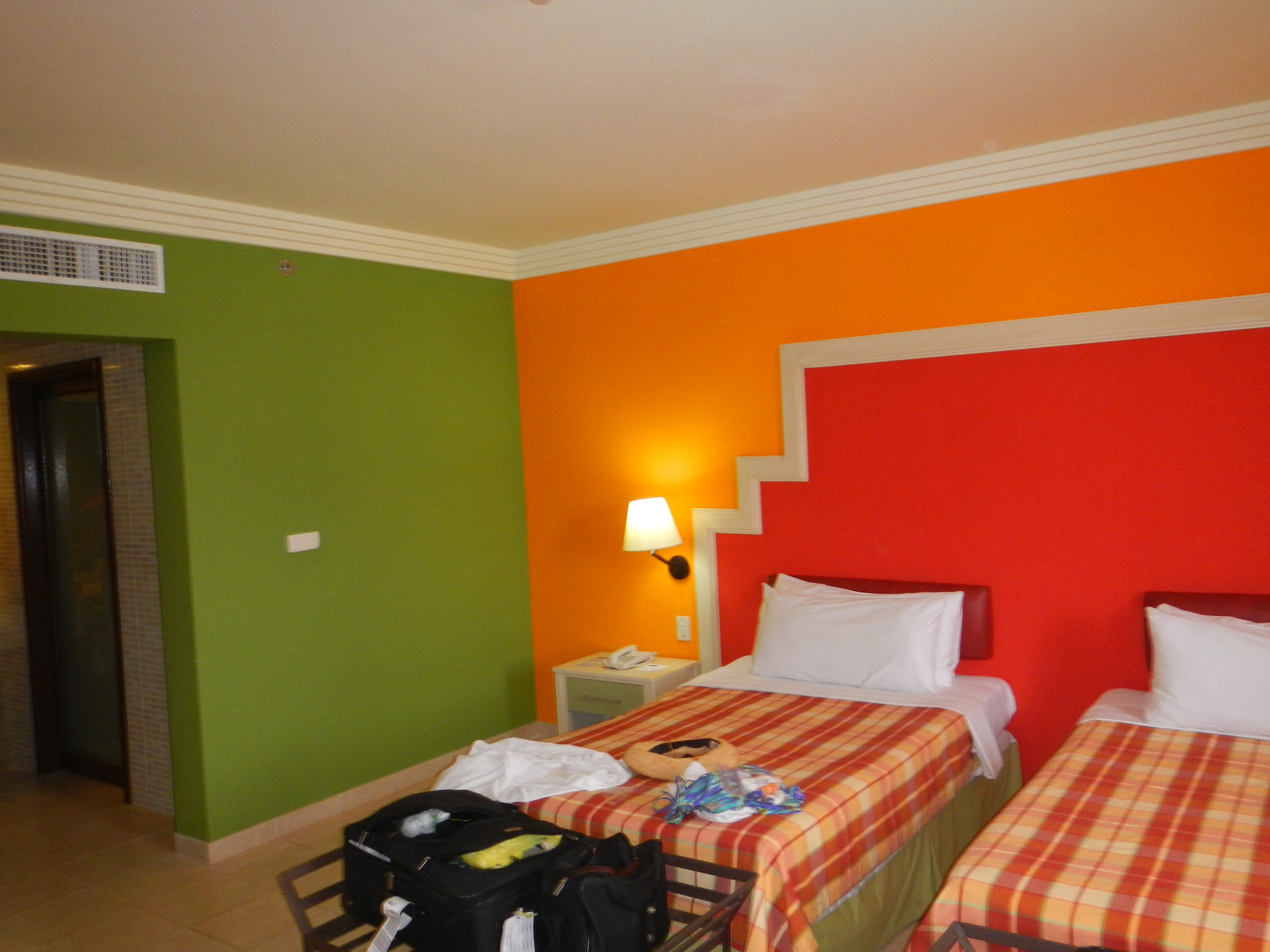
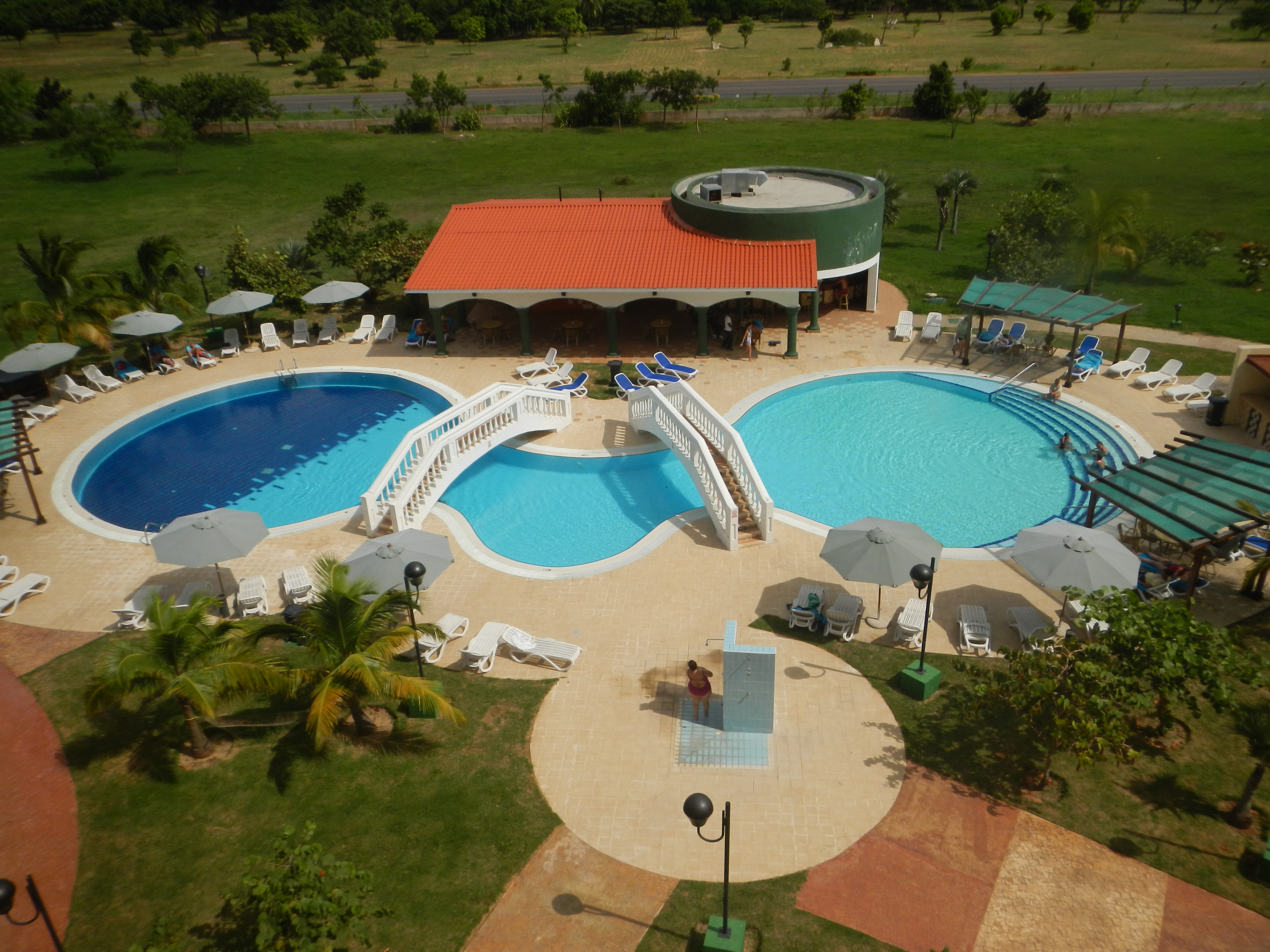
Our Hotel for our stay in Havana was the Government-owned Quinta Avienda, a four-star, relatively new place within walking distance of the Atlantic.  On entering we were greeted by staff offering a complimentary Mimosa, and then we were given our keys.   Our room on the second floor was spacious and, for those of you who have visited The Little Hacienda here on Skinny Island, done in colors with which we are familiar, and you will recognize.

Our Room

Our View

The view of the very large pool was spectacular and inviting, so we quickly donned our swim wear and headed down.  The regular afternoon thunderstorm was moving in, but we managed to get in a swim, then went back up to watch the rain and take a short rest before starting the evening’s festivities.

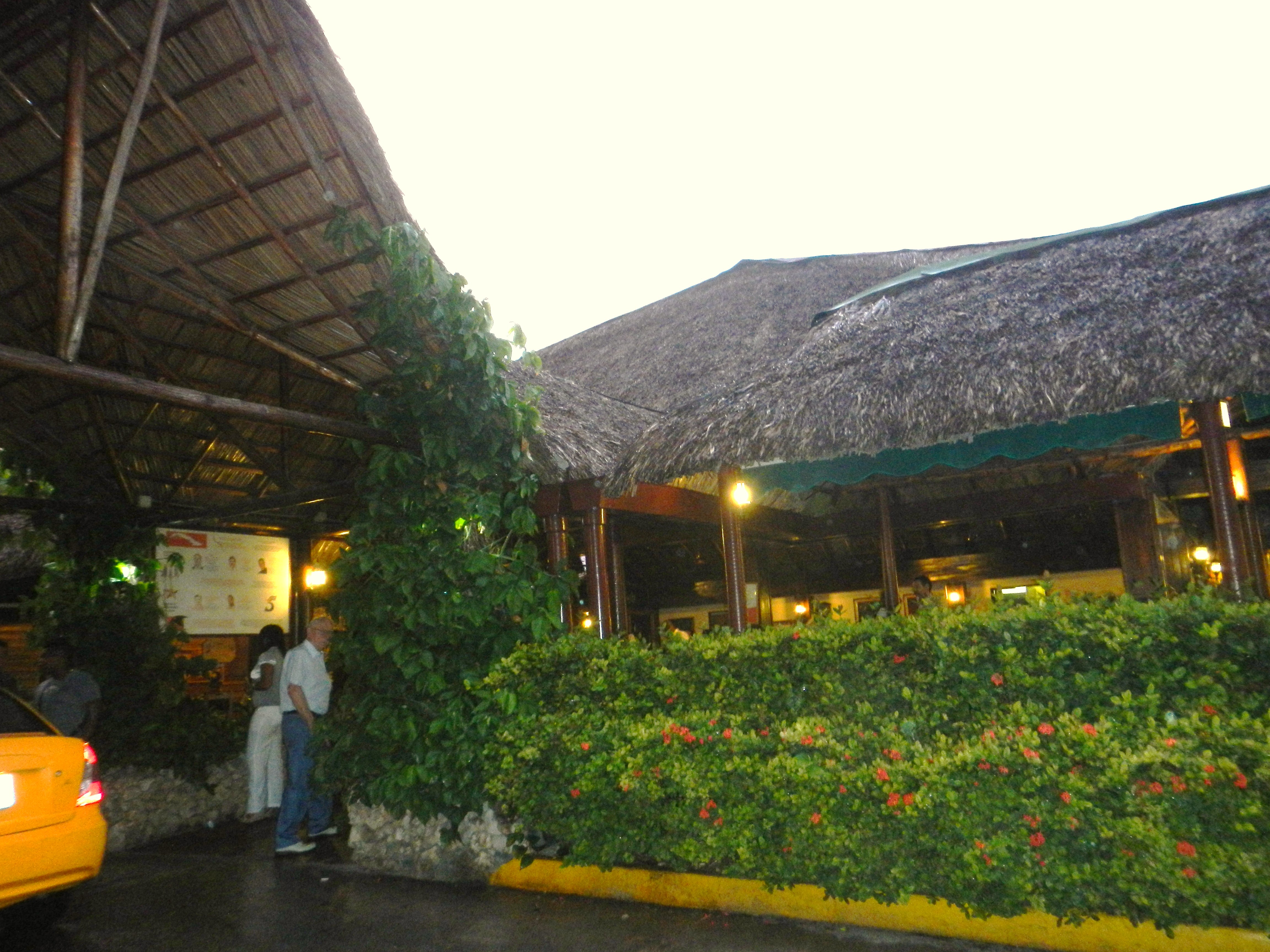
Our dinner was in Miramar, not far from the hotel, in a thatched-roof, open air, Government-owned restaurant called El Ajibe.  We arrived in a light rain and were ushered to several large tables, where we would dine family style.  A large, happy place, with a beautiful bar to one side, our arrival filled the place.

El Ajibe

Upon being seated we were brought sangria, which was fantastic, then bread, fried plantains and salad, black beans and rice, roast chicken, and Cristal.  We started getting to know some of our traveling companions, and quite a diverse group it was.  There were several folks from Florida, a couple from Sonoma, others from Alabama, New Jersey, Chicago, and Buffalo.  By the end of the meal, and our first day in Cuba, it was clear that virtually everything our caustic company representative had said the night before was the complete opposite in reality.  Our government-employed guide was personable and open, the restaurant managers and staff welcoming and congenial, the people cheerful and eager to make our acquaintance.  The place was not in the least threatening or remote.  I smoked the Montecristo poolside, and we retired, beat but very pleased by our first day, and eagerly anticipating a more thorough walking tour the next day of old Havana, including a meeting with the architect in charge of restoration.

El Morro

Posted in Uncategorized | 8 Comments

The Outback

Although the front yard understandably warrants most of our attention here in the Little Hacienda, The Outback, our little seaside hammock behind the house, is pretty unique for these parts.  Everybody on A1A can look out and see the ocean, can walk on the beach, but thanks to the original owners of this place, our natural refuge out back is the only one left for miles either way.

Consisting of palms, palmettos, Florida Bay trees, and a few oaks, it is a 100 x 100 foot

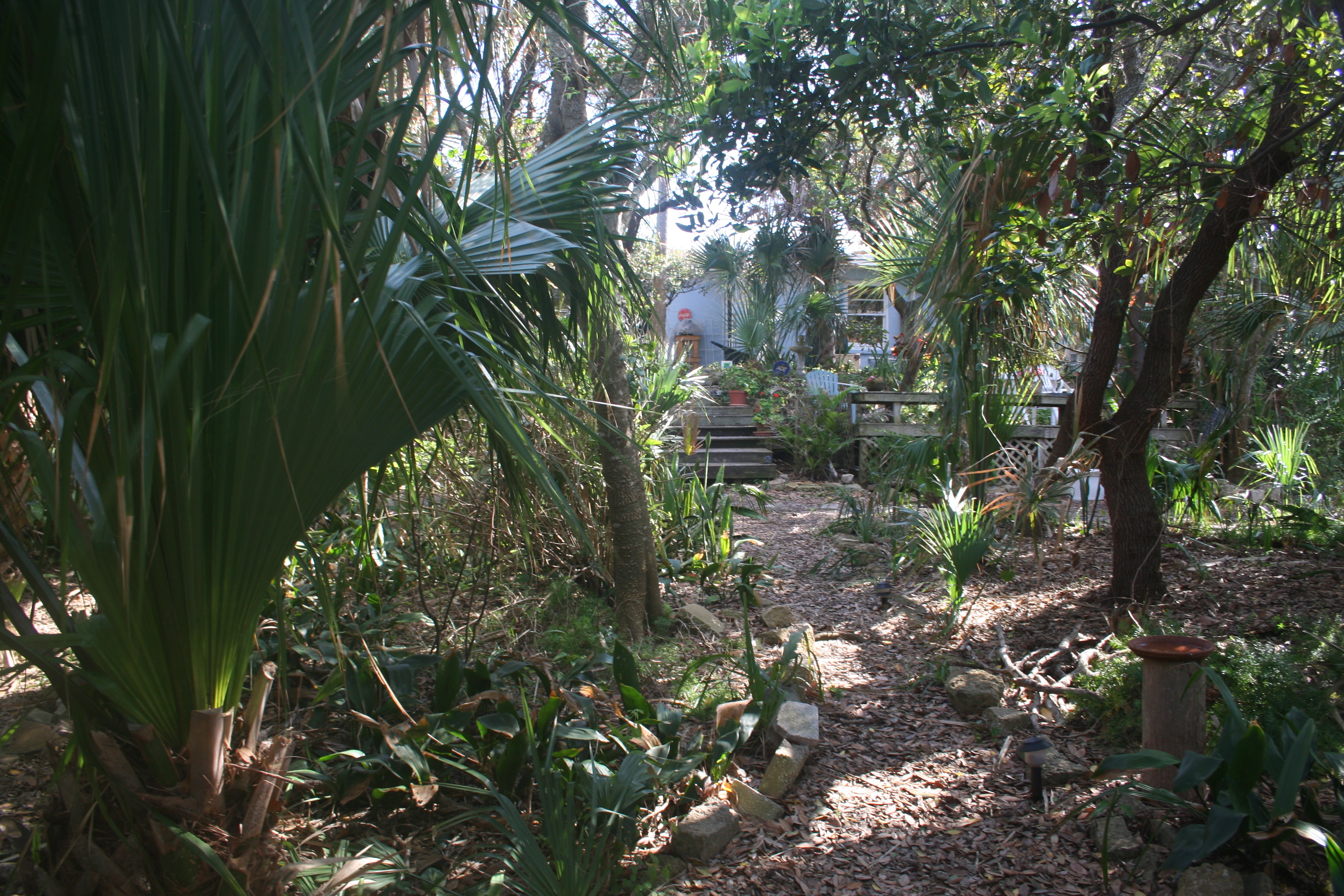
The Trail

The Trail

glimpse of how it all looked along this coast before development.  On most of these barrier islands, the natural structure, carved over thousands of years, would be a dune rising at the ocean, then a trough to the west of that, and another dune, with another trough, which maintains elevation essentially down to the west side of the island.  You can still see this structure on the few undisturbed barrier islands, like Big and Little Talbot,

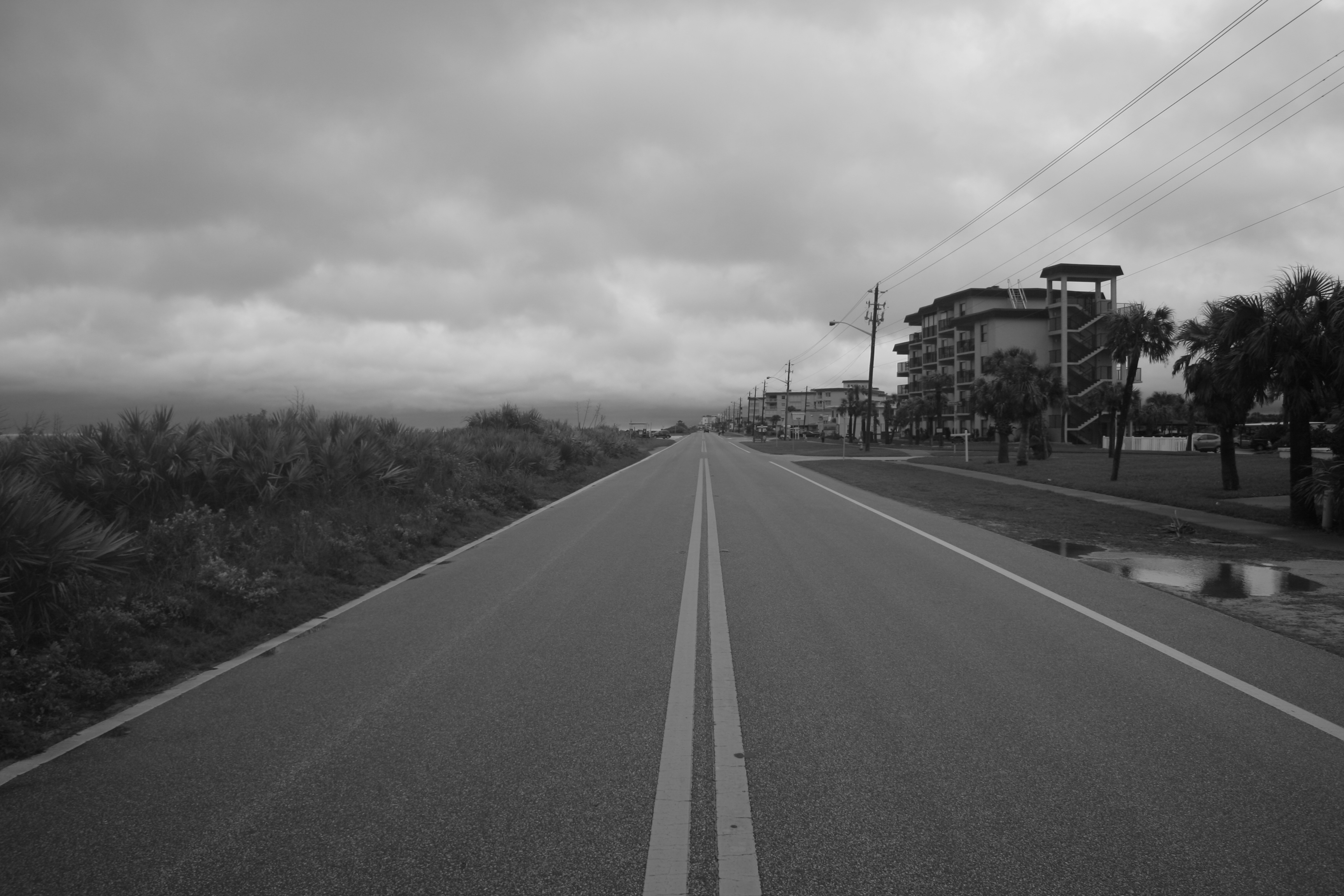
Old A1A

and parts of Amelia.  Here, old A1A was built in the first trough after the dune, essentially filling it.  Our house was built atop the second dune, so behind there is a significant drop.  Typically this is where a “Hammock” will thrive.  In winter the trees lose most of their leaves, allowing some of the afternoon sun to warm the house.  They are leafing out now, and through the summer months there is a lovely cool shade back there.

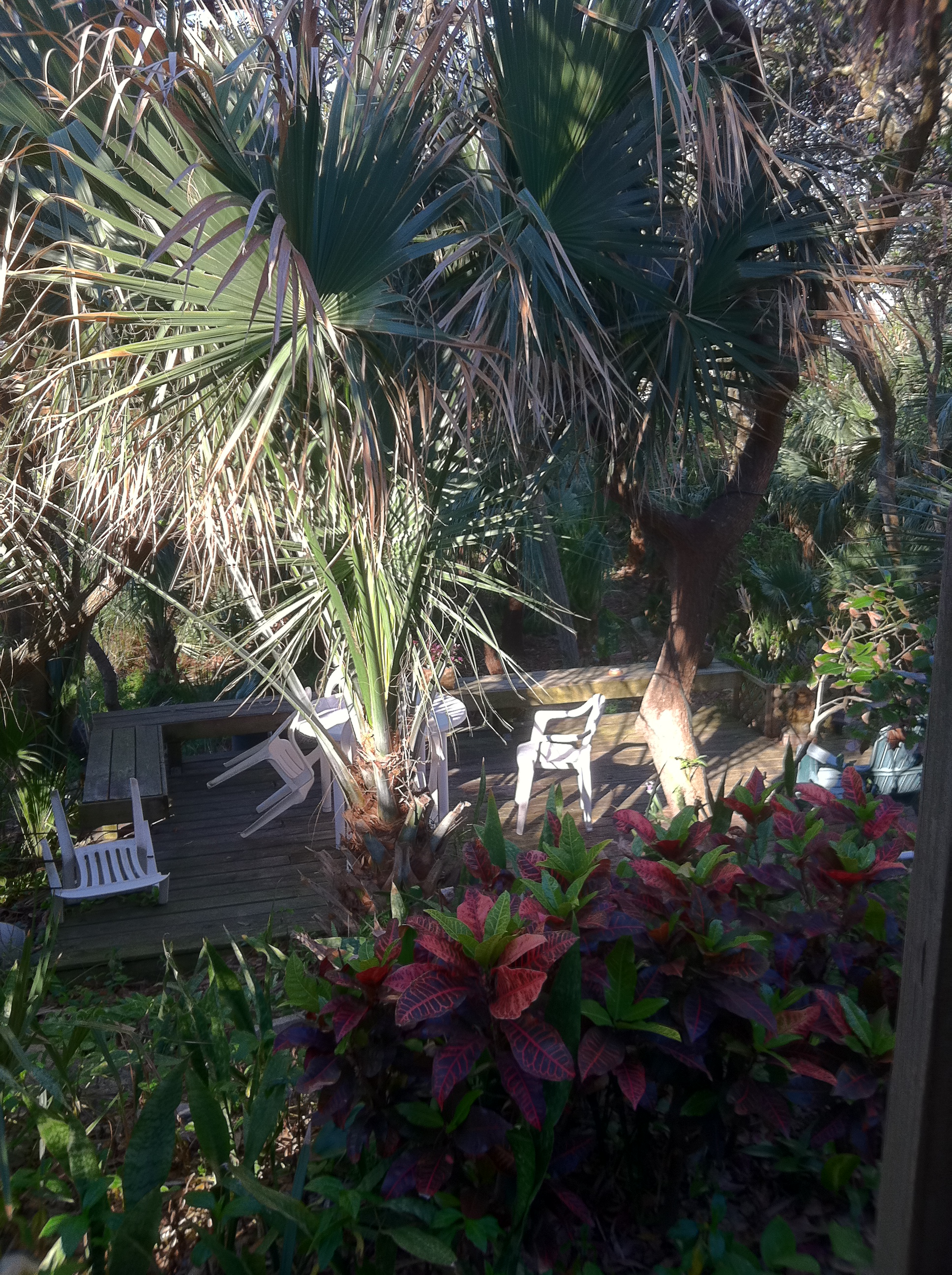
The Deck

The prior owners made a few winding paths and lined them with coquina stone.  We’ve put up a wood fence all around, put in a garden and built a deck down the slope, but we’ve mostly just left it alone.  You can truly get lost back there, and the way the light changes in the leaves at different times through the year is a constant marvel.  On a overlook bench just out the back door is our favorite place

From the Shower

to spend an evening, weather permitting.  The outdoor shower we use when coming up from the beach offers a lovely panorama over the crotons.  For many years the Outback has been home to doves, Cardinals in spring, several rascal squirrels, the occasional raccoon and ‘opossum, a Great Horned Owl for a time, various snakes, box turtles, and a Gopher Tortoise.  Three cats are entombed there.

In the hollow of the Outback, traffic noise is very faint, but the sound of the ocean hangs up in the trees.  Remarkable.

Looking Back at the Little Hacienda

Penta

Posted in Uncategorized | 3 Comments

Palmetto Pale

The Label

Stimulated by our many happy experiences with craft beers in the mountain west, we have decided to brew our own here on Skinny Island.  It is to be called “Palmetto Pale Ale” and, true to our policy of full disclosure here at the Post, we will document the entire process, come what may.  This is not our first attempt at home-brew; we made a very decent ale some ten years ago, but we have forgotten much of the process, so we are pretty much starting from scratch again.  Yes, kids, this is perfectly legal; you can make as much beer and wine as you want.

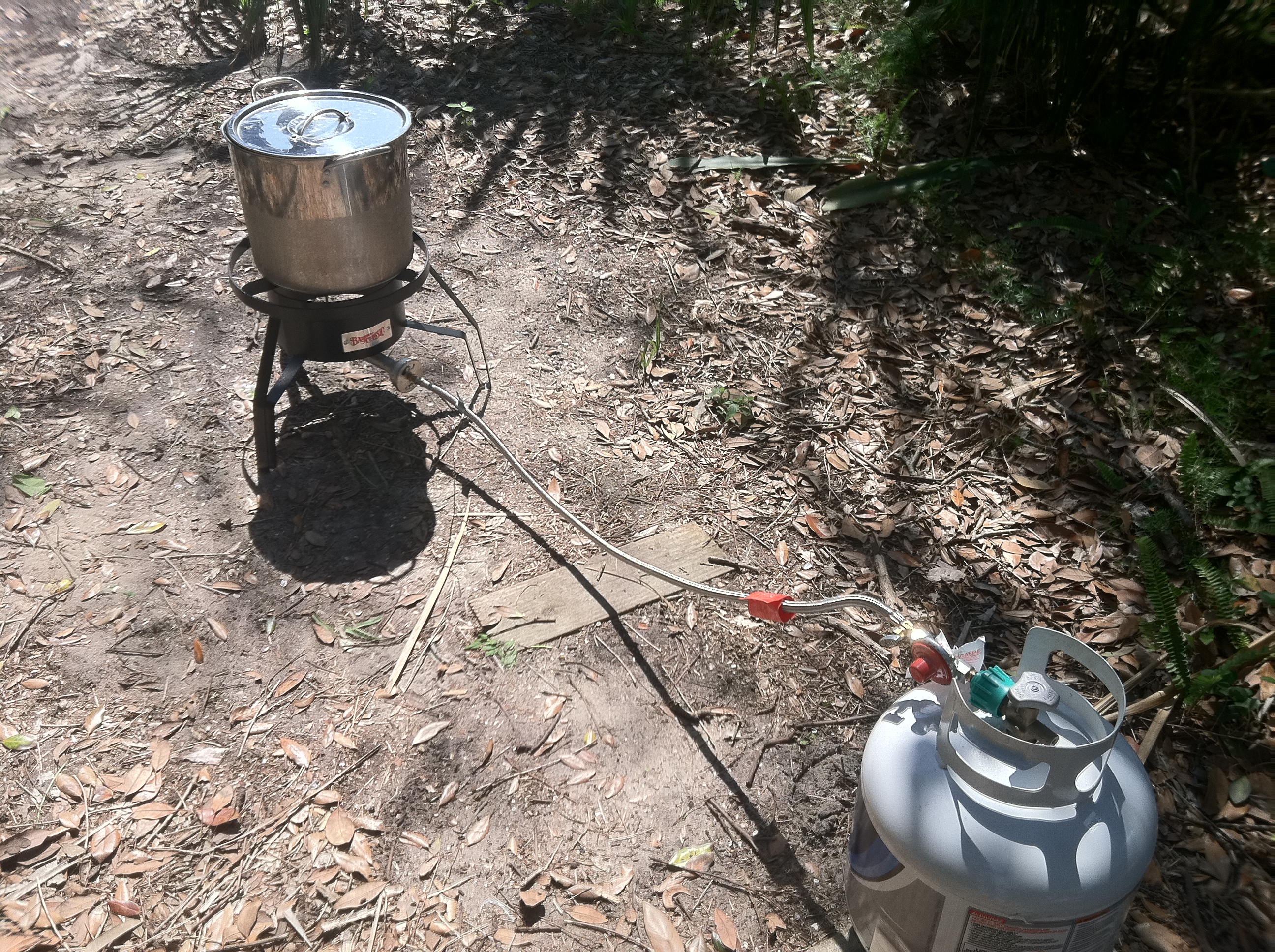
Here goes.  We started by setting up our propane cooker back in the hammock outside, so

The set-up

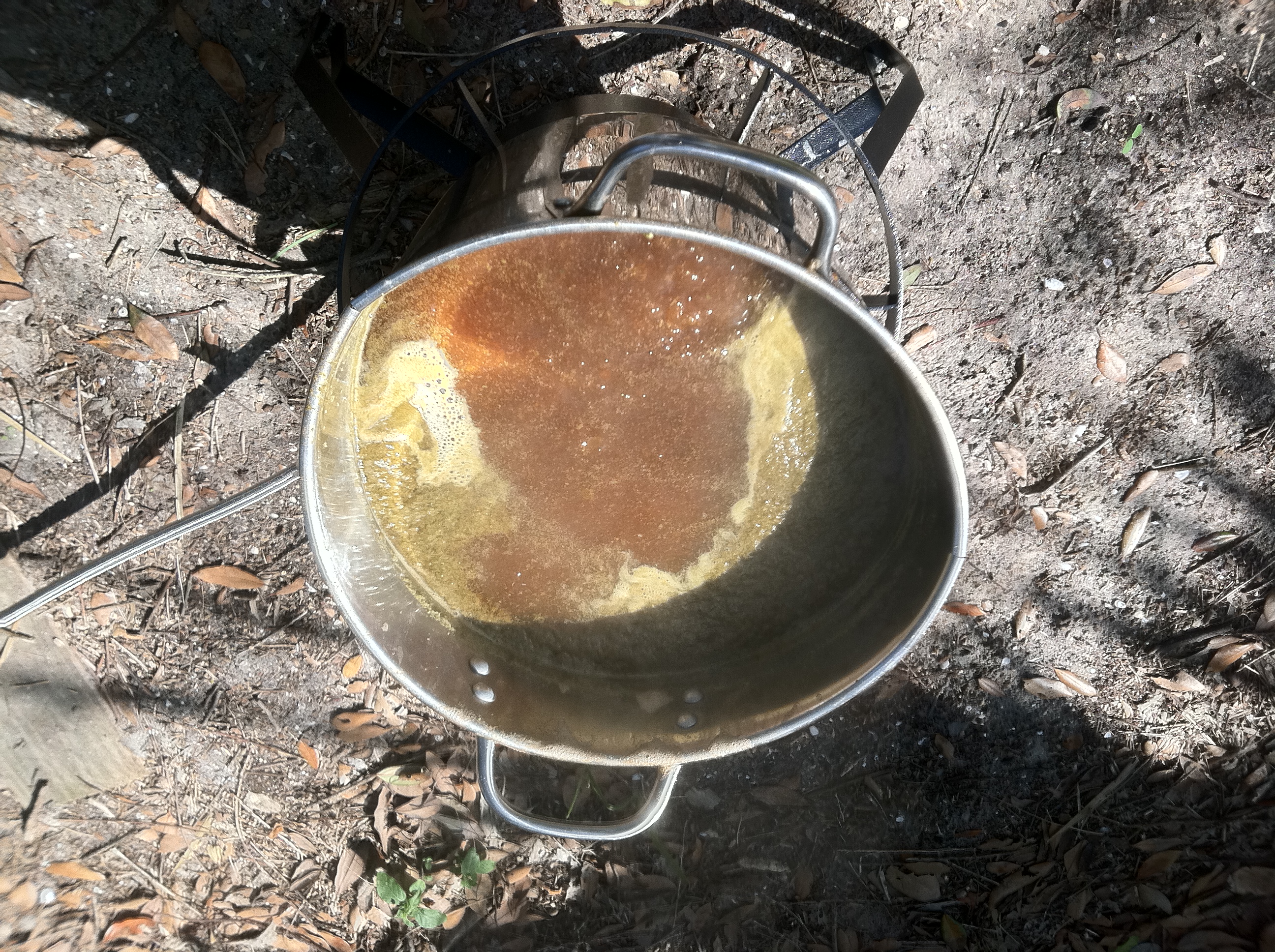
we wouldn’t catch the place on fire.  You bring 2 1/2 gallons of water to about 150 degrees, then add the dry grain ingredients, chiefly barley, in a tight mesh bag, (no that isn’t an old sock, but that’d do, if clean,) steep for 20 minutes, then bring to a rolling boil and add your malt, stirring constantly so it doesn’t stick to the bottom.  This is called the wort. You bring this again to a rolling boil,, then start throwing in your hops, bittering hops first, then, after 55 minutes’ boil, your finishing, or aroma hops, (Cascade, of course, from the great Northwest.)  Another 5 minutes boil, and you cool the wort to about 70 degrees.  Pour this stuff

The Wort

into your fermenter, through a filter to weed out the mush from the grains, add enough water to make 5 gallons, take a specific gravity reading, throw in your yeast, and cap the fermenter with an airlock, which lets gases out but nothing else in, and wait.  This bubbles and ferments for 5-7 days, and then you add some sugar and bottle.  Carbonation takes place in the bottle, and when that’s done, in about 2 weeks, you drink it!  Couldn’t be easier.  Yes, the pot is warped, but it still works.

Five Gallons Fermenting in the Carboy

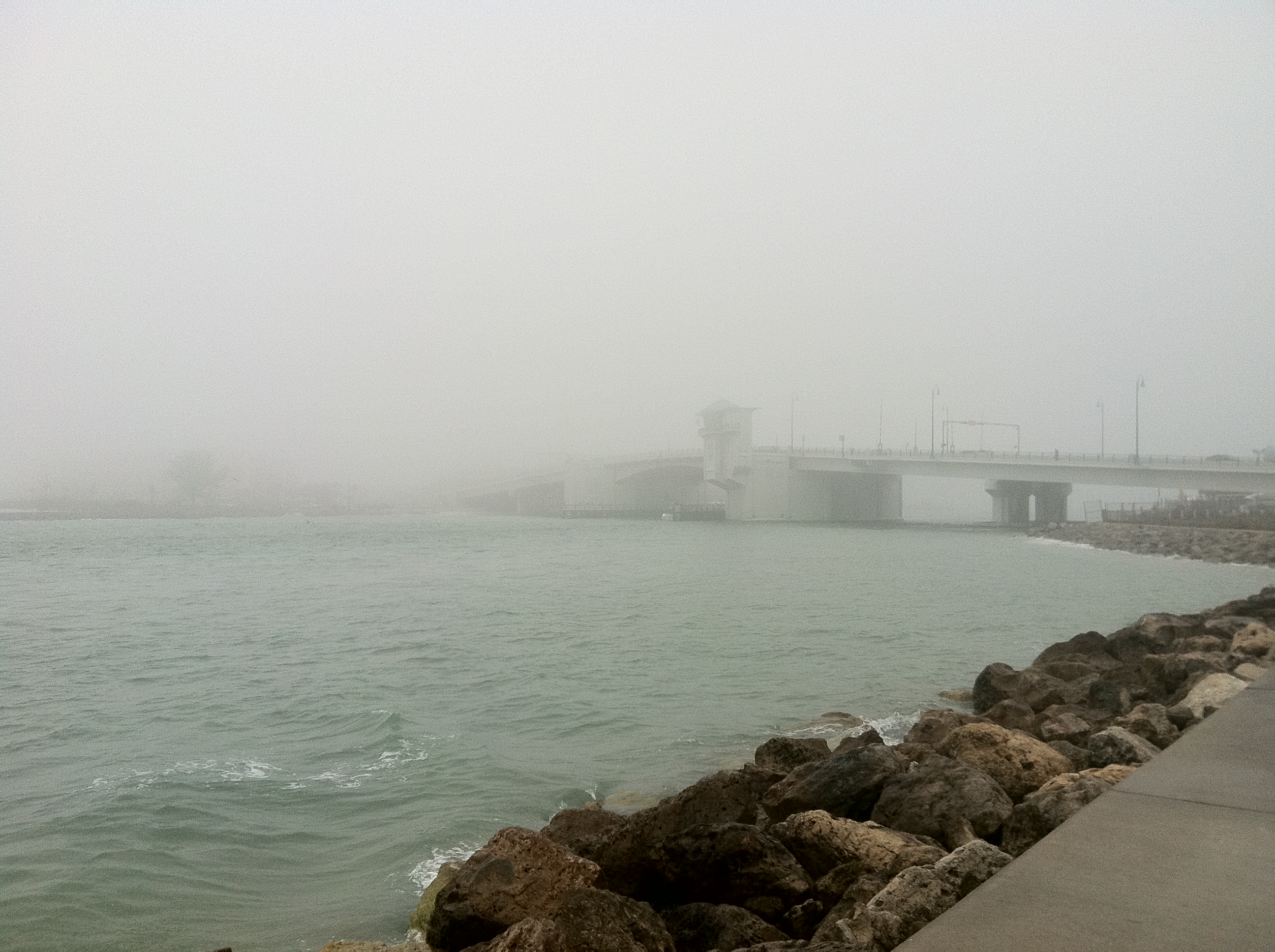
Stay tuned.  By the way, it was a gorgeous day here on Skinny Island, after a thick morning fog, high around 82.  Spring is just around the corner.  The garden is proceeding apace.  More on that later.

Posted in Uncategorized | 2 Comments

Over in Pasadena

Ibis Foraging in Old Pasadena

When the spirit moves us, or more to the point, when the spirit is inclined to move us by events here on Skinny Island, we pack up a few things and head across state to the west coast offices of the Post, our little digs in St. Petersburg, South Pasadena, specifically.  The two annual events which always prompt this dash are the Daytona 500, and Bike week, the reasons for which are self-evident and require no further elaboration.  But to allay any thoughts this may engender that we are one-per-centers, with a myriad of posh homes to enjoy, some elaboration of the facts might be in order.

The very few of our readers who have actually visited both the west coast enclave and the Little Hacienda on Skinny Island will know that the Skinny Island house, while modest and utilitarian, is a veritable palace compared to the Pasadena place.  This is a choice of both economics and philosophy.  We don’t need what we can’t afford, and vice versa.  But to be perfectly honest, its purchase, nine years ago this month, was born of two things even more fundamental: balance and baseball.  The balance aspect stems from my Tampa area roots.  I am a Tampa native, and have roots there from the 1850s.  I wanted to go home, the Bay, the Gulf, etc.  The baseball angle is a tad more obtuse.  In 1998 or so we got the idea to go catch a few games of the fledgling Tampa Bay Devil Rays, a new American League franchise based in St. Pete.  We got a partial season ticket package, 22 games, way in nosebleed.  We’d drive over three hours in the afternoon, watch the game for three hours, then drive three hours back.  Not always.  We found a sweet little old Florida motel on Treasure Island, and stayed there often.  Still, it was costing.  We finally said, hell we like it over here so much, and the baseball, (even though they were the worst team in baseball then,) so we started looking for a little house.  We found one in South Pasadena, a two-bedroom little place, not much to look at from the outside, and as is our custom, set about rehabbing the joint.  It was great.  We got better tickets gradually, eventually ending up about twenty rows back of the home dugout.  My running joke with our seat-mates was that every game was costing me about $1500.  We finally got priced out of the seats, but kept the house.  The year after we gave up the seats the Rays made the playoffs, and the World Series the next season.  Oh, well.

John's Pass, Treasure Island

Anyway, it’s a great little place for a few days get-away.  Great neighbors, and an interesting mix of houses.  You can walk to Boca Ciega Bay, and it’s just a short drive to the Gulf Beaches of Treasure Island.  This week past was cool, rainy, and windy, but we managed walks on the beach, and even some quiet sitting, plus many walks through the neighborhood, some pictures of which are enclosed.

A Little Gargoyle Goes a Long Way

Big Banyan

But the highlight was something we saw while sitting on the beach.  We were enjoying watching a bunch of sandpipers and gulls along the surf, as well as a scattering of Willets, one of our favorite birds.  one particular adult was being followed quite closely by two little ones, all long beak and legs.  They darted after her every move, and demonstrated a short,adept flying burst when she did.  Then, with no signal we could discern, mama walked off down the beach, and the little ones did not follow.  They pecked around in the sand a few minutes, then joined a gathering of sandpipers, and just stood there.  We watched for about an hour for mama to come back but she never did, and the little ones made no attempt to follow.  Here’s what we think it was, an extraordinary moment we were privileged to witness:  they had graduated, and she had turned them loose.  We think we saw the moment that happened, a small, but singularly amazing event of ancient nature.

A Willet

Posted in Uncategorized | 2 Comments

Visual Delights

It’s been a week of weather extremes and visual delights here on Skinny Island since we last checked in.  On Monday we used the fireplace in the Little Hacienda for the first time in a year, thanks to a dip into the thirties, forty-five below on the Skinny Scale,) and an abundance of beautiful cured oak given us by a neighbor, who, unfortunately, lost his house to foreclosure.  Given how often we can use the fireplace, we have enough wood now, on top of what we already had, to last us well into our nineties.  Stay tuned.

Two days of cold, and then we bounced right back to the upper seventies for the remainder of the week, with inoffensive winds bandying about through all quarters, but laying mostly out of the west.  Obliging tides and comfortable temps made for many good beach walks.  We saw quite a few more plover and willets in residence, and while the larger colonies have moved on elsewhere, a good many skimmers.  One morning, on just a short stretch of beach, we found upwards of twenty starfish.  

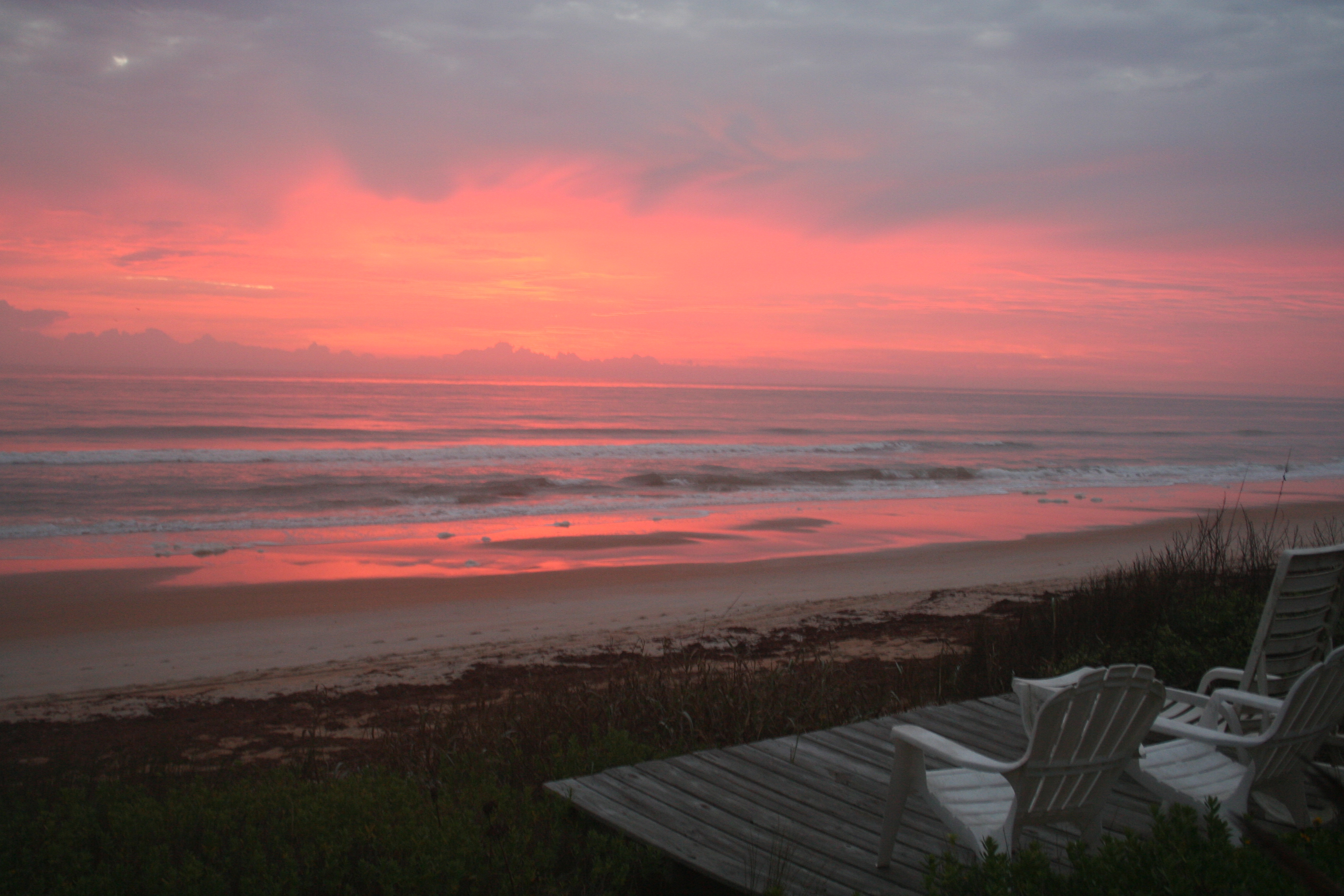
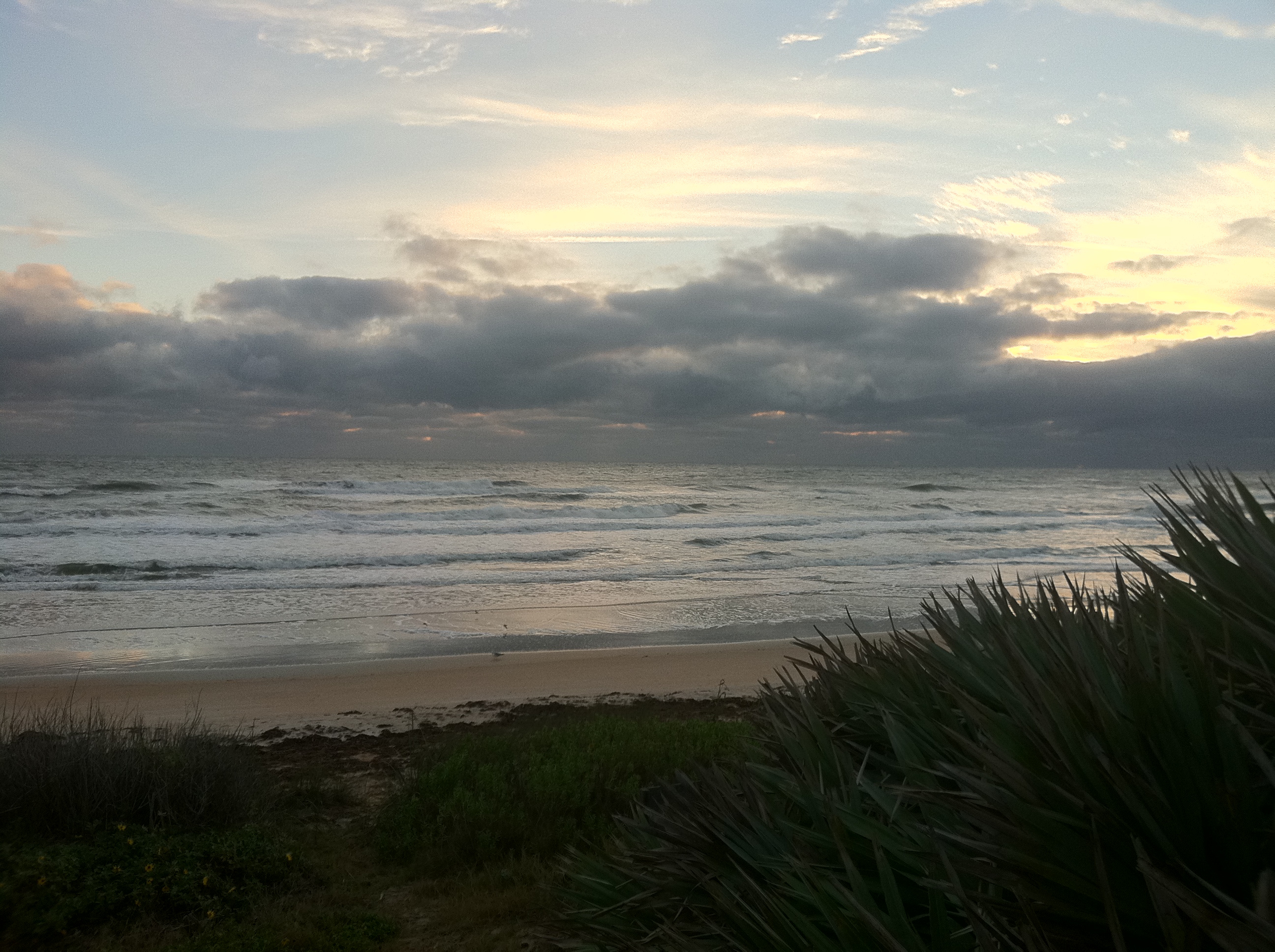
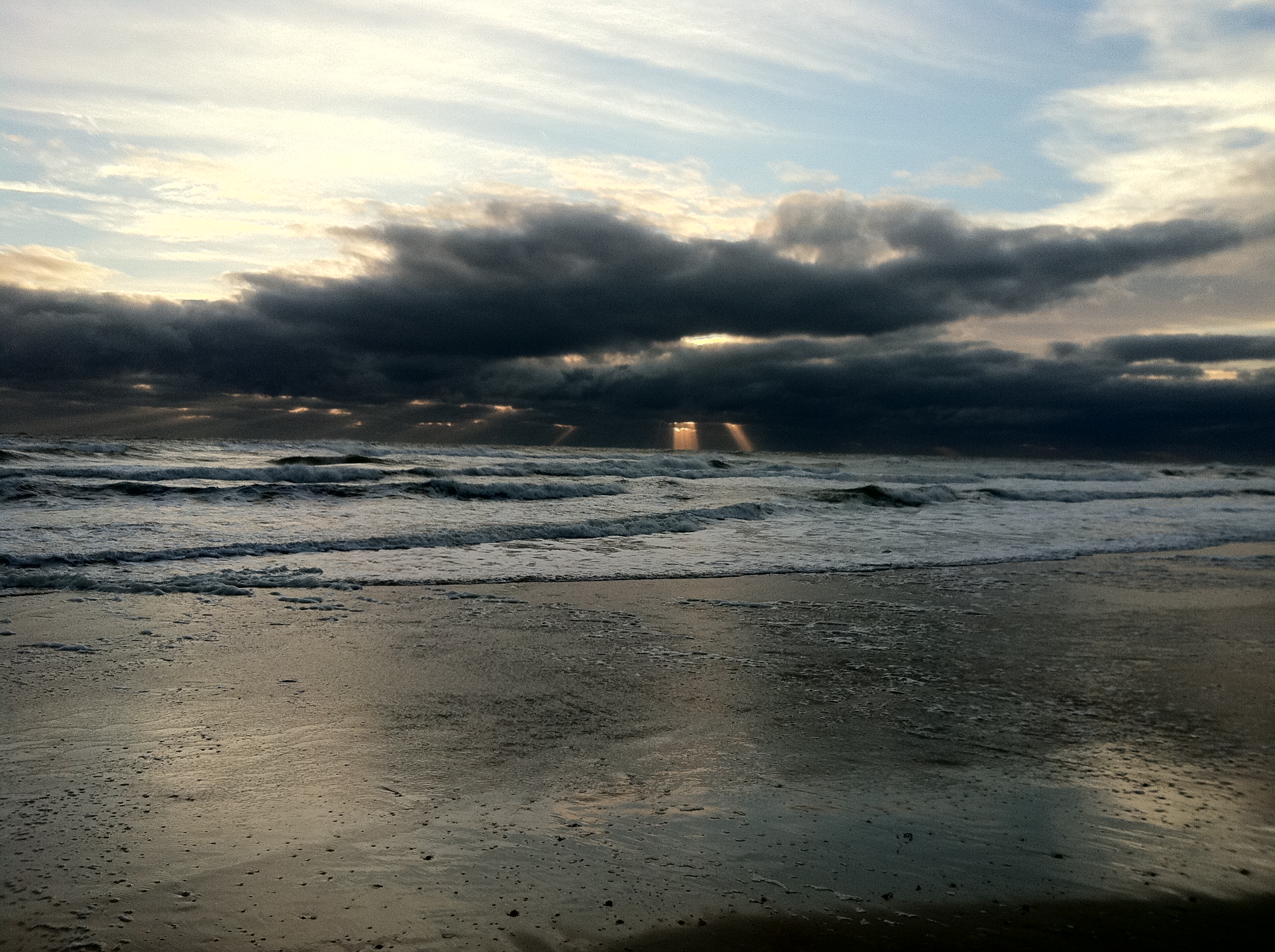
Several mornings, the sunrise was nothing short of spectacular, with just the right placement of clouds to hold and spread the intense coloration.  Afterwards, the light seemed unusually playful in and outside the house, imbuing both furniture and living things with a sharp-edged glow.  The geraniums, in particular, were radiant.  I think it’s something about the fuzzy texture of their leaves that makes it so.

And we finally got some much-needed rain.  The overnight variety, that, gently merging with the sound of the surf, is the best sleep aid we know.  Colder again today, with a bracing north wind.  But it’s back to the seventies again tomorrow.  No complaints.

Posted in Uncategorized | 7 Comments

Forty-five Below on Skinny Island!

After an unusually mild December and January, and half of February, winter finally sagged onto Skinny Island from the north early today.  It was preceded by much-needed rain Friday night, an hours long soaker that replenished our rain barrels, and then increasingly cooler north winds Saturday, a teasing day of sun and clouds that saw the high temperature for the day occur at about 10 a.m.  A record low of 30 was recorded at the airport, several miles south and inland from here, but moderated by the ocean, which as of last night was holding at 62, we bottomed out at 35.  That’s the commonly accepted Farenheit temperature, of course, but we have developed and adopted a new scale, which we will explain shortly.

A fast-moving band of dark gray cloud was revealed out over the ocean at first light, obscuring the actual sunrise, the northwest wind relentless, but there was an empty, invitingly wide beach between tides, and donning a seldom worn, fleece-lined, hooded parka, we headed north, into the wind, for our morning constitutional.  Through breaks in the clouds the sun cast heavenly rays to the water and briefly illuminated clumps of foam washed to the sand that vanished in the wind in seconds.  A scattering of shore birds hunkered down, and a single osprey made slow progress 80 feet up in the wind.  The wild ocean broke in 8-foot waves a hundred yards out, the blown spray of their cascading tops silver against the Payne’s Gray bank of clouds.  Head down to keep the hood from blowing off, and hands freezing despite being buried deep in the jacket pockets, we pushed on to our turnaround point.  There, the sun emerged above the clouds, and with the wind now at our back and the sun in our face, the return trip was almost comfortable and accomplished in almost half the time.  Exhilerating, with eggs and grits the payoff.

* * *

And here’s the new seasonal temperature assessment scale, henceforth known as The Skinny Scale, to which we now adhere.  Having determined, through years of trial and error, that our optimal functioning and comfort occurs at and about 80 degrees Farenheit, any temperature falling below that standard will be expressed relative to it.  For example: it was 35F here this morning, now expressed as 45 Below.  As this post is being composed, it is about 52 outside, or 28 Below.  We keep the temperature inside the Little Hacienda at 8 to 10 Below.  And so it goes.  Tomorrow morning we expect again to experience temperatures in the 40 to 45 Below range.  This is, as stated, a seasonal scale, meaning we only apply it in the cooler months.  It would be senseless to apply it in summer, because there is no upper end of temperature corresponding to a diminishment in function or comfort.  Heat-induced somnolence is not a loss of function; it is equilibrium.

Posted in Uncategorized | 5 Comments

Lessons in Impermanence

We apologize for the lengthy absence of The Skinny Island Post.  We took a long walk and are just now getting back.

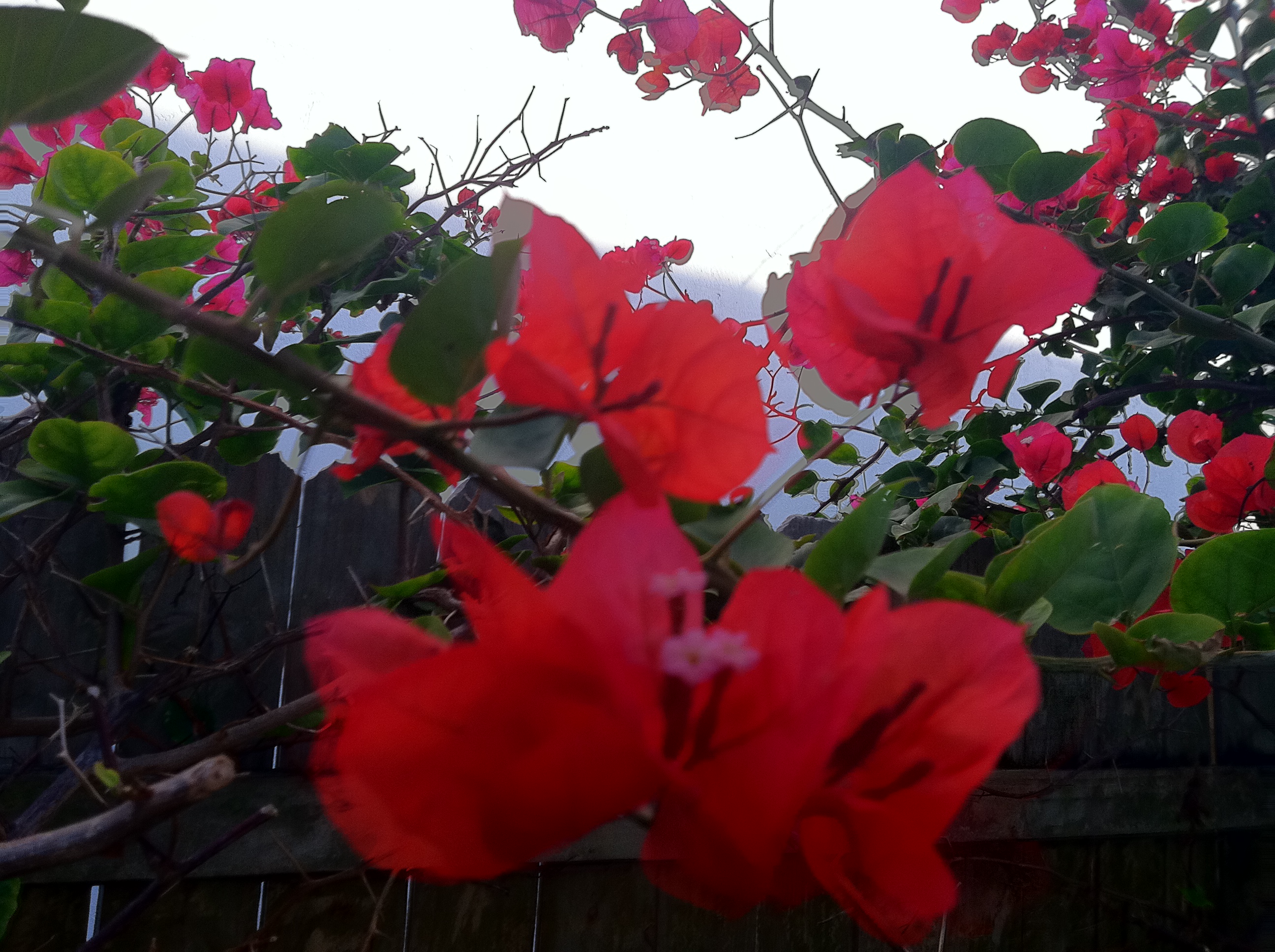
It’s been an unusually mild winter here on Skinny Island.  If memory serves we’ve only had a couple nights down into the mid-thirties; no freezes; and an abundance of spring-like weather since October.  January, especially, was one for the books, with a big majority of days topping out in the upper seventies or low eighties, with pleasantly cool nights.  No complaints here, but it has disturbed the natural balance of things.  The anoles, for instance, our little brown lizards, think its spring, and are out in full force and full combat gear, flaring their red throat sacks, and doing their menacing little dance for competitors.  The Bougainville is blooming madly, and we are going around in shorts at seven in the morning.  Most unusual.    We have some nice lettuce up, along with the old, persistent rosemary, and some dill, parsley, and cilantro, and we are tempted to plant the whole spring garden, but there lurks the memory of February and even March freezes, so we will hold off.  There is no rush, after all.

The weather has been so grand, in fact, that we have become enthused about surf fishing again, after many years of not so much as wetting a line.  We have gotten all the gear out, reorganized the tackle box, and made new leaders, but the same balmy, tropical winter that has provoked the itch again is responsible for our greatest impediment, Snowbirds.  There is a nasty little group of four or five of these invaders who reside in a nearby condo from October to April, and led by a gangly ex-commercial fisherman from Michigan, whom they follow and admire as if on a playground, (and that is what Florida is to them, after all,) they have literally taken over the beach.  The few attempts we have made to stake out a small section of beach, directly in front of the little hacienda, I might add, have been thwarted by a phalanx of rods, chairs, and $300 rolling, fat-tire carts.  They each set up a minimum of four rods in tubular holders, then sit and talk, while occasionally glancing at the rod tips for any tell-tale action, and they actually manage to catch fish in this despicable way.  We view fishing as a solitary, meditative experience, a focused, mindful endeavor with finger to line, but they have to make it a casual social event, like everything else they do.  Why is that?  A section of beach seventy-five to a hundred yards wide is thereby effectively out of play, and I’ll be damned if I’m going to walk a hundred yards out of my way to set up when it’s essentially my beach.  Well, technically not.  It is down to the mean high water mark, but they are generally ocean-ward of that.  We’ve been thinking of going all Local (not necessarily loco, but close) on them like surfers do at their home break, and running them off the beach, but we have so far refrained, guided by the deep breath recognition of the impermanence of this situation.  They will eventually return north, and all will be well and right again.  There will be plenty of good fishing weather come spring, better, actually.  It is a cyclical thing, and if we have learned anything here on Skinny Island, it’s the cyclical, impermanent, but interrelated nature of everything.

For example: the yearly cycle dictates that the beach be full of shore birds this time of year, but it’s not.  There are maybe three kinds of gulls, but far fewer, a scattering of terns and black-bellied plover, and almost no willets.  That’s because the winter overall has been mild in the north, from where these guys migrate.  And it’s probably no coincidence that we saw four willets just this morning, a couple of days after a big snow system moved across the plains and into the Maritimes.

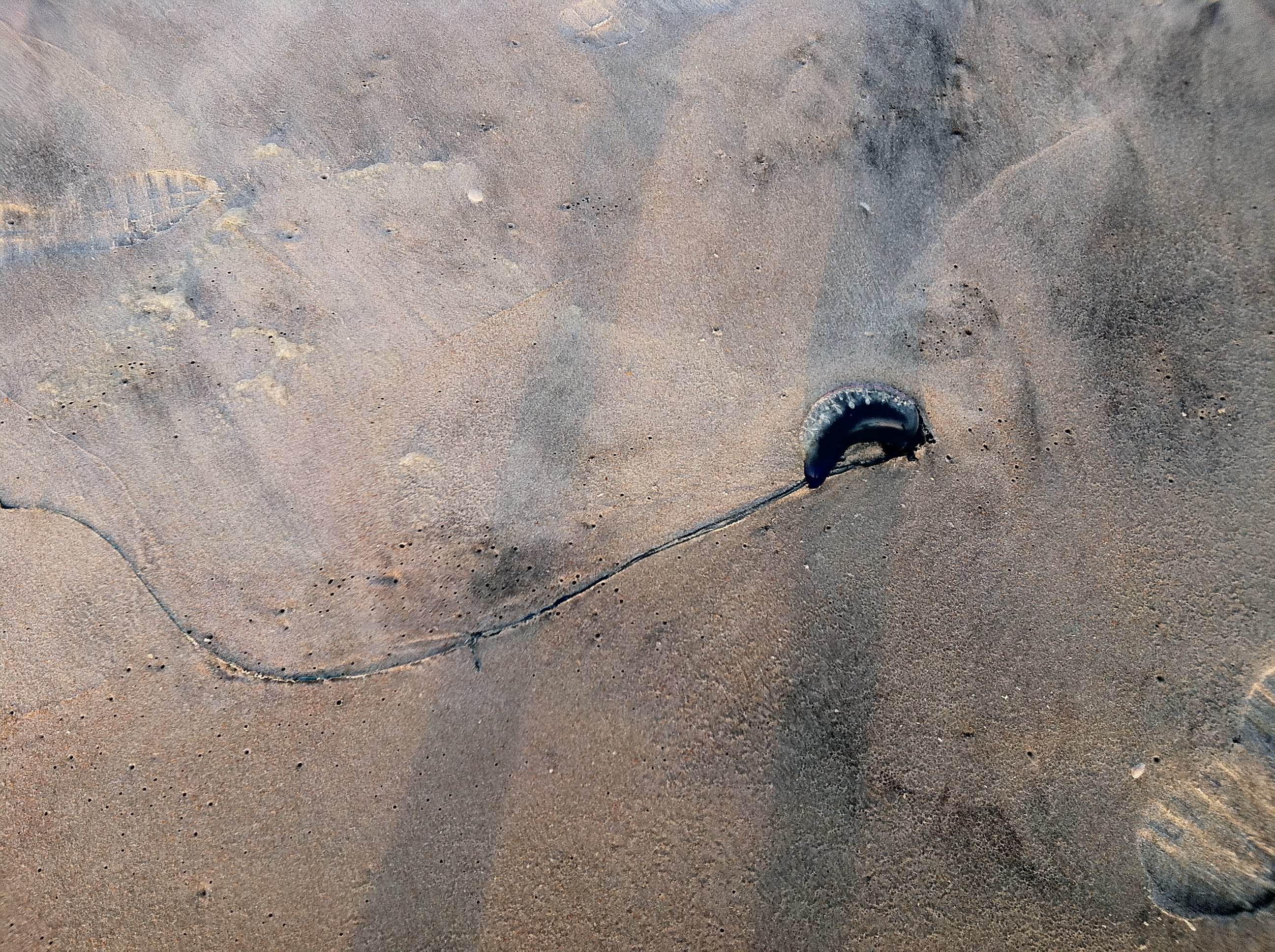
We have always seen the ocean as the one constant, but that, too, is wrong thinking.  Oh, it is always out there, and provides a kind of enduring comfort for that, but in truth it changes not only seasonally, but daily, hourly, and moment to moment.  Early this past week, for three days, it was flat calm, clear and green, with just a slight west wind grooming.  Then the wind swung around through the south and back out of the east, and the whole mood and character of everything nearby changed.  On one of our morning walks we saw many of these small Portuguese Man O War washed in.  This was actually one of the biggest; the majority were tiny– two-inches or less– with a single tentacle of two feet or more, their perfect little gas-filled sails an iridescent indigo.  They have no independent means of mobility; the bag acts as a sail in the wind, but it is a craft without a rudder, and when an east wind blows long enough, they blow ashore.  That’s they way it is.

A day later there was this Loggerhead turtle, quite dead, having been deposited by a retreating tide early in the morning.  It’s hard to determine age just looking, but the barnacles say it had some years on it.  They can live two-hundred years and more, so who knows.  Of great fascination to me is the fact that the females always return to the beach on which they were hatched to lay their own eggs.  We didn’t learn the gender of this one, but assuming it’s a female, it could have been depositing eggs on this stretch of beach beginning in the Second Spanish Period.  A long time, but still the blink of an eye.

Closer to home, both literally and figuratively, we were treated to a further lesson of the certainty of impermanence in the realization that our extensive system of wooden decking is dangerously deteriorating.  We moved into the little hacienda sixteen years ago this month and, after knocking out a few walls, framing doorways, tiling and painting everything inside, we built a wooden walkway around the perimeter and out to the road, and a large deck down the slope behind the house, all of high quality pressure-treated lumber, which we treated at least once, as I recall.  We also built 10 by 10 foot deck across A1A on the dune.  About a year ago we started noticing some of the boards were coming up on the ends, and when we checked we learned that the nails were corroding through, while the lumber itself, though severely weathered, was holding up well.  Since then we have gone about periodically, and as discovery dictates, putting in new nails.  It has become hard to keep up.  Sixteen years of salt air has done a job.  Now we are seeing that some of the wood is decaying, especially on the ends, but only in certain places.  On the beach deck, and on the sections around the house that get full sun and little to no shade through the day, the wood is holding up nicely.  But on the back deck, under the Florida Bay trees that shed leaves year-round, more and more deterioration of the wood itself is showing up, along with more nail decay, and we attribute this to the acidity of the leaves we constantly have to remove, many of which fall through the spaces between the boards.  The vulnerable sawed ends, though butted end to end, are being affected in places.  A full-on replacement at this stage seems impossible, from both a financial and energy-expenditure standpoint, so we are looking to just patch and repair as needed for as long as we are able.  I remember thinking it would last a lifetime.  It’s going to be close, I think.  From this, and all the aforementioned, we are learning.

* * *

And now a few words from the Feral Poet, who tells us he’s going to sit facing a wall for nine years, or until he figures things out, whichever comes first.

Conjugation

whatever is, is right
whatever is, is
whatever is
whatever

No Noise

the noise
abates
on listening

finally,

there is
nothing
to say

* * *

Posted in Uncategorized | 2 Comments

Day 10: Adios, Madrid (Isn’t it pretty to think so)

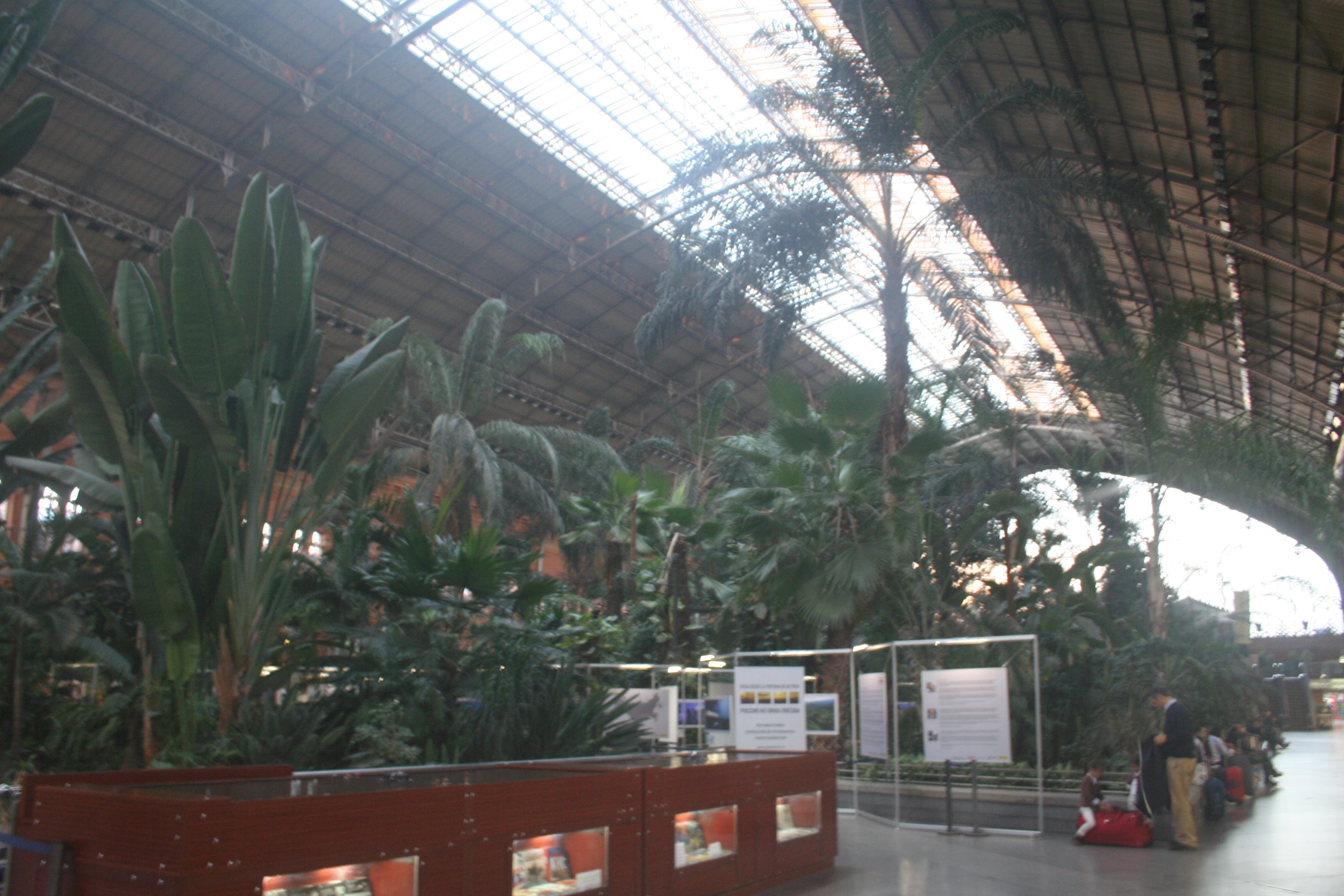
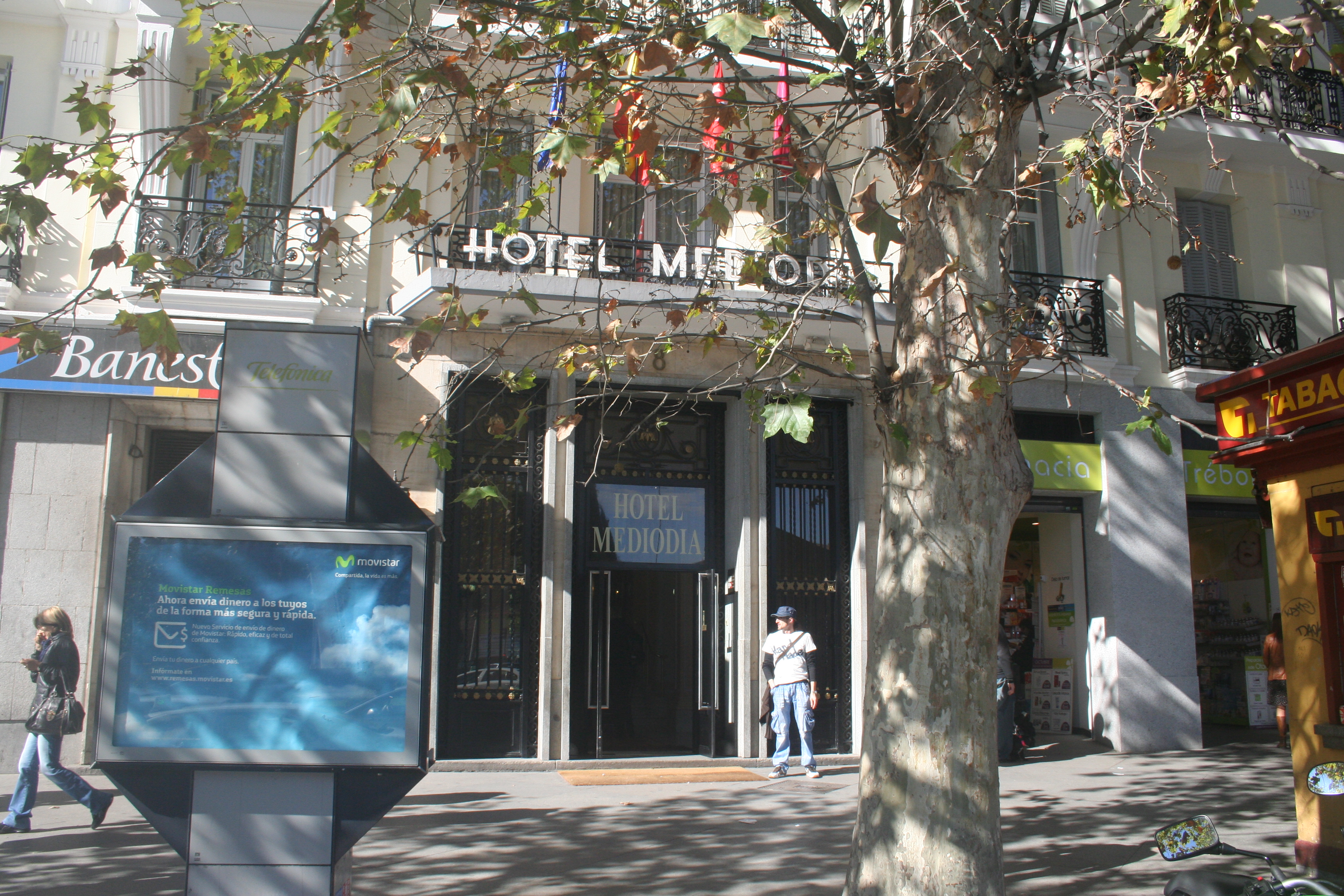
Last breakfast with the wonderful gang we traveled with.  Sat at table with couple from Vancouver who are on their way from here to Barcelona to catch a cruise ship which will take them down the Med, past Gibraltar, and across the Atlantic, docking finally in New Orleans, from which they will fly home.  Everybody else heading home.  Said our farewells, then rolled our bags a few blocks to the Metro, where we caught train back to Atoche and the Hotel Mediodia.  As expected, room would not be ready until 2, so with minimal assist from very rude clerk we stowed luggage behind the desk and crossed over to the great Atoche Train Station to hitch ride to Toledo.  Alas, trains were full until early afternoon, when we’d hoped to be back.  Still much to see in Madrid.  So, with a new plan, we got back on the Metro and rode up to Plaza del Sol for look at Cathedral and the Convent.

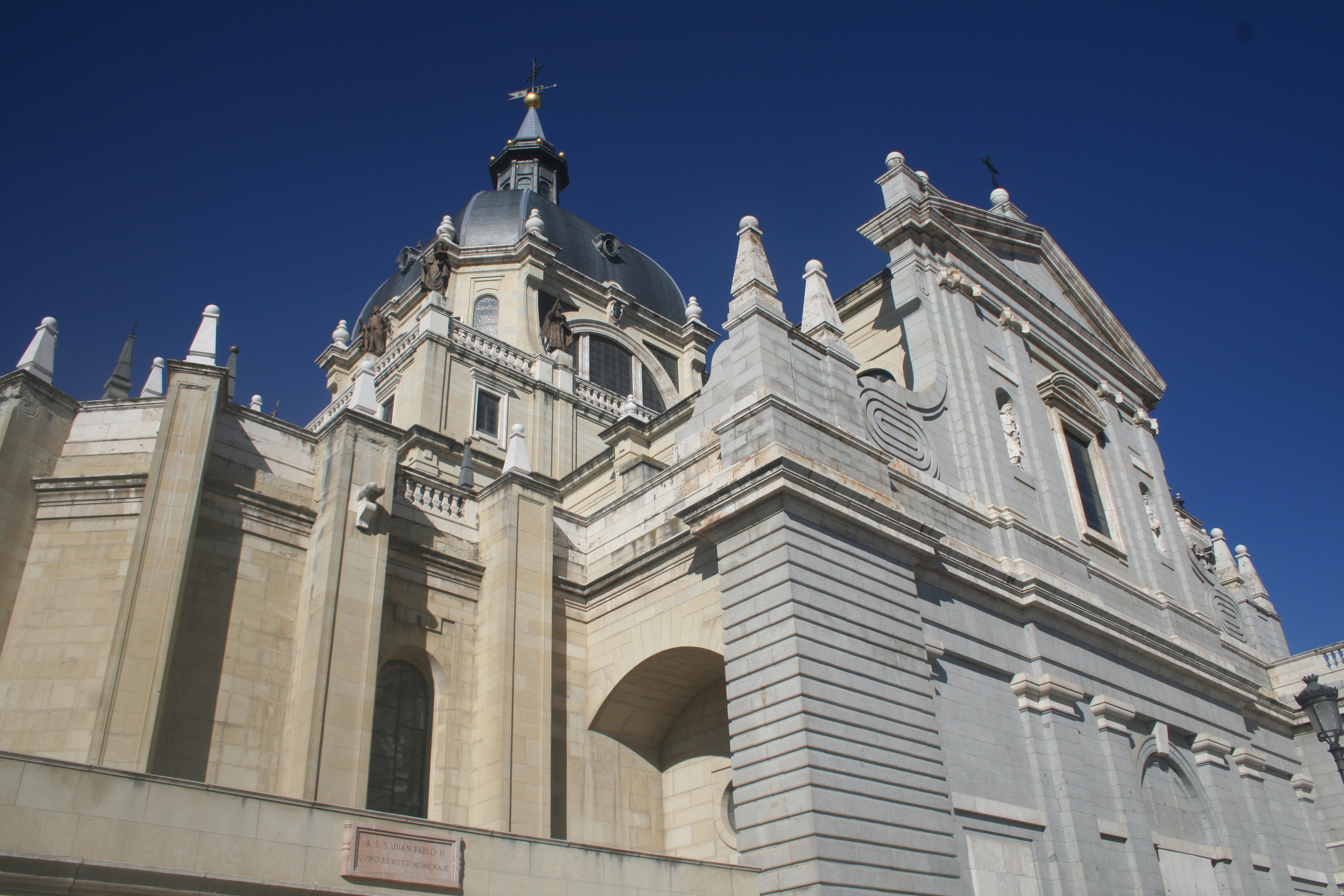
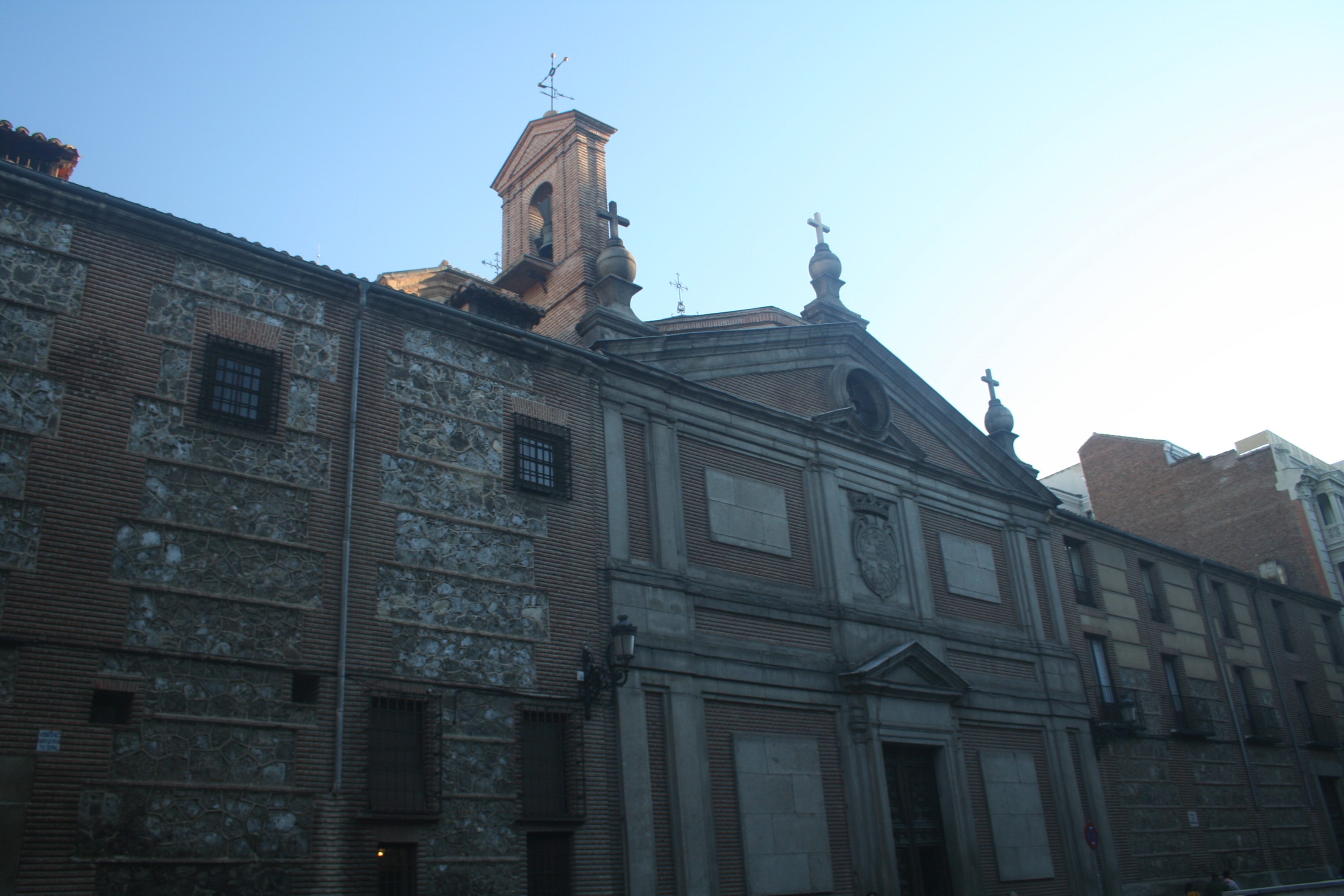
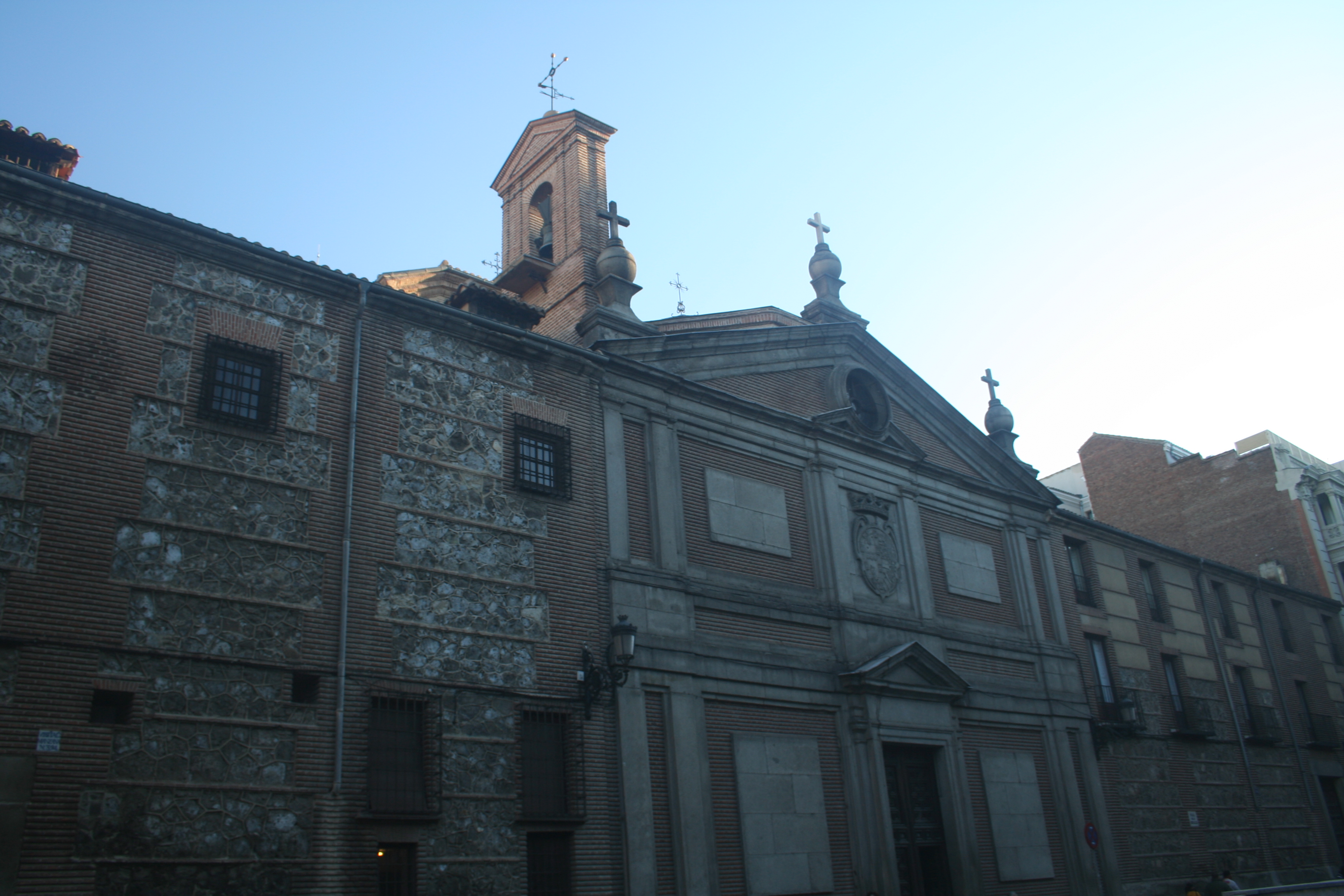
We found the Madrid Cathedral, and went in briefly.  It is a beautiful structure, but quite recent, compared to most of the other churches and buildings we’d seen.  When the capital of Spain moved from Toledo to Madrid in 1561, the seat of the church remained in Toledo.  The capital had no cathedral until construction began on this one in 1879.  Work ceased completely during the Spanish Civil War, and the project was then abandoned until 1950, and it was not completed until 1993.  Too new to really be of much interest.  We wandered down to the Convent de las Descalzas, and got tickets for an English tour starting in a half-hour.  Just enough time for a coffee at a cafe a short distance away.   Saturday morning, and the streets off Plaza del Sol, and Plaza Mayor were starting to fill.  We went back to the convent and met our guide, a lovely Spanish woman who spoke English in a rich, textured accent.  We sat in a small ante room inside while our group filled (more evidence of how uneducated we Americans are; the rest of our tour, in English, were Germans and Spaniards; don’t think we could have done the German tour) and then we were off for a walking tour through this remarkable place. The building is the former palace of Charles I of Spain and Isabel of Portugal. Their daughter, Joan of Austria, founded this order of the Poor Clare (Franciscan) nuns in 1559.  That’s interesting enough, but through the end of the 16th and into the 17th century the convent attracted young spinster or widowed noblewomen, who each brought with her a pretty hefty dowry.  The result being that the convent became one of the richest in Europe, with many of the dowries invested into relics and bejeweled exhibition pieces. Some of the relics housed at the convent include purported pieces of Christ’s cross and the bones of St. Sebastian.  Among the priceless works of art on display are Titian’s Caesar’s Money, Tapestries woven to designs by Rubens, and works by Hans de Beken and Brueghel the Elder.  Over time the demographics of the residents changed, and by the 20th century all the sisters were in poverty.  Nineteen cloistered still call the convent home, and utilize the extraordinary chapels we were able to see when the building is closed to visitors.  As we saw in the Seville Cathedral, there are dozens of small chapels lining the corridors, each dedicated to a particular saint, and most containing great works of art, or significant relics.  The architecture and construction of the building reflects, of course, its role as a palace, with tile and marble everywhere, including long stair case bannisters carved from single chunks of marble.  Unfortunately, no photographs were allowed. We thoroughly enjoyed this place, and though we heard bells from time calling them to various tasks and offices, we did not see any of the secretive nuns.

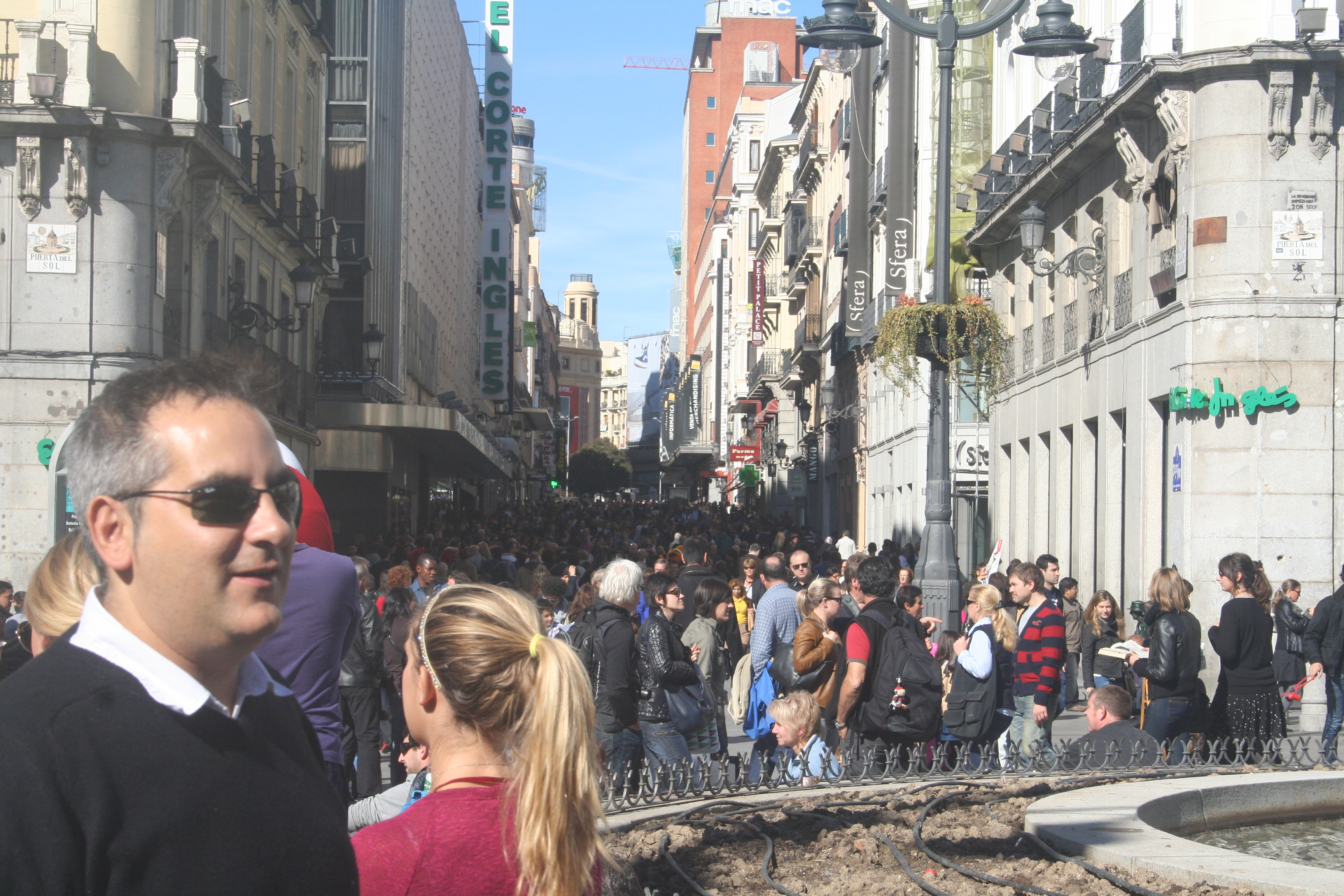
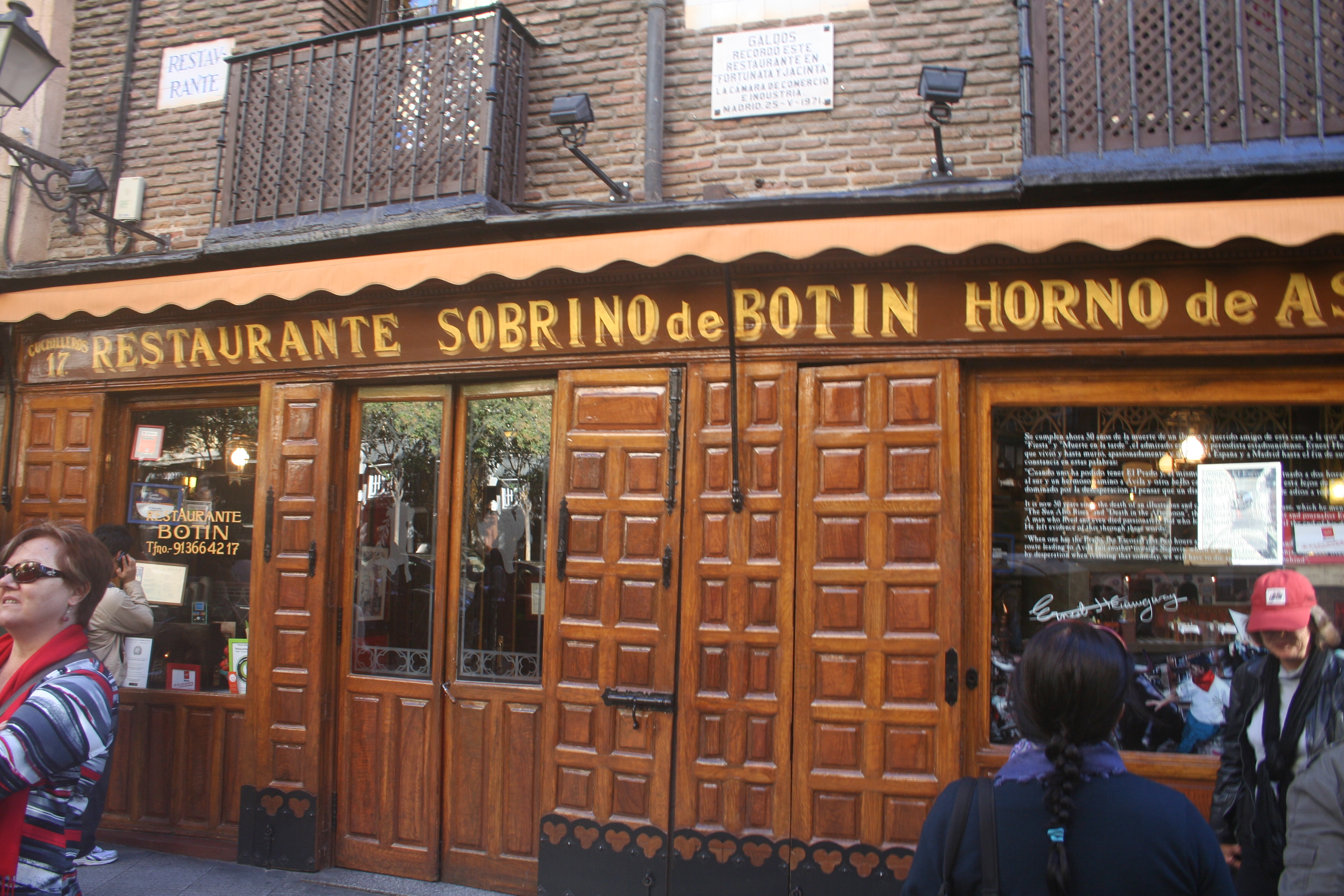
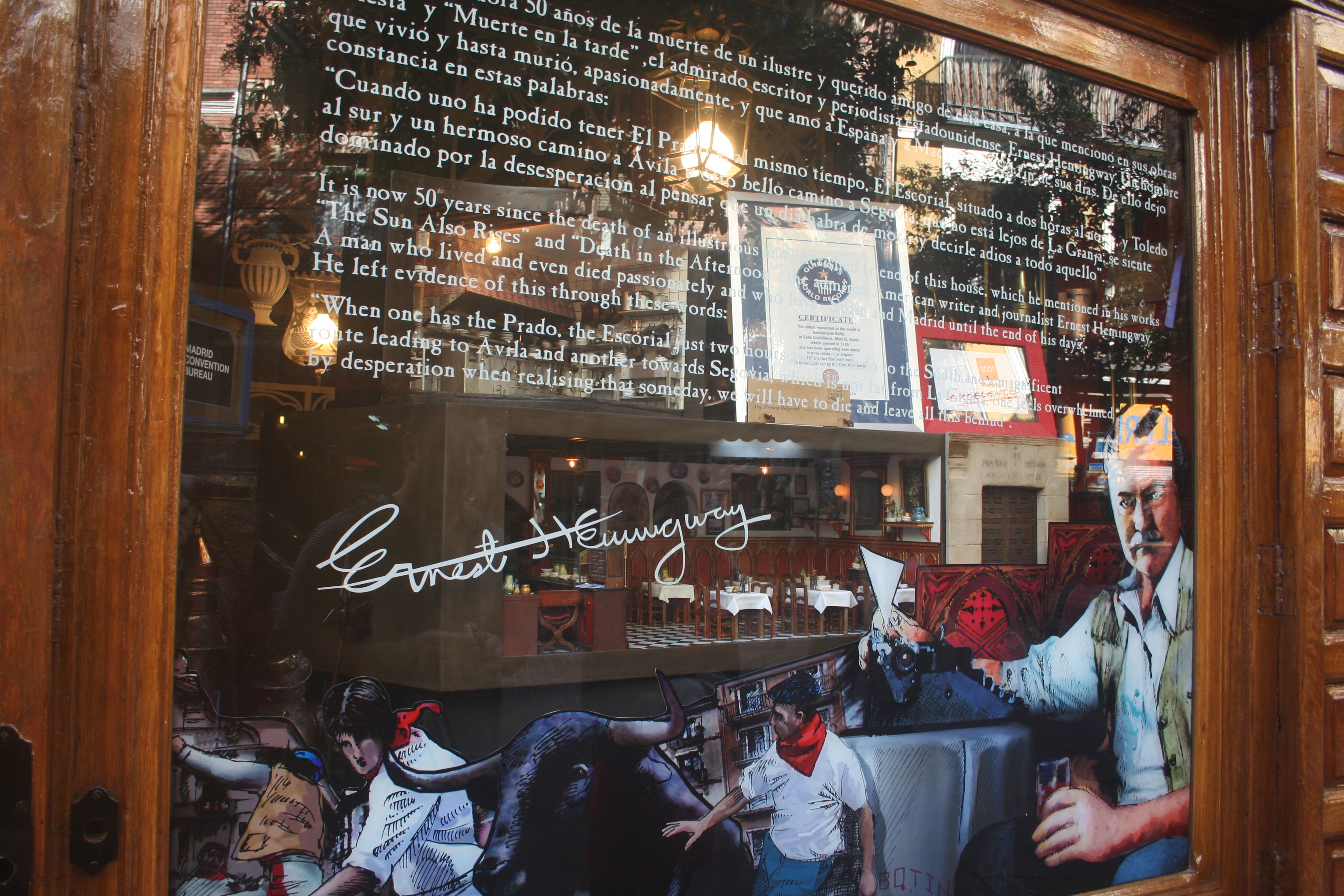
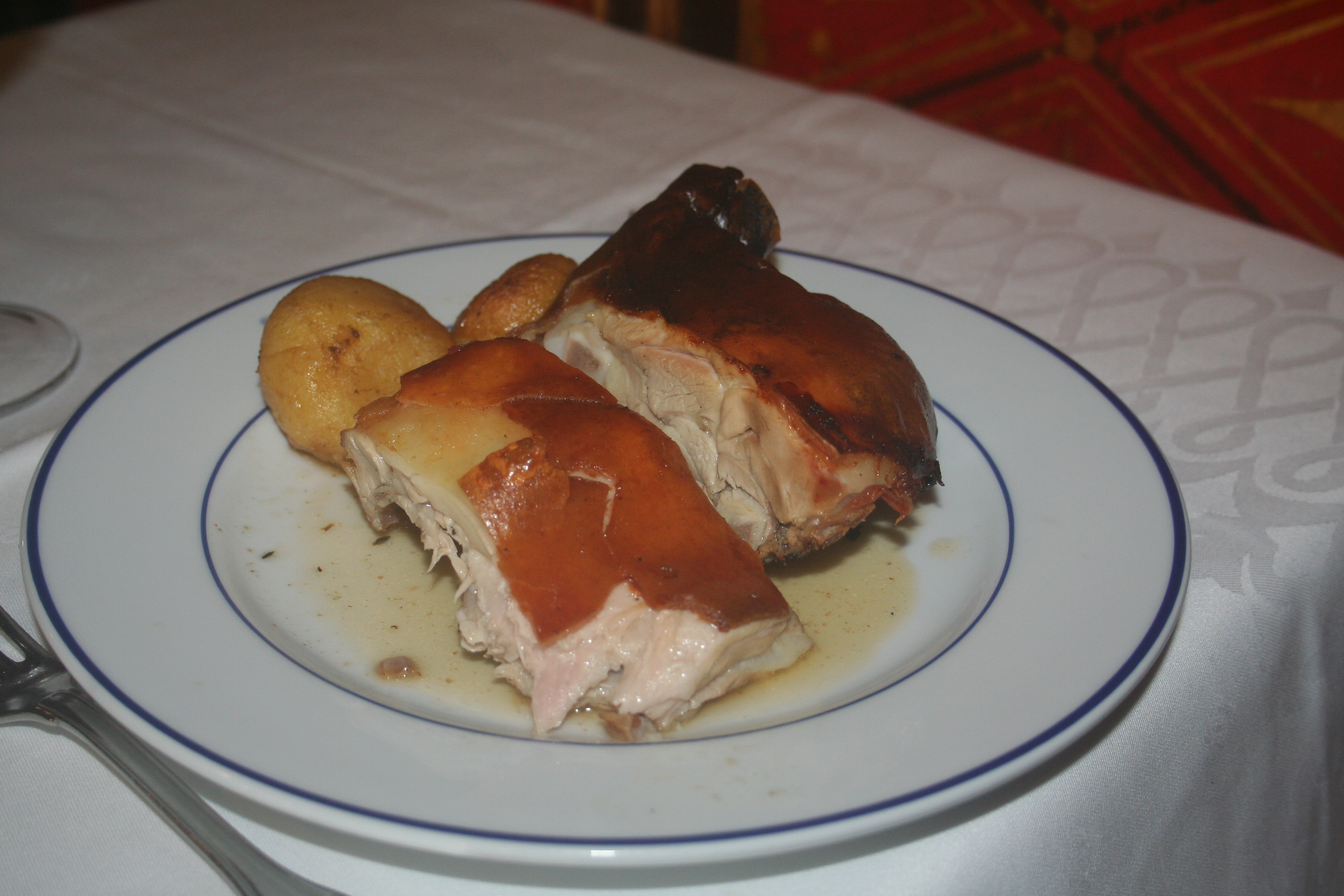
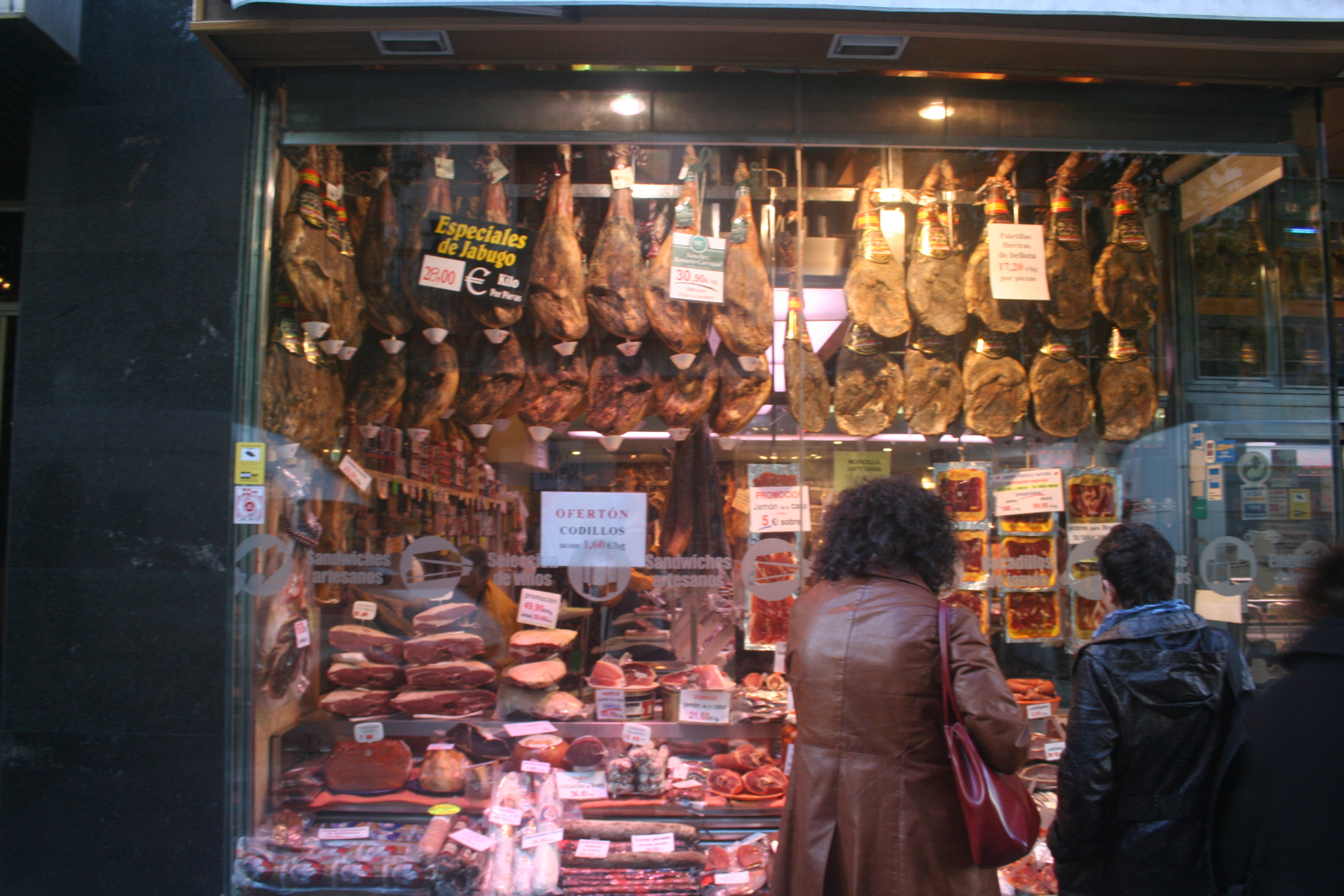
Back out into the street and squares then, the Saturday crowd at full force.  Truly a remarkable sight.  With a little luck and a great deal of perseverance we found one of the last places on our must-see list, a restaurant called Sobrino de Botin, established in 1725, which the Guinness Book of Records lists as the oldest eatery in the world.  Besides that amazing distinction, Francisco de Goya worked there as a waiter while waiting to be accepted into the “Royal Academy of Fine Arts,” and, as attested on the front window, it was Hemingway’s favorite restaurant in Madrid.  It is the place where Brett and Jake have lunch at the end of “The Sun Also Rises.”  When Brett, to paraphrase, says they could have had such a wonderful time together, Jake replies, “Isn’t it pretty to think so?”  One of the great last lines in all literature.  It opened for lunch at one and we got there at quarter til.  I went in and asked if we could get a table, and the very kind gentleman said, yes, he would hold one for me in the small front room just off the entrance, where there were but six table.  We went out and waited, and then were promptly seated at one.  We could see the doorway and all the people trying to get in, and we quickly realized how lucky we had been.  Right away, our little room filled, and after that, if you didn’t have a reservation, you weren’t seated. The specialty of the house is roast suckling pig, so that’s what we ordered, (sorry vegans) and a pitcher of Sangria.  One little pig is plenty for two people, and came with roast potatoes as well. Superb!

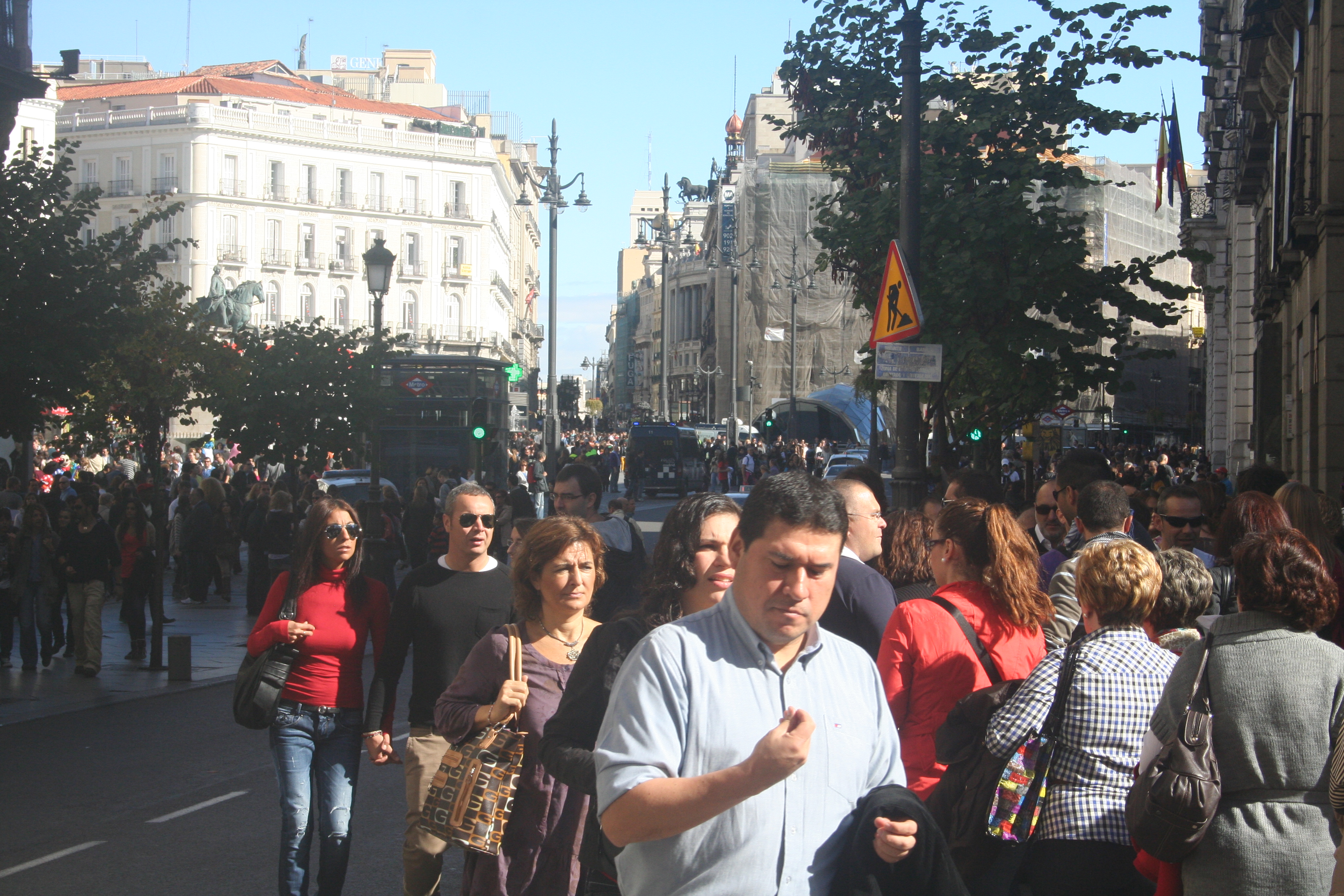
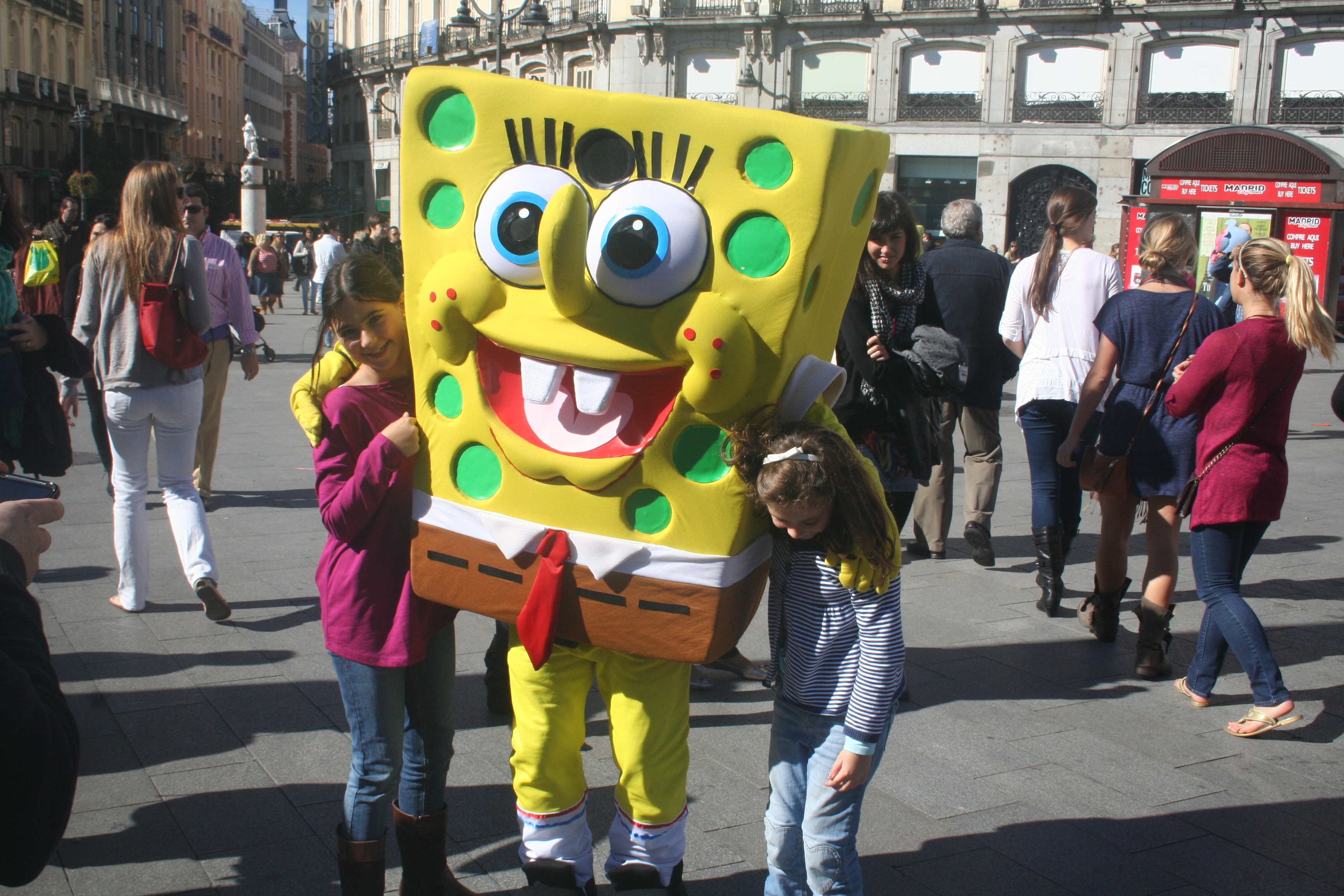
Quite satisfied after our lovely lunch, we went back out into the sun and up to Plaza de Mayor on our way back to Sol and the Metro down to Atoche.  A festival atmosphere reigned.  People were out with their families; young, old, everyone mingling, shopping, flowing in and out of the many tapas bars and restaurants.  The square itself was just about shoulder to shoulder, and even included SpongeBob!  We Leisurely strolled through the crowd, adapting to its laid-back, happy energy, and cruised the wonderful shops on the streets between the squares.  Veteran Metro riders by now, we easily negotiated the changes, and were back walking through the doors of the Hotel Mediodia in fifteen minutes.  Upstairs for a much-needed nap, and then it was back out to the street for the short walk up to the Prado Museum, our last stop in Spain, and which had free admission after six p.m.

Apparently, every teenager in Madrid had found their way to the great round-about at Atoche while we slept.  It was absolutely amazing!  The boulevard up to the Prado is one of the most beautiful in Madrid, with a tree-lined walkway down the middle between the traffic lanes, and many trees on both sides, as well as shops and restaurants until the ample grounds of the Prado.  Another wonderful walk.  We were almost an hour early but a line for the free admission quickly formed, and we joined it early, enjoying the people watching. Inside, we picked up a map and decided to limit ourselves to seeing as many of the masterpieces conveniently highlighted as we could before we dropped.  The Prado is enormous, and houses one of the finest collections of European art, from the 12th to the 19th centuries, and is known for its many Goyas, as well as Valezquez, Titian, Rubens, and Bosch.  In all, there are some 7600 paintings, and thousands of sculptures, drawings, and prints.  Many of the paintings, in the Spanish style of the 15th and 16th centuries, are absolutely enormous, and even the limited tour we allowed ourselves, (it would take days to see it all,) was overwhelming.  It was incredible to be standing ten feet away from paintings we had seen in art history and humanities books, and this visit pretty much completed our tour of the world’s great museums.

Back to our hotel room for a light supper of bread and cheese, needing nothing more after that wonderful lunch, then early to bed to be up in time to get across the square for our 6 a.m. ride to the airport.  It is done, but allow a few impressions.

This was a trip we had long wanted to take, and we are very glad we did it the way we did, as part of a tour group.  It was fast-paced, and we didn’t get to stay in one place as long as we might have liked, but we saw a lot of both countries as a result, and it was way more relaxed than trying to find our way alone.  The architecture, art, landscape, food, and music were so rich, and the people, while we didn’t really get to know them, seemed amazingly resilient, happy, and potentially friendly, had we been able to slow down and make the effort ourselves.  It is a strong, deep, and exceptionally vibrant culture, and we were saddened to learn, in our conversations with our guide, Luis, how difficult times have become for both the Spanish and Portuguese people.  Both are on the verge of financial collapse, and Portugal is losing population.  A way of life that has spanned many centuries seems on the brink.  But they continue, and revel in their unique traditions.  Most people live in the cities, but even there they shop at fresh food markets every day, eat and drink very healthily, and walk everywhere!  There is no obesity problem, that we could see, in Spain, and, in fact the people were quite thin and handsome.  It became something of a joke with us– all the women were size 4 or 5!  It was like they were stamped out of a machine in that respect, and most remained quite lovely into old age.  But there were also disappointments.  Spain has become very expensive.  As recently as ten years ago it was possible to find an apartment or small villa in Spain for the equivalent of a few hundred dollars a month.  Food and services were cheap.  We have long entertained a romantic notion that, on retiring, we might spend a few months a year in Spain, immersing and learning the culture, living that good life.  We’ve let go of that now. Like so much of the world, it isn’t like that anymore, but hey, isn’t it pretty to think so?

Posted in Uncategorized | Leave a comment

Day 9: Madrid

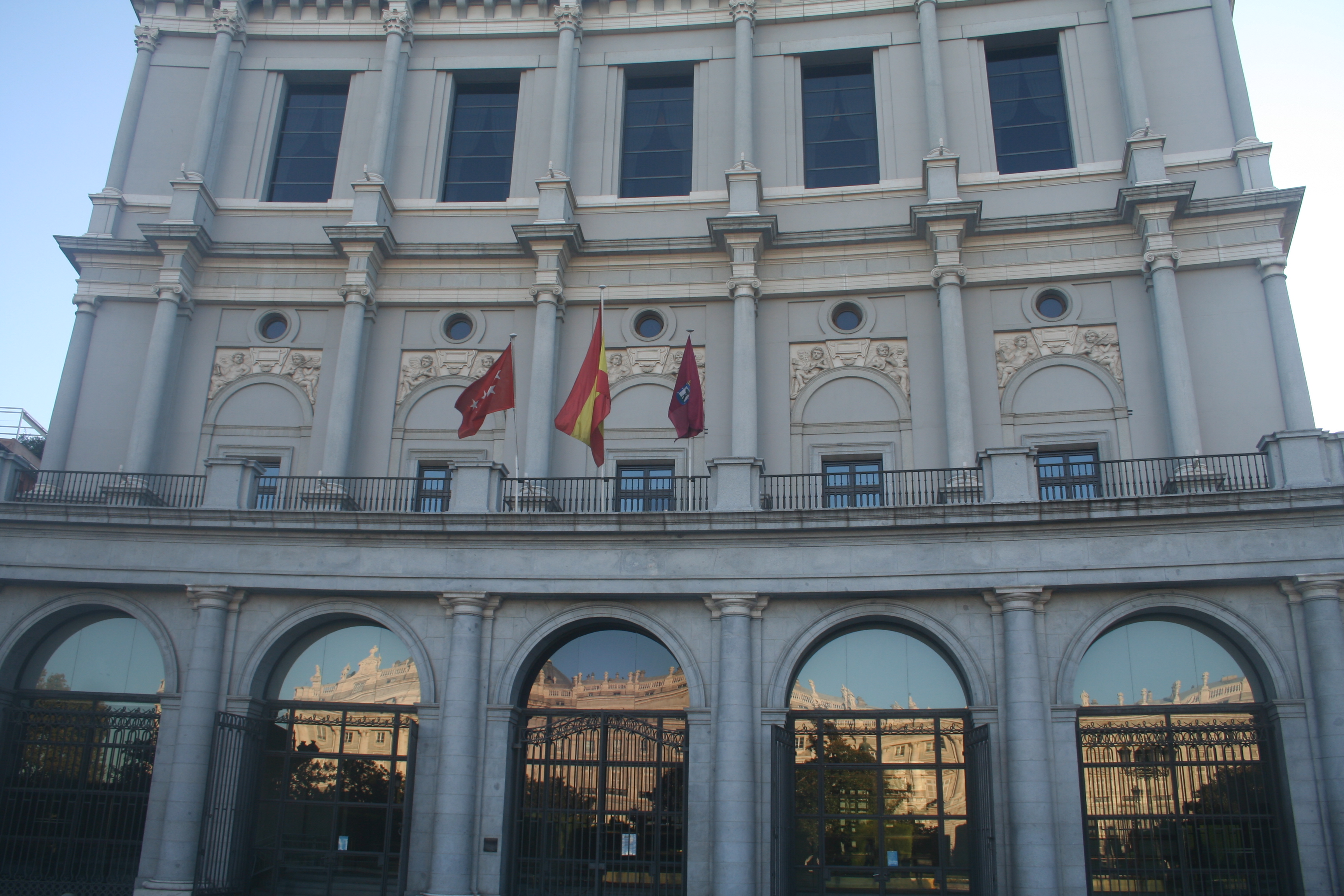
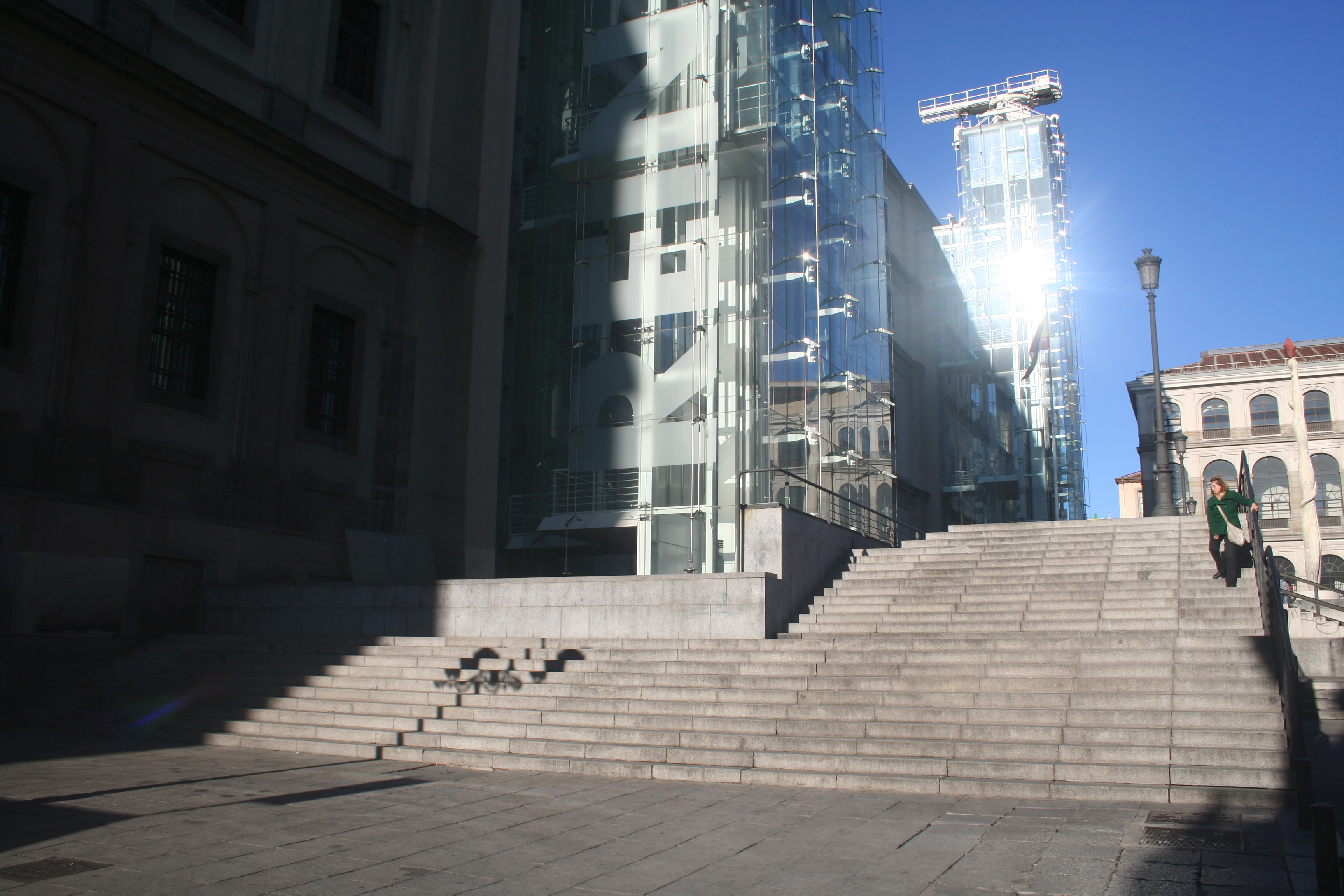
Nothing with group until afternoon, so after breakfast we hoofed up to the Metro station in cool, clear weather for easy, one change trip to old city center.  Scoped out Madrid Opera House, then went looking for the Convent de las Descalzas Reales, which we had picked out of our guide-book as a must-see.  We got there a few minutes before it opened at 10, and were a few back in line, but on entering we learned there would not be an English tour for a couple of hours.  We opted to go in search of other treasures.  More on this remarkable place later.  We ultimately did get in.  We really wanted to get into the Reina Sofia Museum, which was right next door to the hotel we’d be staying in the following night, after the tour ended.  We would be staying an extra day in order to make flight connections.  We had learned that the famous Picasso, Guernica, how hung in the Sofia, after a long and contentious journey around the world.  So we hopped back on the Metro, getting off at Atoche Station, site of the terrible terrorist bombing in 2004.  The Hotel Mediodia is just across the square from the station, chosen by my intrepid companion, because that is where the bus to the airport would depart Sunday morning.  We’d just have to haul bags a short distance.  Little did we know it was also with walking distance of the two greatest museums in Madrid, the Reina Sofia, and the Prado.  Our plan for the next day was to take the Bullet Train from Atoche to Toledo, so we stopped at the hotel desk to inquire if we could drop off our bags the following morning for safekeeping until the room was ready.  Assured we could we went around the corner and into the Reina Sofia, a very modern, airy building.  Spent a long time in the Cubist section, then went in search of the 1930s collection, of which Guernica is a part.  Many, many Picassos– so prolific, he was; we’ve seen great collections in Paris, Antibes, Barcelona, Chicago, and now Madrid– as well as Dali, and Miro, plus numerous excellent Spanish painters we didn’t know.  Several classes of local school kids were there with their teachers.  Beautiful.  We found a group seated on the floor before the huge and astonishing Guernica, quietly and intently following a teacher’s explanation.  We stood and examined this masterpiece from several vantage points.  A depiction, in typical Picasso style, but all in varying shades of gray, of the bombing by German and Italian planes (at the behest of Spanish Nationalist forces) of the Basque town of Guernica during the Spanish Civil War.  11 feet tall, and 26.5 feet long, it is a stunning and lasting anti-war symbol.  From there we located an exhilarating 60s collection and, rounding a corner, were stopped in our tracks by a Mark Rothko, in its own alcove.  We are suckers for Rothko.  You stand in front of one, captured by the color and simplicity, and you say, Hey, I could do that; it’s just a couple blocks of color.  But no, you can’t.

We lunched in a beautiful open garden of the Sofia– jamom y queso, of course– before a Calder mobile, and reflected on our good fortune in having seen so many great collections and masterpieces across the world.  The art and architecture are the reason we do this kind of travel.  The other kind of travel we do– the camping and hiking trips– are about another kind of art and architecture.  Both have enriched our lives in immeasurable ways.   And the Prado was still to come.

We took the Metro back to the Hotel Prago for a little rest, then hooked up with the gang and a bus ride through town with a local guide.  The weather was beautiful, but maybe because the guide wasn’t very good, or we’d already seen most of where she took us, or we had spent everything emotionally in the Sofia, or we were just plain beat, it wasn’t very interesting.  Dropped off at the hotel, and not feeling up to tracking down another Spanish meal, we devoured a couple of Whoppers at a nearby Burger King, took a walk along the newly developed river front, and turned in early.

Posted in Uncategorized | Leave a comment