The Feral Poet

The Feral Poet & John Ashberry

In their infinite wisdom, the editorial board of The Skinny Island Post has elected to give the Sunday page to island resident The Feral Poet, at least for the short term, to do with as he sees fit. This is the only known photograph of The Feral Poet, the one on the left, pictured with the eminent poet John Ashberry, in the south of France in 1989. They had both just consumed a bottle of wine each, and The Feral Poet, wearing a bolo tie he picked up in a western shop in Paris, is doing his best to make sense of the world with the one good eye he has left. The far more experienced Ashberry is, as always, unflappable.

* * *

Golden Plover
Walk with me. The tide is out
and the sun low in the west
and dipping into that bank of clouds
there. Maybe we’ll have rain yet tonight.

to take the edge off the heat
and play Latin rhythms on the bedroom awnings.
There are plover and pelicans  and osprey out;
we’ll walk against the wind at first

and have it at our backs coming home.
It isn’t complicated. Little marvels
silently shared absorb us on the way,
you don’t have to say anything.

I think those are golden plover;
see how the light seems to come up from the sand
to ignite his breast. I want to live forever
but we’ll turn around where we always do.

* * *

Last Days
There isn’t much else to say.
We find a moment to listen
and it’s nothing like we remember;
birds plentiful as rain
when we were kids
flutter on the edge of extinction
and the few that do return
in spring to trees behind the house
sound somehow different now,
less convincing; maybe

I’m making this up. I saw
a pair of Cardinals this morning;
heard their song this afternoon.
A few doves skitter in and out of sight;
a single Mockingbird resumes
from a different quarter each time,
defining in a much too poignant way
the boundaries of this tiny,
ancient hammock by the sea.

* * *

When Radio Died
There are mysteries in the rain tonight
playing out across the island;

old synopses of fearful dusks
along the coast, sunsets in glass jars,

fireflies in the cemetery. My recollections
weave down a shell road in moonlight

to the music of my father’s cigar cough.
A fine Chevrolet rusts beside a phosphate pit,

its ebonite steering wheel big as the forgery
of love we committed in the name of family.

What is it with rain that wants to keep so much hidden?
We went our separate ways when radio died.

Posted in Uncategorized | 2 Comments

Thelma’s Place

One night, about three years before we moved into this old house, I admitted a patient with a very interesting story to the hospital telemetry unit in which I worked.  She was a frail little woman in her eighties, dehydrated and digoxin-toxic, meaning she had overdosed on her digoxin, not an uncommon diagnosis on our unit. We frequently admitted folks who couldn’t remember whether they’d taken their digoxin that morning, so they took another, and maybe repeated the sequence several days running.  The result being that their blood pressure bottomed out and they presented with extreme disorientation and confusion.  We were usually able to stabilize them and send them home in a few days, none of which made Thelma Burns’ story at all remarkable.  What did was that the EMTs who brought her in– they had been called by concerned neighbors– said she’d been living on her porch in a house up in Ormond-by-the-Sea, because the house was too full of junk to even walk through! She was apparently a hoarder.  One of the paramedics said, from what he could tell, the whole house was stacked floor to ceiling with books, magazines, newspapers, furniture, clothes, and all manner of odds and ends.  There was a small cot on the porch where they found her, but he didn’t know how she cooked and ate, or if she did.

She was fairly uncommunicative that first night, so I didn’t learn any more, I was off the next night, and when I returned she had been discharged.  Of all the hundreds of patients I treated, she and that little story are among the few I retain. It struck me as both sad and intriguing for some reason, maybe that she seemed so alone, and life had gotten away from her. But that’s not the end.

When we bought this house it had stood empty for more than a year, the realtor wasn’t really sure how long.  The owner was in a nursing home in Ft. Myers, and the sale was being handled by her POA brother, who wanted a quick sale.  When I saw the seller’s name, it rang a bell, but it wasn’t until after we’d moved in, in talking to a neighbor that I put the whole thing together.  The neighbor told me that when the prior owner moved out it took three days to remove and haul out all the junk inside the house.  Yeah, it was Thelma’s place.

The intrigue grew. When we moved in the walls of the rectangular flat-roofed addition on the south side of the house were lined with simple wood shelves on which were a number of fired clay pieces, pots, bowls, plates; and behind the house built into the slope of the dune was a small concrete block structure that appeared to have been a kiln! Thelma was apparently a potter.  And for several years we continued to get mail addressed to her from the Department of the Navy.  A navy potter.  The property records indicate there was only one owner prior to our purchase.  Thelma, or she and a husband perhaps, had built the place in 1949, and she lived here until the nineties, when she became my patient in Cardiac Care.  There’s a story in there somewhere, I can feel it.  I’ve started back-tracking through the records.  I’ll let you know.

Posted in Uncategorized | Leave a comment

Skimmers, etc.

Low Tide Beach

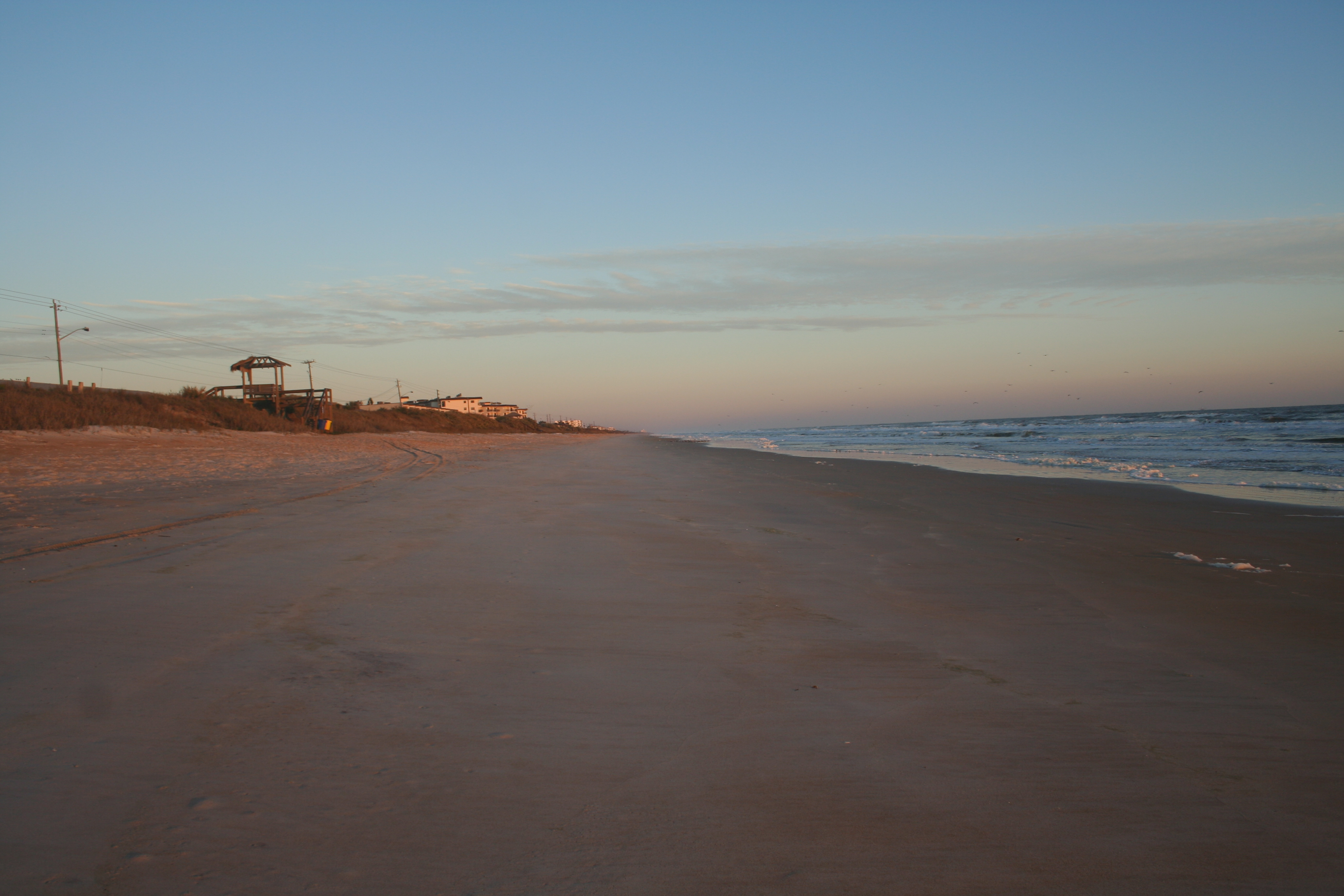
Cool and clear this morning; brisk walk on wide, low-tide beach, nobody else out but a few birds.  In spring and summer the beach is home to a wide variety of shore birds: Sanderlings, Stilts, true Sandpipers, Egrets, Ibis, Great Blue Heron, Night Heron, and three kinds of Plover. It’s fun to watch how their different adaptations dictate their feeding techniques. The short legs and short beaks of the diminutive Sandpiper only allow him to hunt for little crustaceans in very shallow water, generally in a retreating, spent wave.  The Stilts, with much longer legs and a long, somewhat upturned beak, can go deeper in both water and sand, and get the bigger stuff, like fat sand fleas.  Other larger waders, like the Herons, generally found in salt marshes and estuaries, apparently somewhat lazy, like to hang on the beach when fishermen are around and snag bait shrimp, mullet, and hand-outs.  The egrets are amazing fishers, stalking small prey in the shallows with their heads tilted to one side to see into the water, then striking with amazing speed and agility.  But the Night Herons are the real treat.  Half the size of an adult Great Blue Heron, they have shorter legs, neck and beak, and are a beautiful greenish gray. You have to be out early to see them; they’re gone as soon as the sun pops out of the ocean; but in the dusky morning light you find them standing statue-still, facing away from the ocean, just before the soft sand the tide doesn’t reach.  They love ghost crabs, and are extremely patient hunters.  They’ll stand in one place for ten or fifteen minutes, having located crab holes, just waiting for one to come out, (and come out they do; it’s crab nature to venture out to feed in the morning,) and when the do relocate, they do so very slowly and gingerly, so as not to create vibrations in the sand.  They move very quickly when needed though, catching the crab in their beak on the dead run, then manipulating it to the right position to swallow, a process that can take ten minutes or more.  It is a delight to watch.

Skimmers in Flight

In winter, all the aforementioned birds are absent.  In their place are a variety of gulls, and for the past three years, a fairly substantial colony of Skimmers, though this year their numbers seem to be smaller.  Last year they stayed together as one unit; this year they are mixed in with the gulls for greater numbers.  They are clearly unmistakable, though, one of the most elegant, beautiful birds you can see.

I came upon two separate groups of them on my walk this morning, ten or so in each group mixed in with a larger number of gulls, and got some good photos of them in flight. They have black feathers on top of the wing, with white undersides and bellies.  There is a black hood around the eyes and a black and orange beak.  The wing-span is huge for the size of the bird, enabling a kind of hover while making forward speed, and the bottom half of the beak is longer than the top, which acts as a scoop for small fry and other little creatures as they fly just inches above the water’s surface.  They skim for food, a remarkable sight.

Because the different species are generally after different foods, they pretty much coexist without incident on the beach.  There are scraps between members of the same species though, especially the sandpipers.  They are extremely territorial and get in terrible snits when another piper encroaches on their sand.  I have yet to determine how large these territories are, but they are defended enthusiastically, the little birds squawking shrilly, their little backs arched and feathers bristling.  It’s a hoot.  The gulls chase each other off too, but for the most part, there is little hostility between species.  Adaptation made room for cohabitation.  Interesting. There’s a lot going on out there.  Just wait, when the water warms up things really get crazy.

Sailing Pelican

Posted in The Beach, Uncategorized | Leave a comment

Invaders, etc.

Mid-afternoon, sun finally trying to break through.  Spent all morning on medical stuff inland, so it’s good to be back on the windy coast, anticipating a little color in things when these clouds move out. Gray is fine, but it is monotonous.

* * *

About ten years ago I saw the biggest rattlesnake I’ve ever laid eyes on in all my years in Florida, just across the road on the path down the dune through the palmettos.  I couldn’t judge length because he was coiled, menacingly, I hasten to add, but he was big around as my arm, with a head nearly big as my fist. I beat a quiet but hasty retreat, of course, and didn’t go back down to the beach for a couple of days.  When I did go again I made a lot of noise, and for a year or so after.  We never saw him again, but the palmettos are pretty thick over there so he may have hung around a while.  I thought about it when I’ve made an effort to kind of clean things out over there, but that’s always been in winter, so I was pretty safe.

Though their number have diminished sharply in the time we’ve been here, or more accurately, our sightings of them have diminished, what he was after was the little brown dune mice that are indigenous to the dunes and scrub lands.  We used to see them on this side of the road, too, but not so much anymore.  Cats and snakes had something to say about that.  Besides the family of elegant black snakes, we’ve seen quite a few gray and orange rat snakes over the years, and a couple of kings.  One night after dinner I went out to the back deck and found a gray rat snake stuck between boards of the deck. He had tried to pass down but got wedged by the mouse you could clearly see in his gullet! I pried up enough of the board to free him and he carried his on-board dinner into the dark.

But due to a Papa oversight, the dune mouse population thought they had a reprieve at one point.  They found a tiny opening in the soffett I had failed to close and, for a few weeks one winter, we had a kind of hilarious (in retrospect) running battle with them.  They would wait until we were asleep, of course, and then they would start scampering about the attic.  That went on for a few days, and then I got a couple of small live traps.  We didn’t want to kill the little rascals, but deport them.  We tried cheese first as bait, but they didn’t fall for that.  Peanut butter did the trick. I would set the traps up in the attic before bed, and you could hear when the trap sprung.  Most were false alarms– the little dudes were pretty good– but I did catch three, I think.  I’d climb up the ladder and get the trap, then take the little guy out and drive up the road a-ways and let him go.  One night, though, one got down into the house.  We couldn’t get him the first night, but we set the trap up in the front bedroom the next night, and with Melba’s help–she chased him down the hall–we got him.  That’s about the time I found the method of entry and sealed it.  Haven’t been bothered since.

In another stretch it was raccoons.  Just to the west of where we are on Skinny Island is the Tomoka Basin, where the Tomoka River empties into the Intracoastal Waterway, which has a number of designations depending on where you are.  Near us it is called the Halifax River.  Anyway, the Tomoka Basin is a pretty wide area from island to mainland, dotted with small, uninhabited spoil islands.  We figured the raccoon visitors we used to have swam over from the spoil islands and found our lush little enclave.  They used to come calling frequently, which upset Cecil greatly, but he never gave an inch.  One night I heard a racket at the back screen door, and upon investigation saw Cecil in a defensive stance, and two gigantic Raccoons confronting him.  When I opened the door to chase them away, one of the bold rascals tried to barge in! I had to block him with my leg. Every few nights we’d see or hear them, and even Cecil got used to it, and let them slide.  Unfortunately, they frequently continued on to the beach, and over time quite a few were hit and killed on the road.  We don’t see them much anymore, or the opossums .  No place to run, no place to hide.

We lament the loss of the animals, but not the mega-plant on the dune, a non-native, invasive species that has steadily choked out the indigenous plants lo these many years. Not a Brazilian Pepper, the most prolific invader along the coast, it is something perhaps similar, a very salt-tolerant, touch plant with an elaborate root system enabling propagation in multiple places. To be honest, I have actually encouraged its growth by my several efforts to eradicate the thing.  Cutting it back, which I have done at least three times–to the ground–only stimulated its growth.  To compound the issue, on two occasions, while wielding my trusty machete, I have been harassed and accosted by well-meaning citizens, enraged that I was defacing the dune.  So, this time I determined to do it right.  I had a county environmental person certify that the plant was indeed an invasive species; I contacted county permitting, who told me I didn’t need a permit from them to eradicate the thing, but I might from state EPA.  I contacted them, and they said have at it.  The environmental guy said what I needed to do was cut it down as far as I could, and immediately paint some undiluted heavy-duty Round-up on the exposed cut.  He said it would act systemically on the plant, but wouldn’t harm the dune, or any other plants there. I recruited my son, who waded into the stuff with a chainsaw, while I followed with Round-up and paint brush.  We did it in December, and to date it looks like we killed the mother.  Spring will tell, but I’m ready.  Any sign of green and I’m out there with the chemical again. Of course, this time, with the EPA go-ahead email in my pocket, nobody even challenged me. Maybe it was the chainsaw.  Anyway, now we can see the ocean again.

Posted in The Beach, Uncategorized | Leave a comment

Pieces Parts

Wild and raw. Front moving through early with substantial rain and stiff wind from north-northwest. One of those situations when the high temperature for the day occurs at six a.m. then drops all day. Ocean moving like a big white-capped river north to south. Watching gulls beating against the wind give up, turn and sweep quickly south. Intent irrelevant; weather trumps everything today. Brought in some wood in the dark before the rain, bay and oak we’ve culled from the back.  Will have a fire later to cut the chill, with something good to read.

* * *

A day for reflection and contemplation, and fittingly, a brief discussion of Thomas Merton, my nightly reading matter (again) of late.  A Cistercian, or Trappist, monk, (b.1915-d.1968) Fr. Merton was an amazingly prolific writer throughout the fifties and sixties, while living as a contemplative at Gethsemane Monastery in rural Kentucky.  His autobiography, The Seven Storey Mountain, which recounted his early life, Columbia University days, conversion, and entry into the monastic life, was hugely popular, and set the stage for a nearly continuous barrage of books, poems, articles, essays, and reviews over the next twenty-seven years. A bohemian by nature, he was intensely Catholic, serving in his capacity as a priest in various roles in the Monastery, and also intensely catholic, which is to say commitedly ecumenical, open to a broad range of theology and philosophy.  He wrote about everything from mid-night fire watches in the monastery, to SAC bombers flying overhead, to treatises on the history of monasticism, (and some beautiful essays about the joys of living in the little hermitage he was grudgingly allowed on the grounds,) and it is fascinating to follow the arc of his thought that, while essentially removed from society, nevertheless brilliantly both mirrors and informs the exciting, promising, and tumultuous culture of the times.  It is a very gifted man’s very public (ironic, for a hermit) pursuit of Ultimate Reality that leaves no book unread, no theology unexamined, no stone unturned, while accepting that God is nowhere if not nearby, in the simpliest of tasks. Most tellingly, for me, anyway, is Merton’s clear assertion that doubt is the engine that drives this pursuit, and always will be; the beautiful paradox that states: in the absence of doubt, God is absent.

There is a tradition of Thoreau and Dickinson running through much of Merton’s work, and ultimately, a fairly hardy embrace of Zen Buddhism, which, if you read any of the other earlier Christian contemplatives– the Desert Fathers, St. John of the Cross, Teresa of Avila– seems to have been there all along. My more theologically learned friends warned me to not fall sway to the Christian mystics and contemplatives, and I am aware of the dangers, but in Merton, (who himself frequently confronted the seductive nature of solitude,) I find an honestly relevant synthesis of doubt and faith that, though born of solitude, is all about community.  Works for me.

* * *

Forget the groundhog, the beach cactus says spring is just around the corner.  Feels a long way off today, though. Went down to the beach when the rain let up to feel the wind and stood facing it with a mixed flock of gulls. Flying is pointless, just wait it out. Sea running five to seven feet; wind scouring out even the pock-marks of rain in the sand and the tracks of birds. We have always been beach people, that is, fond of going to the beach, but we never realized, until living here, what a long-term harsh environment it is.  Like most folks, we naturally didn’t go to the beach if the weather was inclement. Living not only through the weather, good and bad, but the climate– weather over time– has forged a whole new respect, a better understanding of the big sweep of things, and our itty-bitty place in it. The ocean rules, man. It’s presence keeps us warmer in winter and cooler in summer than the mainland, and when the wind blows off it, we’re the first thing it hits. Weather generally moves west to east here, but we can get squalls in off the Atlantic in summer, and it’s always a treat to watch rain coming or going on the water, and in late summer there are the fantastic light shows of thunderstorms fifty miles out.

Today is its own magic. We treasure the calm, blue, sunny days, and we grouse when February drags on cool and gray like this, but we’ve learned to shrink our expectations, and like the birds, either go with the prevailing wind, or hunker down and face into it.


Posted in The House, Uncategorized | Leave a comment

Bad Behavior

Results of a Thirty-Minute Walk

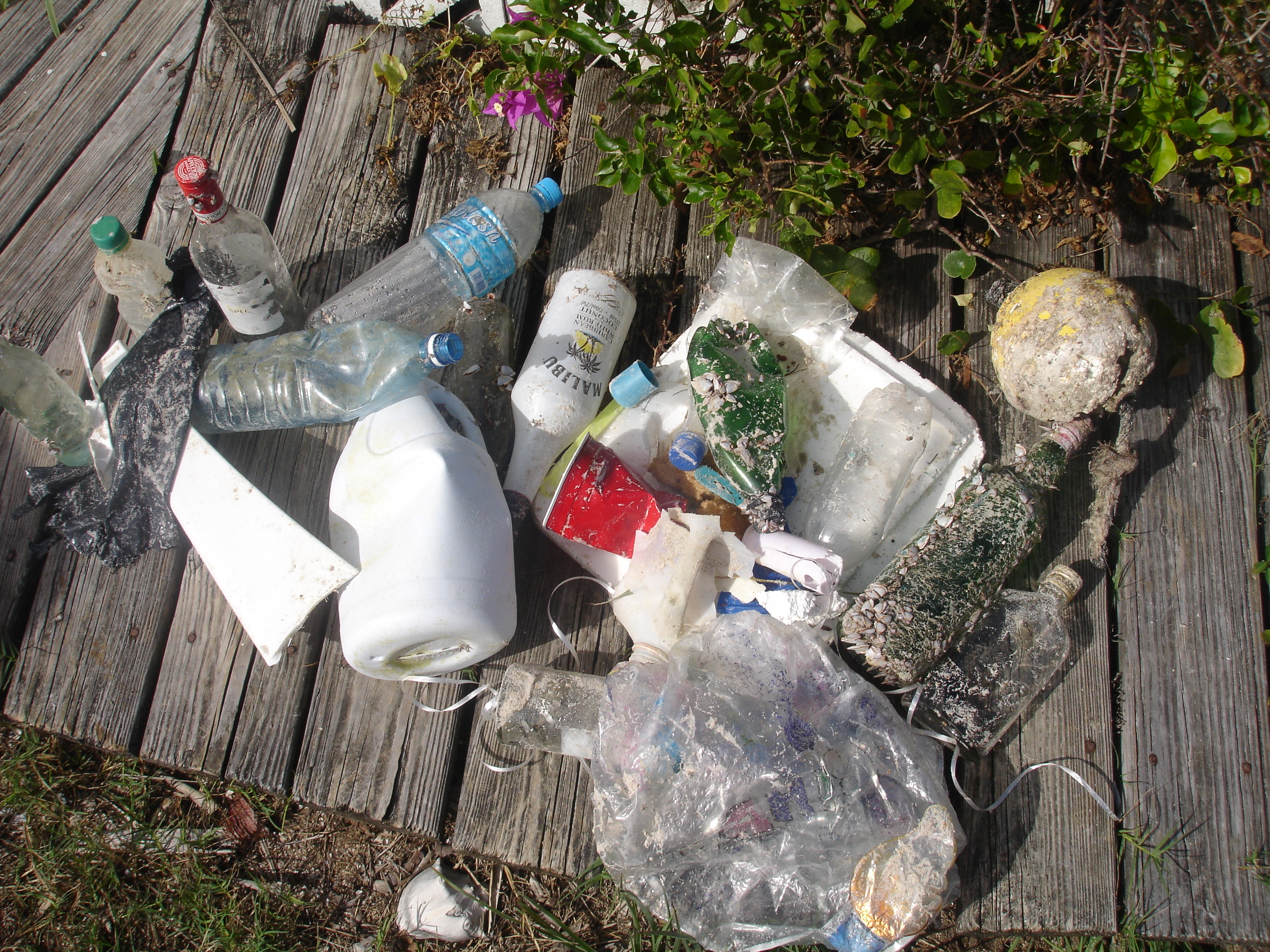
We’ve taken to carrying plastic bags with us for walks on the beach, to have something to put all the trash in.  The stuff pictured is what wouldn’t fit in the bags on one thirty-minute walk.

Some days are worse than others.  We find a lot of cruise ship debris, like balloons, entangled in ribbon, everyday stuff like water and soda bottles, plastic bait bags, styrofoam cups and cooler pieces, syringes, condoms, beer cans, and lots of fishing line.  There are garbage and recycle bins at the dune walkovers every hundred yards or so, but they are rarely used, and we have seen other beach walkers step over and around stuff time and again.  It’s like they literally don’t see it.  There’s certainly no ownership.  I don’t get it.

And what’s with feeding seagulls on the beach? It isn’t kind, and it isn’t cute.  It’s some kind of weird character flaw.  These are the same folks who feed bears and bison out west. Unfortunately, a seagull can’t take your head off, so it’s not of equal immediate danger. Don’t do it; don’t teach your kids and grandkids to do it.  Seagulls can fend for themselves. Just go to any Florida landfill; you’ll see what I mean.

But here’s my dilemma, and you tell me if it’s hypocritical. I want a personal pelican.  I think I have from childhood on, but certainly since seeing one in some movie a long time ago, I can’t remember, some cornball 60s thing, maybe “Blue Hawaii.” Anyway there was this pelican hanging around the beach house, or dock, like he lived there, real tame and all. He would waddle around and squawk for fish, and somebody would toss him one. Now I don’t think I’ve ever heard a pelican utter a sound, let alone a squawk, but that’s beside the point.  It would be very cool to have a personal pelican waddling around on the deck here, or standing with his big beak down and his eyes rolled up at you like they do when you’re surf fishing.  That’s really where I got the idea, and is the heart of my dilemma.  See, I know I could get one to live up here at the house, but that would entail training it with a lot of finger mullet.  The mullet is not an issue.  I have a freezer full to use for bait, and I can always get more.  The issue is one of ethics, and whether I would be breaking my own prohibition against feeding sea birds.  On the surface they certainly seem the same, but underneath I see perhaps a subtle but distinct difference. Fundamental to this difference is a difference in intelligence.  Pelicans are much more intelligent than seagulls. This is manifested in a number of ways, none more obvious than a pelican’s frequently clownish behavior, indicative of a well-developed sense of humor, and that indicative of intelligence. I believe pelicans are a link between birds and man. In observing pelicans all my life, I believe they want to mingle with us, as social equals, despite their near decimation by DDT.

A mullet here, a mullet there; he follows me up the path through the palmettos; we wait for a lull in the A1A traffic; and we’re home free. I would gorge him then, and satiated, he might lumber off, but he’d be back. He’d remember, and pretty soon, it wouldn’t be worth his while to be anywhere else.  I’d learn to play the ukulele for him. He might even convince his pals to cease and desist with the flyover poop splatters. You think about these things out here.

A Pelican

Posted in Uncategorized | Leave a comment

The Cats

We each brought a cat to this house on Skinny Island after, as John Lennon once quipped, “The separation didn’t work out.” Meemaw’s Melba, a two-year old tabby, used to the wide driveways and lush lawns of suburbia; and Cecil, my year-old, very hefty, apartment-raised Maine Coon.  Cecil disappeared before the two of them could even disagree the first day.  We eventually found him, three days later, bloody-faced, battered and cowering behind some still packed boxes in the garage.  We never did find out what had happened, but he never went anywhere near the road from then on, and he had a little permanent cleft of his nose and mouth, and his eyes were always slightly crossed.  Completely incompatible inside the small house, Cecil took to staying outside, in the back woods, and Melba inside, befitting the Princess she thought she was, but went out at will, and we saw her a number of times in those first weeks across the road in the dunes, and on several occasions brought a little dune mouse back with her. Admonishing her was pointless, of course, so we gave up and hoped for the best.  Fifteen years later, though much has changed and she is now the outside cat, she is still here.

To know Melba is to love her. Merely to encounter Melba, however, without the requisite commitment to understanding her deepest thoughts, is an exercise in emptiness, if not downright danger.  To say Melba is aloof is like saying the Atlantic is a big body of water.  She has certain minimal expectations of us, primarily food, water, and modest shelter, but the association essentially ends there.  There is an elderly couple who take a morning walk by the house every day, and they always look for Melba and have something to say about her obvious aloofness and disdain.  They find it delightful.  When we took off for five weeks last summer we asked them to check on her and fill her food bowl and they were thrilled. It was like being asked to pick up after Grace Kelly, or something.

Still, the years have mellowed Melba, though we may be the only ones to see that.  She will surprise, on occasion, and want to climb in your lap if you are sunning outside. She has a little wicker cat carrier we’ve left outside for her, kind of a little wicker igloo with a round opening, and she loves to spend part of her day in there on a pink towel.  When it’s cold she wants to come in to the add-on room, which over the years has served as apartment, writing and painting studio, junk room, and cat hang-out. She is arthritic and slow-moving, and tends to miss the litter box when inside, but hey, she’ll be eighteen this summer.  She’s an old lady.

Cecil was a big, good-natured sweetie.  Topping twenty pounds, eating was naturally his sole priority.  He would bang on the back screen door with his head every morning at 5 a.m., demanding to be fed, which worked out because that’s when we needed to get up in those work days. No need to set an alarm with Cecil around. When not eating he stayed almost exclusively in the back, sleeping on the deck or out somewhere in the jungle.  He liked to sleep in one of those big terracotta pot plates, curled to fit as best he could, but most of him hanging out. He was a pacifist by nature, with a squeaky little raspy cry belying his size, but he was ferocious when cornered or challenged by the occasional stray that might appear, and could inflict serious damage. Certainly no lap kitty, he was, nevertheless, truly affectionate, and loved to have his head scratched, looking up at you with those little crossed eyes.  He lived for twelve years, and died while we were on one of our western trips.  He’s buried in the jungle, just down from the deck he loved.

And then there’s Pico (Pekoe.) He arrived here some five years ago as part of a duo of kittens our son brought with him when he was staying here between things.  He referred to them as “Crack Kitties,” and said he had rescued them from a bad situation.  He called them Pico and Lewis. They had the run of the place as kittens, chasing each other around the back deck and steps to the obvious amusement of old Cecil. Melba, still the inside cat, barely knew of their existence. They were fun to watch, and after our son moved on, we kept the kittens.

One morning early we let them out the back door of the apartment and they scampered off as always.  A few minutes later I went around front to bring the truck up to go into town and saw something in the dim light out in the road.  It was Lewis.  He had been struck and killed.  I got a shoe box and put him in it and Pico came up and sniffed him and I closed the box. He’s buried down in the jungle too.

After that, Pico became the inside cat; I was not going to go through that again.  We tried having he and Melba share the house, but she would have none of that and became the outside cat.  Very early on, I started taking Pico out for walks on a leash.  He took to it right away, and now eagerly comes to the back door for his twice daily outdoor excursions. Luxuriant and tawny, he is the cleanest, sweetest, best-natured cat we’ve ever had.  He loves to read the newspaper every morning with us and, quite hilariously, loves to take mid-day naps with us.  You just say, “Come on, Pico.  Wake up. Time for a nap.” And he’ll come sauntering in.  Our three-year-old grandson even says that now when he’s over.  And around nine at night, no matter how much sack time he’s put in, Pico heads for the back bedroom for a full night’s sleep.

Now, to the name.  When Meemaw took him in for his shots when he was still a kitten and told the vet his name, she was asked how it was spelled. “I think he spells it Pekoe,” Meemaw says, “Like the tea.”  That’s right, how he spells it.  Don’t think the vet had ever heard that before.  So that’s become kind of a running joke now, which brings to mind an old observation from poet T.S. Eliot, a cat lover and creator of Mungo Jerry.  He said, “A cat has three names: A name you give him; a name you call him; and a name only the cat knows.” So maybe Meemaw’s intuition has it right.  I still call him Pico, and it’s not like he actually responds to either spelling.

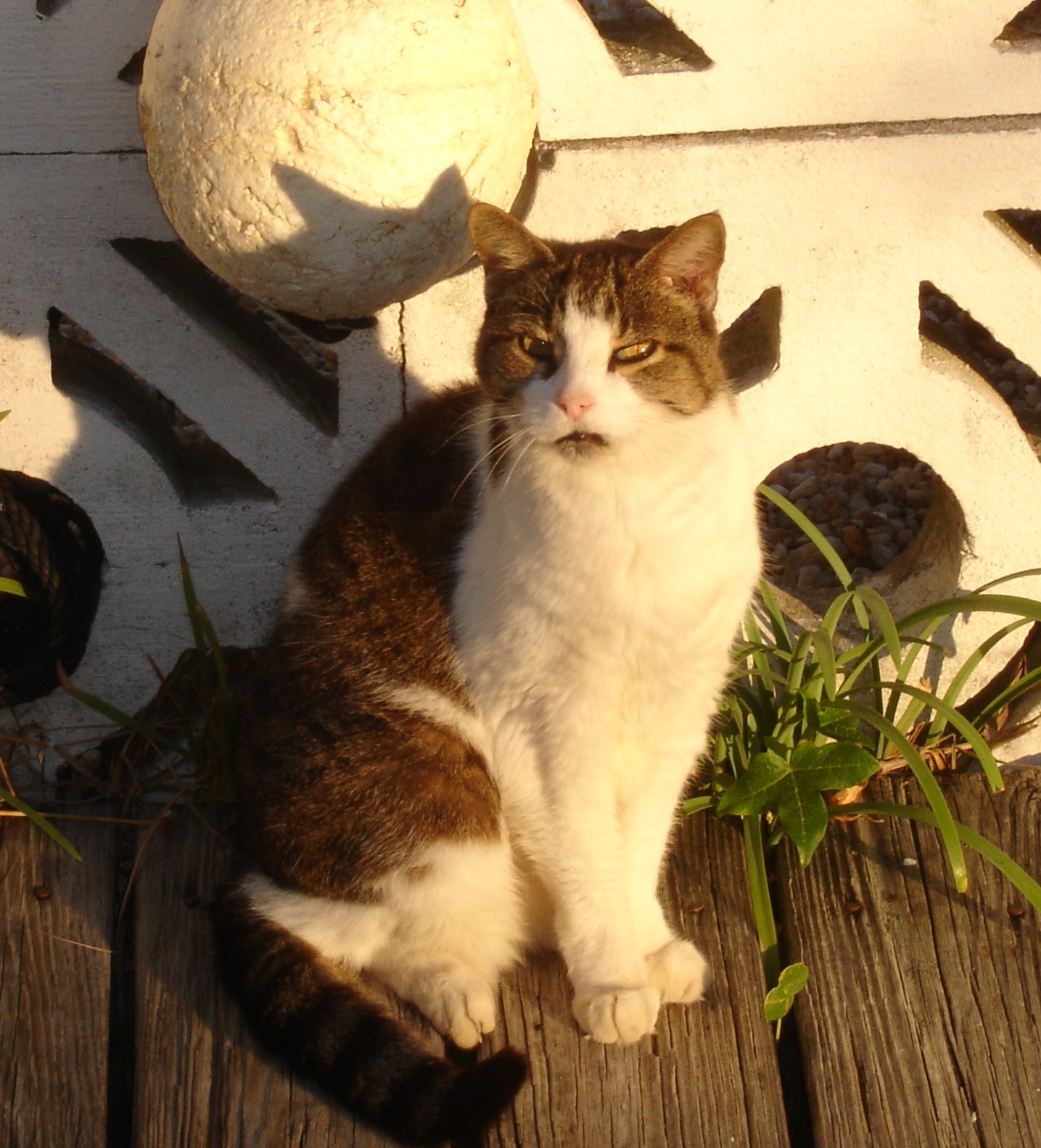
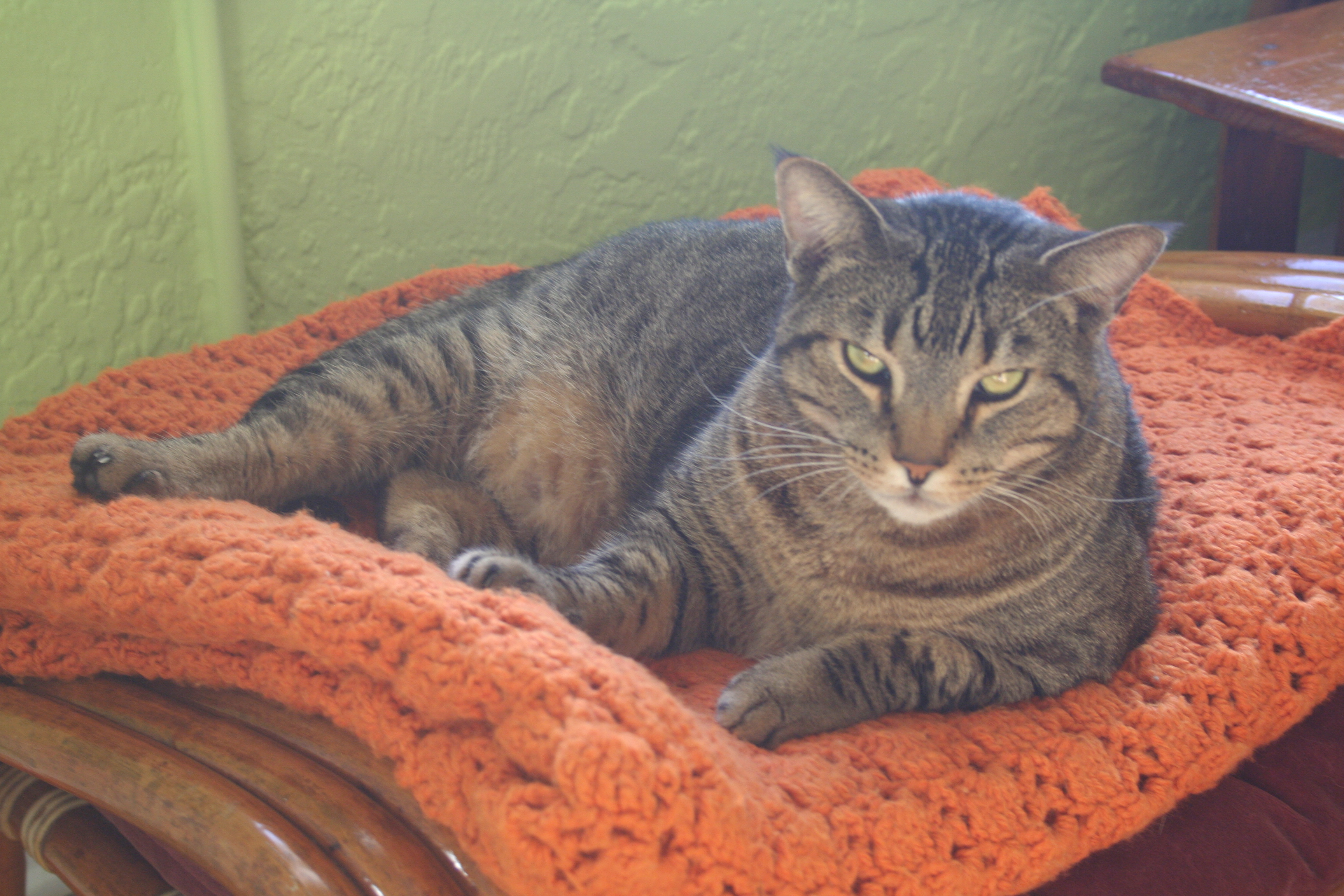
Got nothing against dogs, mind you, we’ve had dogs and loved them dearly.  But they are a serious pain in the ass, and you all know the difference between cat people and dog people, so we won’t go into that.  A certain segment wouldn’t be able to follow if I did.  Melba and Pico (Pekoe) are pictured below.  Sun is out.  Going to go sit in it a while, listen to the waves, and start planning the garden.

Miss Melba

Mister Pico (Pekoe)

Posted in The House, Uncategorized | Leave a comment

In the Beginning . . .

Low and Gray Again Today

I moved in here before we were actually the owners of this place.  We were worried it might not pass the bank inspection prior to closing; it had stood vacant for quite some time, and we thought we needed to make it a little more presentable.

The floors throughout, except for the living room, that is to say the two bedrooms, hallway, tiny galley kitchen, and dining area, which was apparently an add-on, were old asphalt tile, missing and broken in places.  The living room floor was a bare concrete slab, but etched, as if in some attempt to impersonate tile.  Not much I could do with that for the time being.  I patched and repaired the old tiles as best I could, and tried fixing a square of plywood up in the attic crawl space to cover a small patch of termite damage.  I bent several #10 nails trying to drive them into the Dade Pine rafters.  I think I spent two or three nights here– a bed had been left in the back bedroom– and it was pretty eerie. I heard noises, and a couple of times woke thinking someone was in the house.  Another manifestation of old houses.  There’s always a spirit or two lingering about until you establish yourself.  This one wasn’t in the least malevolent, just observing, I felt, and by the third night, he was gone.

The day the inspector was supposed to come I swept the place out and started planning renovations.  The living room, bedrooms, kitchen, and dining area took up about 900 square feet, at best.  Attached to the north side of the living room was a one-car garage, and next to that a flat-roofed addition, another add-on, a rectangular space of twenty by thirty feet.  The ocean view from the living room was provided by a large plate-glass window, with a double-hung casement on either side.  In the west wall was a fireplace with some kind of cover fixed over the opening, and in the north wall was a large, built-in bookcase. On the other side of the kitchen were the two bedrooms, connected by a hallway, with the bath in the middle.  The front bedroom stood out from the main house, with casement windows taking up virtually all of the east and south walls, giving great ocean views.

Evidence of some afterthought, however, was the dining area at the back. Entry to that could only be made through the kitchen.  There was a window into the back bedroom from the dining area, and also the living room.  You couldn’t get there from the living room, you had to go through the kitchen, very inconvenient.  So, I concocted a plan.  I needed to take out the living room and bedroom windows that looked into the dining area, knock out the wall below both, frame them out, and either hang doors, or leave them as open pass-throughs, in order to provide more flow from room to room.  I wanted to lay a wood floor over the etched living room concrete, and put down Saltillo tile throughout the rest.  No carpet, this was going to be a beach house.  Track in sand, sweep it up, drip wherever.  The bookcase wall in the living room presented another, slightly larger challenge.  Because space was so limited we had talked about utilizing the garage as more living space.  It was really too small for even one car, if you wanted to get in and out.  Taking out the bookcase would create a space large enough to hang double doors. That would entail about twice as much work again as I would have clearing out and framing the two windows, though, but it could be done.

When the inspector came, she barely looked at the place, and signed off.  We closed and I continued living here alone until I could get it really livable.  One at a time, I took on the aforementioned projects, starting with the strange living room/dining room window. Once the window was removed, itself a monumental project, I hacked through the concrete block below and sculpted the proper size space, then framed the whole she-bang, being careful to match the existing half-round moulding that existed throughout the house.  Same with the bedroom window, but there I hung a single French door.  Meemaw moved in sometime along here, and the work continued.  We laid the wood floor in the living room.  Beautiful.  All this while both of us were working full-time.  Ah, relative youth.  Couldn’t do it now. I took out the living room bookcase and knocked through the block below, framed it and hung double French doors.  This all was happening in the spring and summer of our first year here, and it was a joy to work with the windows open, to look up and see the ocean just a couple of hundred feet away.  If there were decent waves, I put the work aside and paddled out.  It was a marvelous time.

I built a pressure-treated wood walkway all around the house, and a deck off the back, working around a beautiful Florida Bay which grew close to the back door.  Then we started on the tile.  Saltillo, if you don’t know, is a Mexican terracotta tile, a foot square.  We ran it, grouted it, and sealed it in the two bedrooms, hallway, former garage, and add-on space.  The dining room slab floor, I discovered, dropped more than eight inches from kitchen to back wall and had to be filled and leveled before tiling.  We did.  Let’s see, what else?  Oh, yeah, we built a drywall enclosure for washer and dryer in the old garage; dry-walled, built closets and installed a toilet and shower in the add-on, and then I built the big deck and steps down the back dune into the hammock, and an outdoor shower and enclosure on the back wall.    Somewhere along there I took down the single garage door and hung double doors, which made way for a single giant Moroccan kind of thing not long ago.  I can’t really remember how long this all took, but I know I didn’t get to the beach deck until 2002, so it was all done between ’96 and then.

All this was something of a disruption to the lives of the indigenous animal population, especially with the introduction of two cats, who will have their own posting soon.  The abundant anole lizard population was initially devastated, but then both cats grew tired of such easy pickings, and they’ve come back strong.  The snakes were amazingly curious at first.  I found a rat snake in the new shower; a pygmy rattler made it into the dining room as I was leveling the floor; and after testing the new outdoor shower, I returned from putting away the tools, and found a gorgeous black snake helping himself to the pool of water.  A balance has been established. And while we still frequently see critters, especially the ubiquitous anole, and a family of indigo snakes, for the most part, they stay outside.

And oh yeah, that first year I built a 8×12 foot outdoor storage shed, which I just rebuilt from the ground up last year, and if all this ain’t crazy enough for you, we bought an old house in St. Petersburg in 2003, and renovated it from top to bottom, too!

I think we’re pretty much done now.  There’s just the ongoing battle to keep the jungle from growing into the house.  Wouldn’t have it any other way.

Posted in The House, Uncategorized | Leave a comment

Spanish Bean Soup


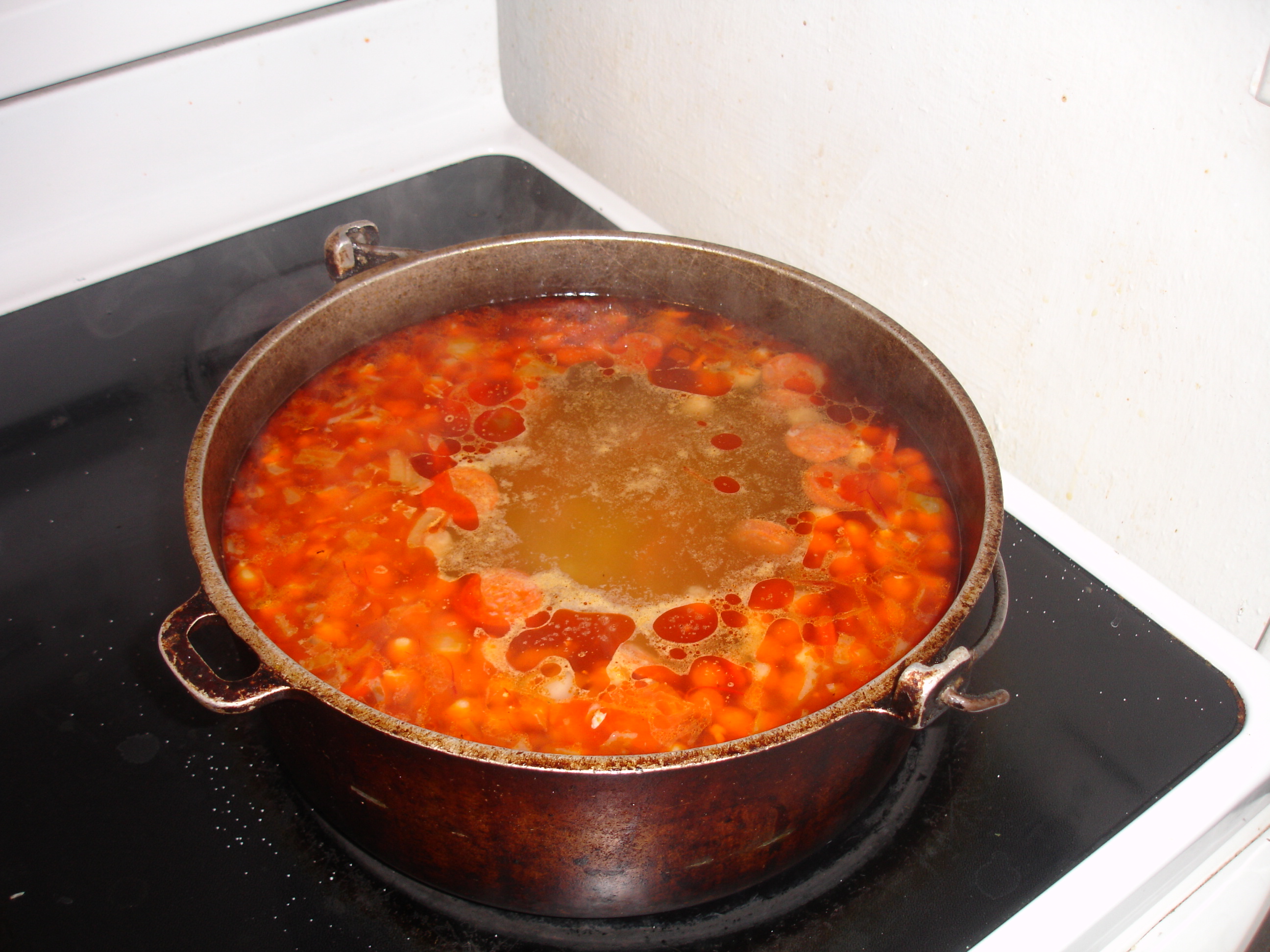
Spanish Bean Soup


Blame it on the rain today.  Nothing but writing and cooking going on.  To that end, here’s the recipe for Papa’s Famous Spanish Bean Soup, great for a rainy day, or whatever the weather, based on the old (original) Columbia Restaurant recipe:

Cover with water and soak 16 oz. dry chick peas overnight, or flash boil ’em; let stand a half-hour, and proceed.

When ready, fill pot pretty full with water, (preferably a cast iron pot, as pictured) and bring to boil, adding salt and pepper.

Chop 1 medium onion and 4 or 5 cloves garlic and saute, with pinch of Saffron (essential), in olive oil until translucent.  Add to chick peas.

Chop approx. 8 oz Chorizo and add.

Turn heat to low and let ‘er cook several hours til chick peas are soft.  Peel and dice four potatoes and add to soup an hour before serving.

Serve with salad, Cuban bread, and red wine.  Has been known to make grown men cry and women actually civil.  Get started, there’s still time to have it tonight.

Posted in Uncategorized | Leave a comment

Some Locals

This little section of Skinny Island is not without its interesting folks and characters, present company excluded.  The ones I can attest to have either passed in front of the house, were seen on the beach, or encountered on walks along A1A.  I can’t speak to the ones undoubtedly hunkered down in the many nearby condominiums, like whoever lives in the one just up the road with the Christmas tree and light still up.  You don’t have to look far or work hard here, stuff just all eventually comes by.

A guy we’ll call Ray is probably the best known.  I started seeing him about ten years ago, very nattily dressed then, usually with a straw fedora rakishly set.  Apparently in his fifties, somewhat diminutive, he walked with a distinct swagger, swinging his arms, as if some Bon Vivant out for a stroll.  But I noticed he would stop periodically and stare at the sidewalk, or at a beach sunflower, or a stick, for minutes at a time.  Again, impressive to me.  I appreciate someone who will stop to appreciate the smaller things.  But in my first actual encounter with him– he suddenly appeared at my side while I was repairing the fence– I found him vacant and completely nonsensical.  His periods of stopping and staring at nothing on the sidewalk grew longer, and then he was gone, for months, I think.  It went on like this for years, times of seeing Ray, and times of his being absent.  A neighbor said once he had been picked up and taken somewhere for walking into someone’s house.  He came to our door once, muttering something unintelligible, and I chased him off, but I’ve never seen him at all threatening.  A few years ago his appearance changed dramatically.  He appeared in dirty, disheveled clothes.  I heard that he had lived with his mother down one of the side streets, and as long as she was alive, he was well dressed, but now she was gone, and a brother, who was his caretaker, was not so caring.  I also learned, or so the story went, that he had been struck by lightning as a child, and had been in and out of institutions all his life.  He began a practice he continues to this day, somewhat useful, actually, of picking up every cigarette butt and minute piece of trash he can scour along A1A, out at the crack of dawn in a hooded sweatshirt.  But he has become more and more oblivious to his surroundings, and wanders into the road quite often.  At least a dozen times I’ve seen him narrowly avoid being hit, and I’ve admonished him to watch what he’s doing, but my words were just met with that vacant scowl.  He will get hit, I’m sure of that.  I just don’t want to see it.

Just in the past three months another piece of work has appeared, again seeming to live or camp somewhere nearby.  He is a large, bearded man of happy countenance, who pushes one day a bicycle, the next a shopping cart up the sidewalk, while wearing a fully loaded backpack and carrying a saxophone case.  Sometimes I see him with a woman.  I had a kind of conversation with him once, which is to say he caught me coming up the sidewalk from a walk and proceeded to regale me with the most tangential, loopy, mumbo-jumbo I’ve ever heard.  I agreed with everything, excused myself, and went inside.  He just passed by moments ago in the rain, lugging the saxophone.  Must have a gig.

One morning I went down to the beach and found the sand under the deck scooped out to form a cozy hollow, and a blanket spread out.  I never saw anyone, and the blanket was gone the next day.  For years there have been beer cans and chip bags there in the morning, but not so much since my son and I cleared out a massive invasive species choking out the palmettos and providing cover; at least no one is living there at the moment.

And then there’s Running Boy.  He still makes an appearance now and again, but I haven’t seen him this winter.  He’s a tall, very thin, very tanned young man, with tousled blond hair, usually seen carrying a couple of plastic grocery bags containing all his worldly possessions, and always engaged in a running monologue.  But besides the speech, he’s an actual runner as well.  On several occasions, while running or walking the beach myself, he has blown past me, sans grocery bags, at a good six-minute per mile pace, monologue intact.  You can’t talk to him; he’s in his own world and, clearly homeless, a survivor who loves the beach.  Stay safe, running boy.

Gone for years now, maybe the most interesting was Duct Tape Man.  Usually seen on highway 40 on the mainland, he did put in a few appearances here on the island.  He sported a huge, conical helmet constructed of duct tape, and he was a mutterer too.  I’d love to have known his story.  I think the Mother Ship he was waiting for finally came for him.

The rests are walkers we’ve seen daily for fifteen years but don’t know by name and aren’t really deserving of a nickname.  Most are old ladies, widows, probably; a few dog walkers; a doofus guy in short shorts; a lady who walks and sings, badly; a corpulent bicyclist who insists on ringing his little handle bar bell; a couple of mouth breathers; and a sweet Chinese couple, him tall, her half his height, usually in jeans with matching Lands End jackets and hats, and always holding hands.

But we all miss Yolanda.  A fixture when we got here, she was very old, probably in her nineties and, with her sturdy cane, a regular and quite vigorous beach walker.  Yolanda could stride out, people, with a look of determination, not at all unpleasant, mind you, that nevertheless said steer clear. I was coming home from seeing a hospice patient in Flagler Beach one afternoon and came up on an accident on A1A in front of the convenience store two-hundred feet north of us.  Yolanda had been hit crossing the highway from the beach.  EVAC arrived as I reached her, but it was too late.  She died in my arms.  Such are the comings and goings of Skinny Island.

Posted in Uncategorized | Leave a comment