
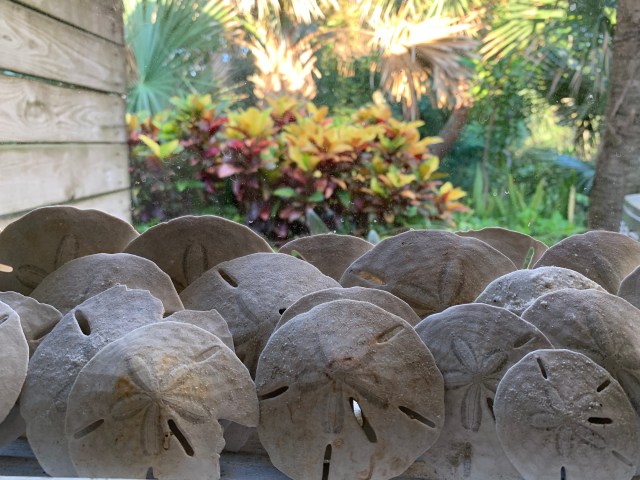
 We pick up sand dollars whenever we find them on our morning walks. We frequently find fragments, but rarely whole ones. When the animal dies, a species of urchin, phylum Ehinodermata, class Echinoidea, they are very brittle, and rarely survive the pounding of waves. But we do find them. I have become adept at locating them in the sand where others miss them; a small rounded dome in the sand, often covered with a crust of some kind of parasite attached to the surface, which I scrape off while walking. It is the exoskeleton we collect, solid but delicate, though we have found a few living, or recently dead specimens, which are brown or purple, unlike the bleached white deceased ones, soft and pliable, with an underside of cilia, they use to collect food. We try to return those to the ocean. The mouth of the organism is in the center bottom. They not only use the cilia to eat, they use them for mobility, and for burrowing in the sand just offshore. A remarkable creature. We have a west window in the studio where we display the ones we have found. We have over sixty.
When I was a kid on the Gulf coast, we used to find I lot more, I think. Just fragments when we beachcomb there now, like here, on the Atlantic. When you examine a broken one, you see all the internal rooms and chambers. I’ve long thought it would be great to play saxophone late at night in a beach-side dive called the Sand Dollar Room.

 The Skinny Island Post
Love the story.. I see a beautiful oil painting, particularly of the lower photo. .. just a thought.. Thanks, Sharon Willis
Sent from my iPhone
>
Good idea!