

Enedis, Informing
On the bus at 0830 for our first excursion into the countryside, a drive to Vinales in the Pinar del Rio province, west of Havana. It was more than an hour’s drive, which gave Enedis an opportunity to fill us in on a little Cuban history and further customs. Standing at her seat at the front of the bus, she faced us with microphone in hand, and between bits of edification, was likely to burst into song, usually “Guantanamera,” by far the most popular Cuban song. With some lyrics attributed to Jose Marti, it is virtually a sacred piece, but always sung with great joy and gusto. Enedis sang it frequently, every band and vocal group we heard did as well, and once, on our long drive to Santa Clara, our driver Miguel spontaneously let loose with it for a good twenty minutes.

Road Sign
Passing the road out to Mariel, a city on the coast about 25 miles west of Havana, the city closest to the U.S., and thereby the place where many Cubans began their exodus to the States, Enedis pointed out the heavy equipment on the road. The government is widening and resurfacing the highway to Mariel as part of the Master Plan, which includes the renovation of Havana from the Old City out. The plan is to build up the port at Mariel to make it capable of handling commercial ship traffic, leaving the narrow channel to Havana Harbor free for welcoming cruise ships. The new highway will enable goods and freight to be more easily and quickly trucked from the Mariel port into Havana. This billboard of Che was but one of many we saw in the countryside. Some were just revolutionary slogans, but most depicted Che. The tradition is to use deceased heroes in these communications, and since Fidel is still alive, there are very few showing his image. That will come later.
We saw only a small number of cattle, and Enedis explained that the Cuban people ate very little beef. The meats were chicken, pork and fish, and, in fact, the raising and killing of beef was tightly controlled. We determined it was probably because of the great amount of grain a beef industry consumes. It just isn’t efficient, (and there are no McDonald’s . . . yet.) Ranging far and wide on the culture, likes and dislikes of the Cuban people, Enedis also let us in on a little slang, which would soon be put to use by some of our group, as it turned out. An attractive woman was referred to as a “Mango.” Handsome men, as well. It seemed appropriate, as we were then passing many beautiful Mango groves.

Local Bus
Ah, transportation. Our drive also afforded Enedis time to tell us about this most remarkable Cuban phenomenon. Most of the cars, and a bus system, are in Havana, with very few private vehicles out in the country, and the ones you do see, of course are classics. At every overpass and off-ramp of the freeway, (which was also in need of a serious do-over,) we saw people standing, as well as out by themselves along the highway. Turns out hitch-hiking is the accepted way to get around in the countryside. Everybody does it, including men and women in white lab coats Enedis said were doctors. No Mercedes taking them to work. Folks in all kinds of vehicles stop to pick up these riders. We saw many trucks like this one, carrying up to twenty passengers to work in the fields or into the cities. Also many horse-drawn carts with automobile tires. An interesting related aside: We learned there are four different colors of Cuban license plates: Blue is government; yellow, private; black diplomatic; and red for foreign workers. It is illegal for a government vehicle– car, truck, whatever– to pass a hitch-hiker without stopping to pick up. There are agents at intervals along the highways to monitor this. Everybody rides.

Horse Taxi
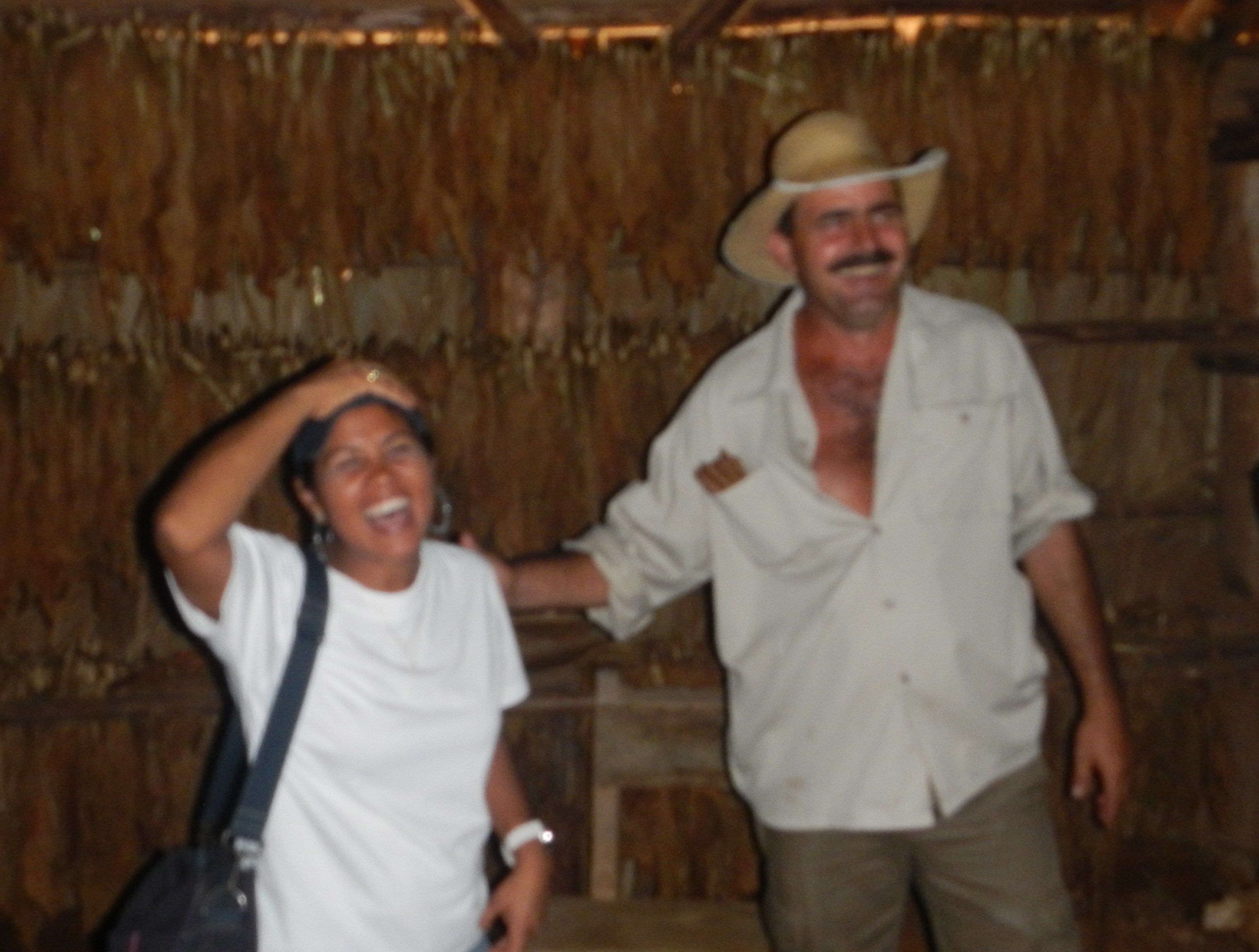
Enedis and the Grower
Our first stop was the home and farm of a tobacco grower, near Vinales. Pinar del Rio is a very lush area with perfect soil and rainfall for growing tobacco. It is supposed to be the best in all of Cuba. The crop was already in so we didn’t get to see it in the fields, but our stop was absolutely wonderful. We dismounted the bus and were ushered right away in the drying barn, in which row after row of tobacco leaves were curing on the walls and suspended from rafters. We were joined by the grower himself, who looked straight out of Hollywood casting! A very handsome man, with a big, robust personality to match. “Mango!” the ladies all exclaimed.

Rolling
He sat down before us with a wide board in his lap, and taking a handful of leaves, deftly rolled two cigars in a matter of seconds. Lighting one for himself he sat back and puffed while flashes flashed, and the he went around offering smokes to any who wanted them from a stash in his shirt pocket. Many of the gals, who had probably never smoked a cigar in their lives, or better, had probably given hell to any man around who did, partook, and then had their pictures made with this gentleman.

Lighting Up in the Drying Barn
He then escorted us into his nearby house, a small but utterly comfortable place, where his wife served us potent Cuban coffee from a tray. We were allowed to tour the house and grounds, and the gentleman had some cigars for sale as well. I asked him who bought his product and he told me Cohiba, Partagas, and Romeo and Juliet, makers of some of the best cigars in the world. To smoke a premium Cuban cigar you have seen rolled by the man who grew the leaves is a bit staggering for a cigar aficionado, but I survived.
The house and grounds were equally fascinating. Everything was simple, but efficient and
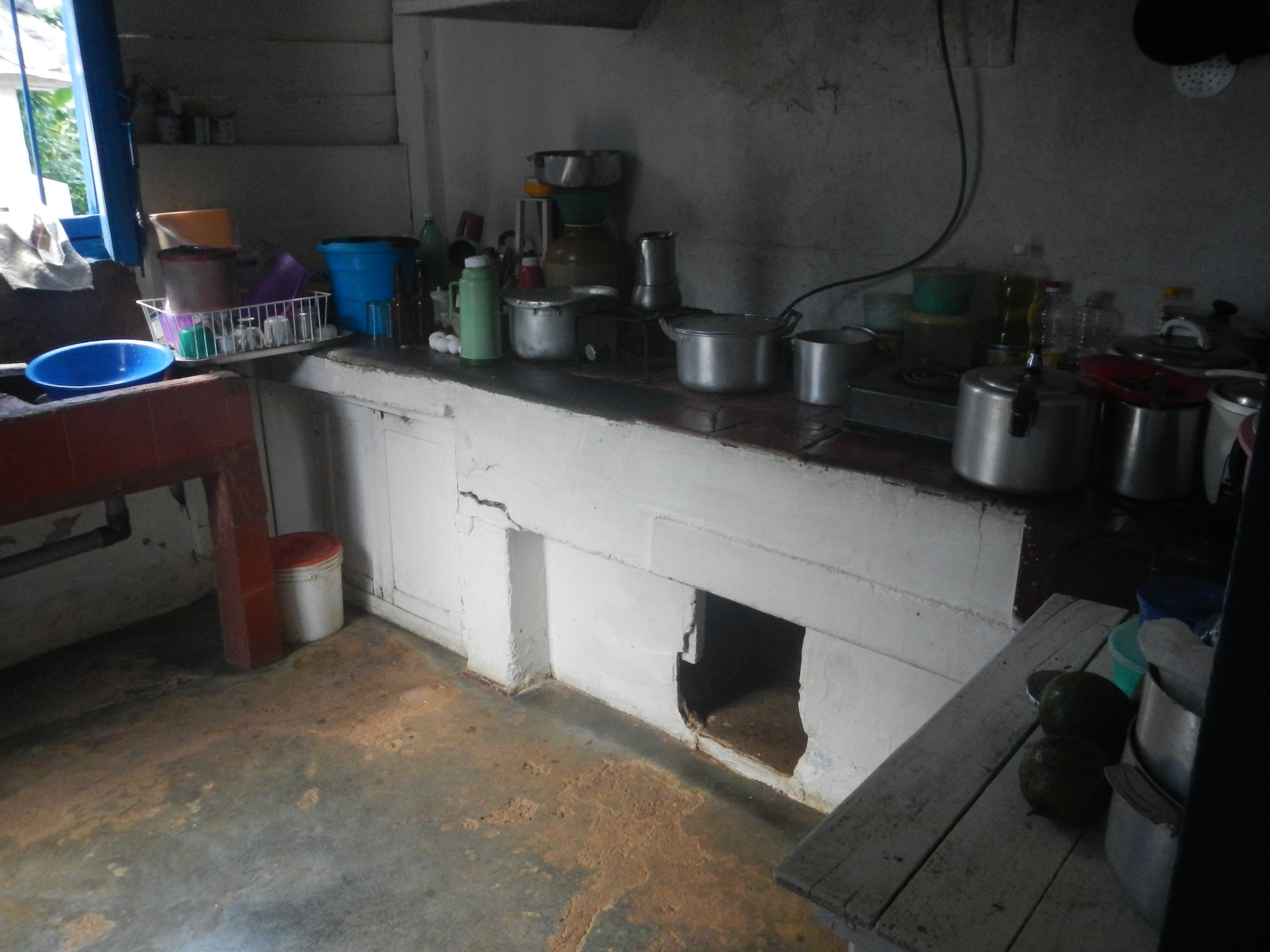
Farm Kitchen
practical. The kitchen was three times larger than our little in The Little Hacienda, and I would love to throw together a paella in there. Outside, many chickens strutted, there was a pen with geese and ducks, and in one of the out
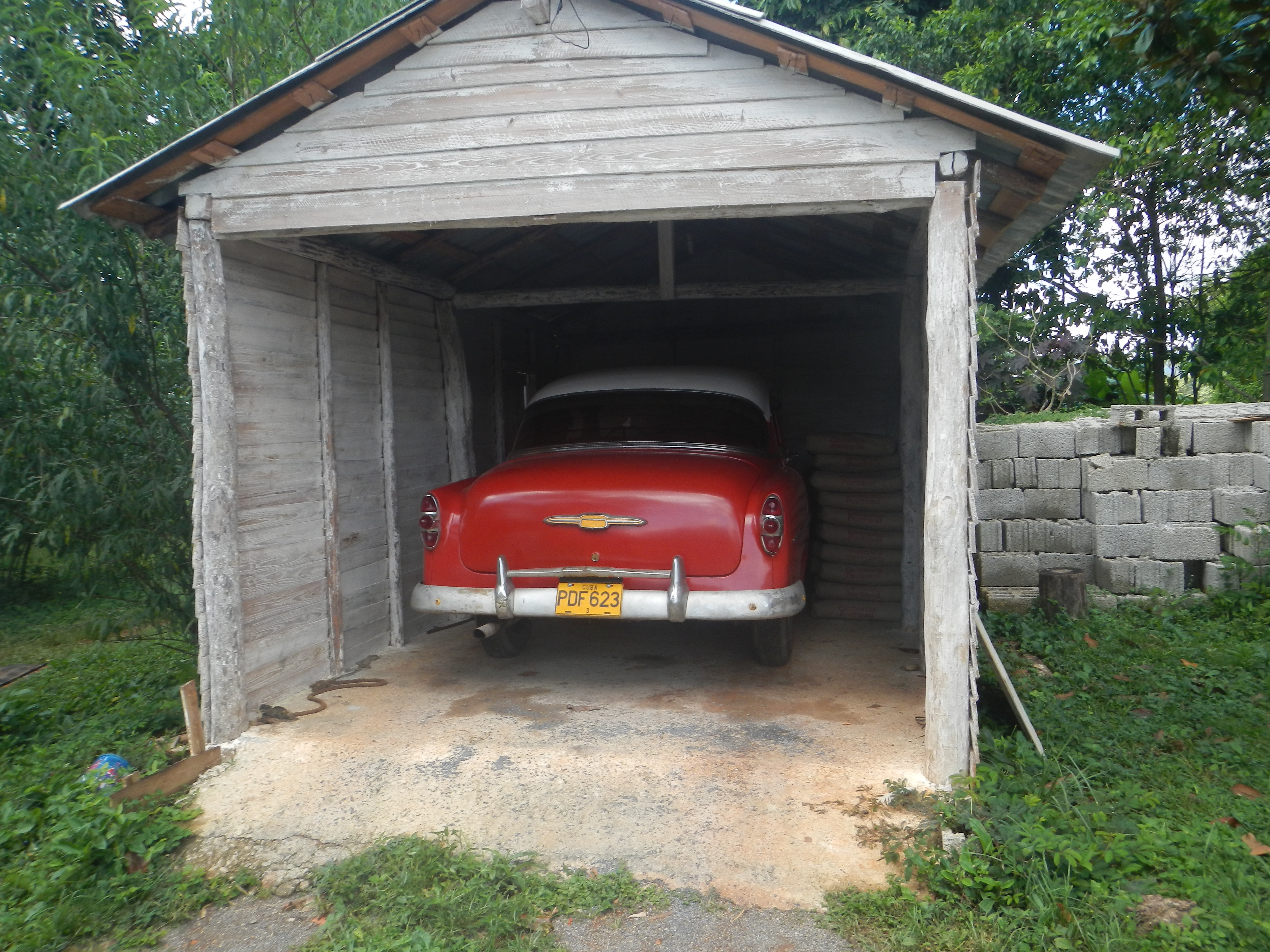
Classic!
buildings a cage with two large rodents, destined for the dinner table. Not to be outdone by city folk, he also had this little red beauty parked in its own shed.

Papa’s New Best Friend
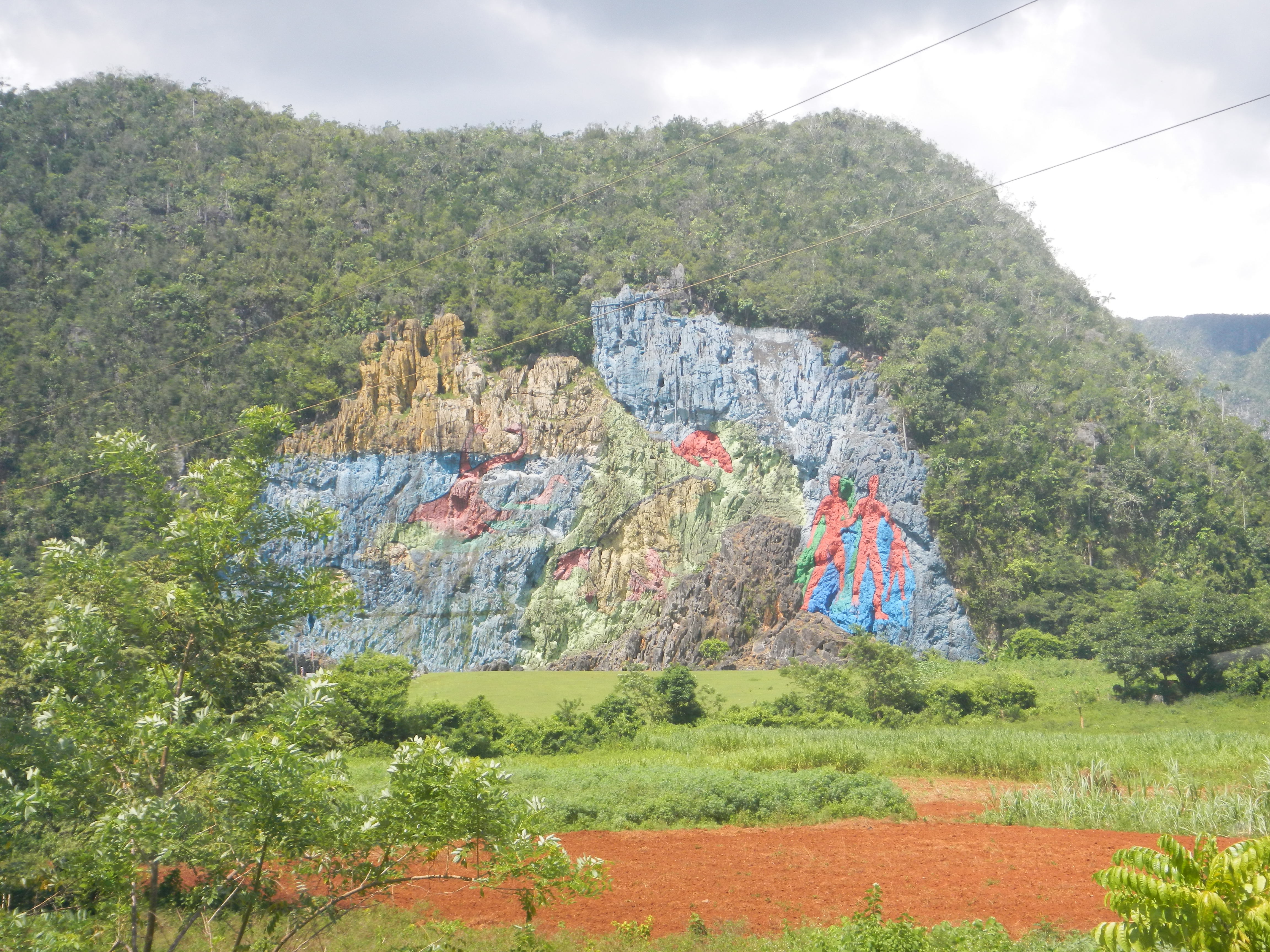
Mural de la Prehistoria
Back on the bus and off to lunch at a most unusual place, a state restaurant in a National Park, the site of the Mural de la Prehistoria, a mural painted onto the rock face in a beautiful valley between the low mountains. Commissioned by Fidel in 1961 to depict evolution, it stands 300 feet long and 200 feet high. It was pretty much impossible to get in one photograph except from this distance, but trust me, it was a unique work of art. In giant figures, it showed the development of man from the Pleistocene period on.
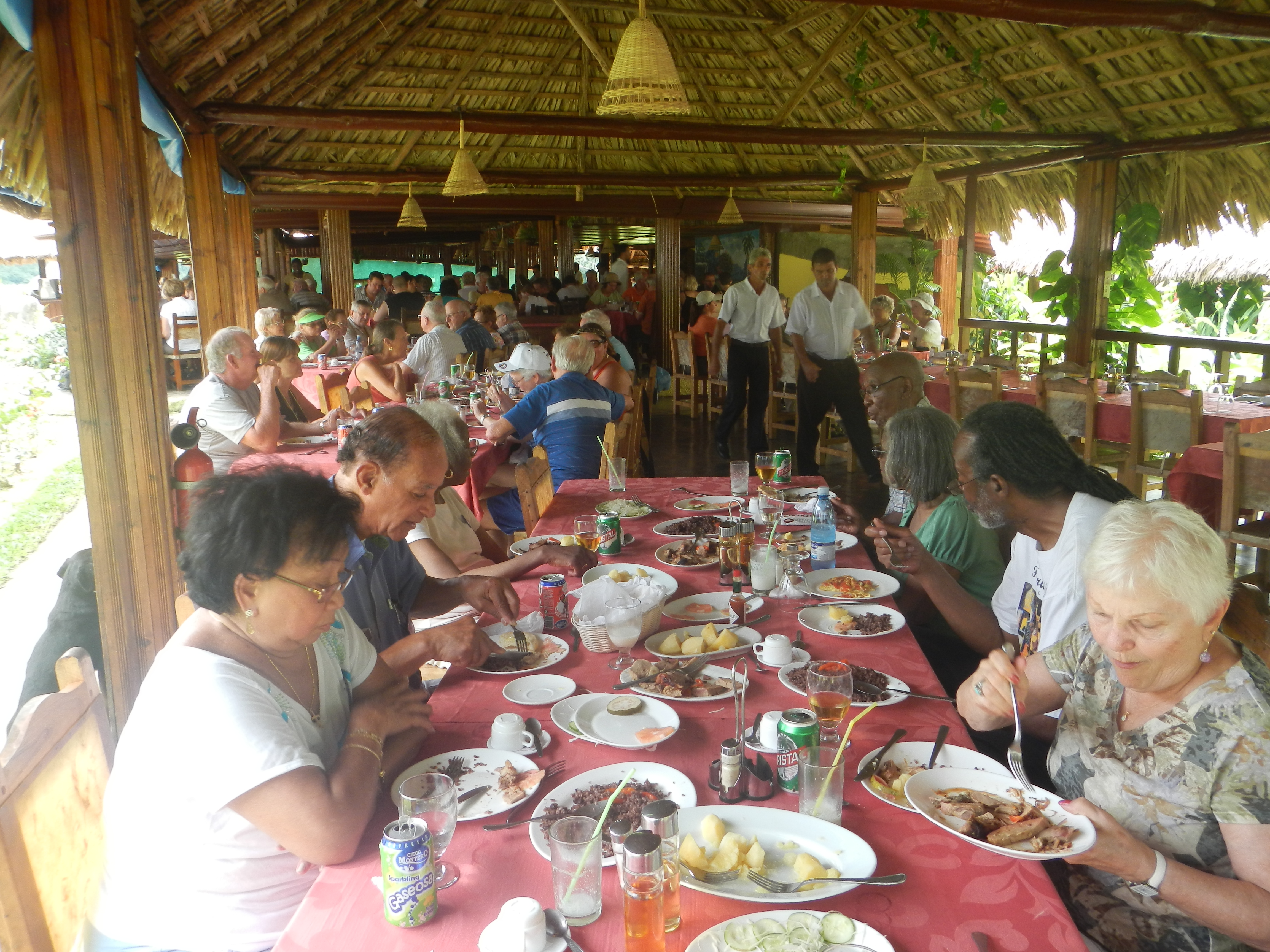
Lunch
Lunch was exceptional, in another thatched-roof, open-air pavilion, and featured a pina colada to start, then salad, roast pork, vegetables and potatoes. Once again, we were treated to traditional Cuban music by a trio consisting of two guitars and a percussionist. Excellent, again. Stuffed, we wandered around the grounds of this beautiful place, taking photos of the mural, the mountains, and a thunderstorm moving up the valley, then climbed back on the bus for the drive through the small town of Vinales and on to our next destination.
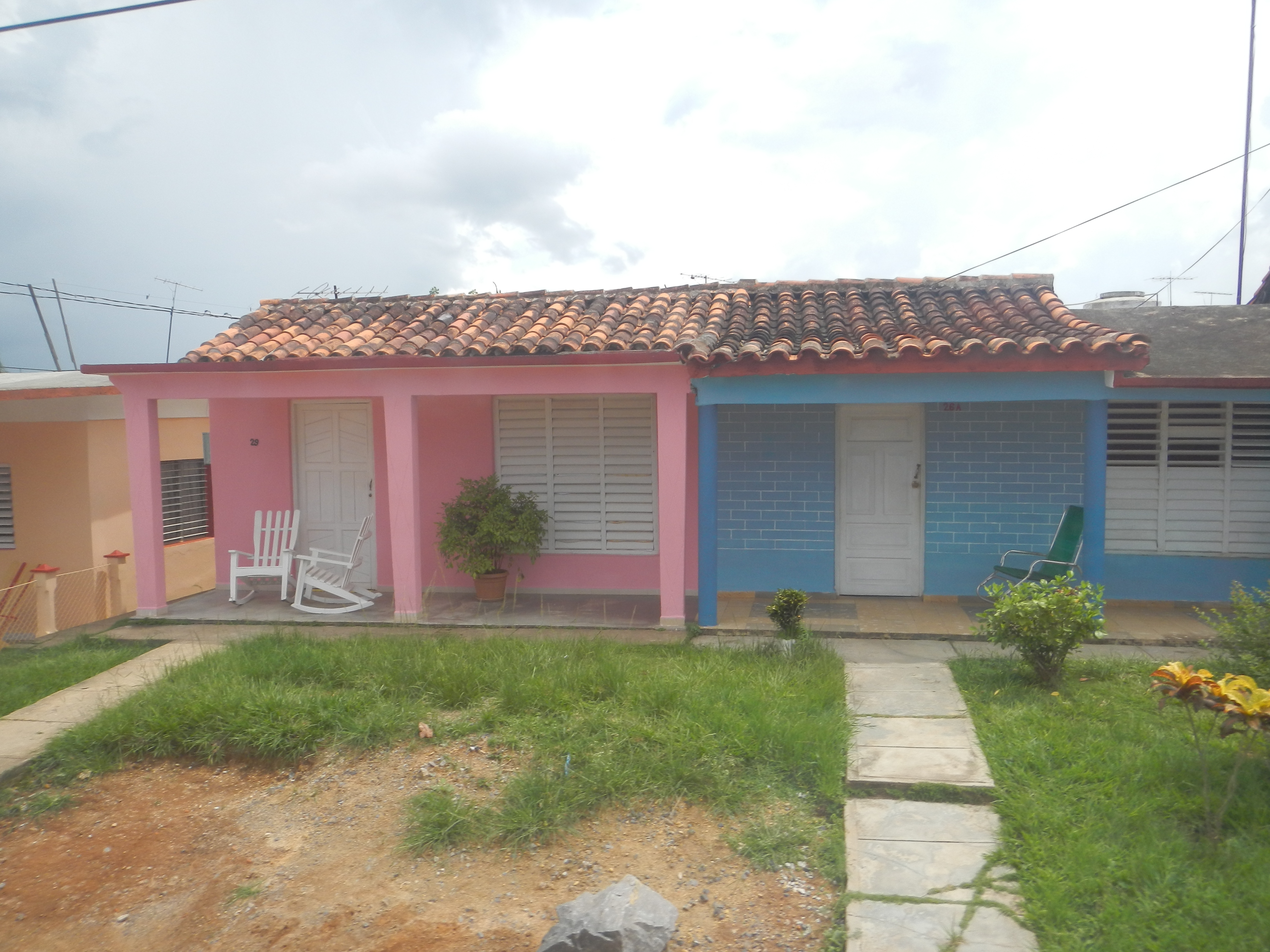
Vinales
Vinales is a small town with a population of about 30,000. This photo shows a typical house, one-story, with a sitting porch. We stopped at the square in the center of town for a brief walk-about. There was a small church of one side of the square, and outside that vendors selling food and trinkets were set up. Our last stop in Pinar del Rio was at a Finca, a farm, this one a small organic operation just outside Vinales, and for Barbara and I this was one of the highlights of the whole trip. Significantly, in some way, my camera batter died as we were walking up the dirt drive to meet the farmer, so words will have to suffice here.
He was a tall, thin man wearing a broad straw hat, and he welcomed us effusively, with a shy smile, gesturing for us to climb the hill to his little house. The house was literally one room, with a table and bed, and a deep covered porch on three sides, one side offering a commanding view of a rolling green valley and the mountains in the near distance. Large, screenless windows also afforded a stunning view. It was simple, practical, unassuming, and spectacular. There were benches and a few chairs on the porch, but the farmer and another man brought out more chairs and made sure we were all seated before he began telling us about his farm. With Enedis translating, he told us of the many herbs, vegetables, and fruits he grew, as we looked down on the terraced, raised beds. I cannot enumerate all there was, but I’ll throw out all I remember: tomatoes, squashes, onions, herbs and peppers of all kinds, corn, guavas, limes. A skinny dog constantly patrolled the beds. Using only chicken manure and compost, he sold his produce in Vinales and to the nearby obstetrics hospital. A few feet from the house stood the kitchen, essentially a roofed portico with cook stove, table and sink. The man exuded an unassuming, genuine grace, obviously in tune with his surroundings and his work. They were all inseparable. With Enedis translating, I told him how wonderful his place was, and that I envied him. He took my hand and smiled broadly.
Pretty pooped, we rode back to the Havana hotel, had a dip in the pool, and rather than head off into town for dinner (not included,) we stayed in the room, had crackers and beer, then went out to the portico where we had breakfast every morning and smoked.

 The Skinny Island Post
The similarities between Cuba and Africa are wonderful, and not at all surprising.
Yes, unmistakable connection. Africans essentially built Cuba, and celebrated in dance and music through it all. Just magical!
That describes it perfectly. Thanks! And that is how I will describe it when my next character (probably Professor Richard Branson) has one of these, and comments about it, in an offhand way, to himself! I needed to know just enough about it to be able to say something ‘right’! You are the first person I have ever known who has actually smoked one of these, and then talked about it. Can we get them here in the states, yet, or are they still verboten? It has always been my understanding that, for some reason, they may not legal here (?)
No, you cannot buy Cuban cigars in the States, and don’t try to bring them in from Cuba, they have cigar-sniffing dogs in Miami.
The tobacco farmer looks more than a little like a young Papa Hemingway.
Ooops…I just read the other comments. Apparently I am not the only one to note the resemblance!
Ha!
Pingback: The Cuba Diaries: Day 3 | Home Far Away From Home
Who are you?
Fascinating! Is it me, or does the tobacco grower look like a young Ernest Hemingway? In the picture of you and him, he is a dead ringer!
He was, Kim, and the photo doesn’t do him justice. He was beautiful, rugged, manly, and just about the coolest dude I’ve ever come across. That he knew it, is only a secondary blip. Hemingway in his 40s, fer sure. Watch tomorrow for the trip to Hem’s Finca outside Havana. Just beautiful!
The resemblance is astounding!
How about a description of what the cigar tasted like? I have heard so much about these things over the years… how great they are supposed to be… you are obviously having an authentic one there… dish, already! What’s the difference in taste? Enquiring Minds!!!!!
George, it is hard to describe. It is not bitter, even in the strongest blends; but always aromatic, and smooth. No after-taste. There is a difference!