
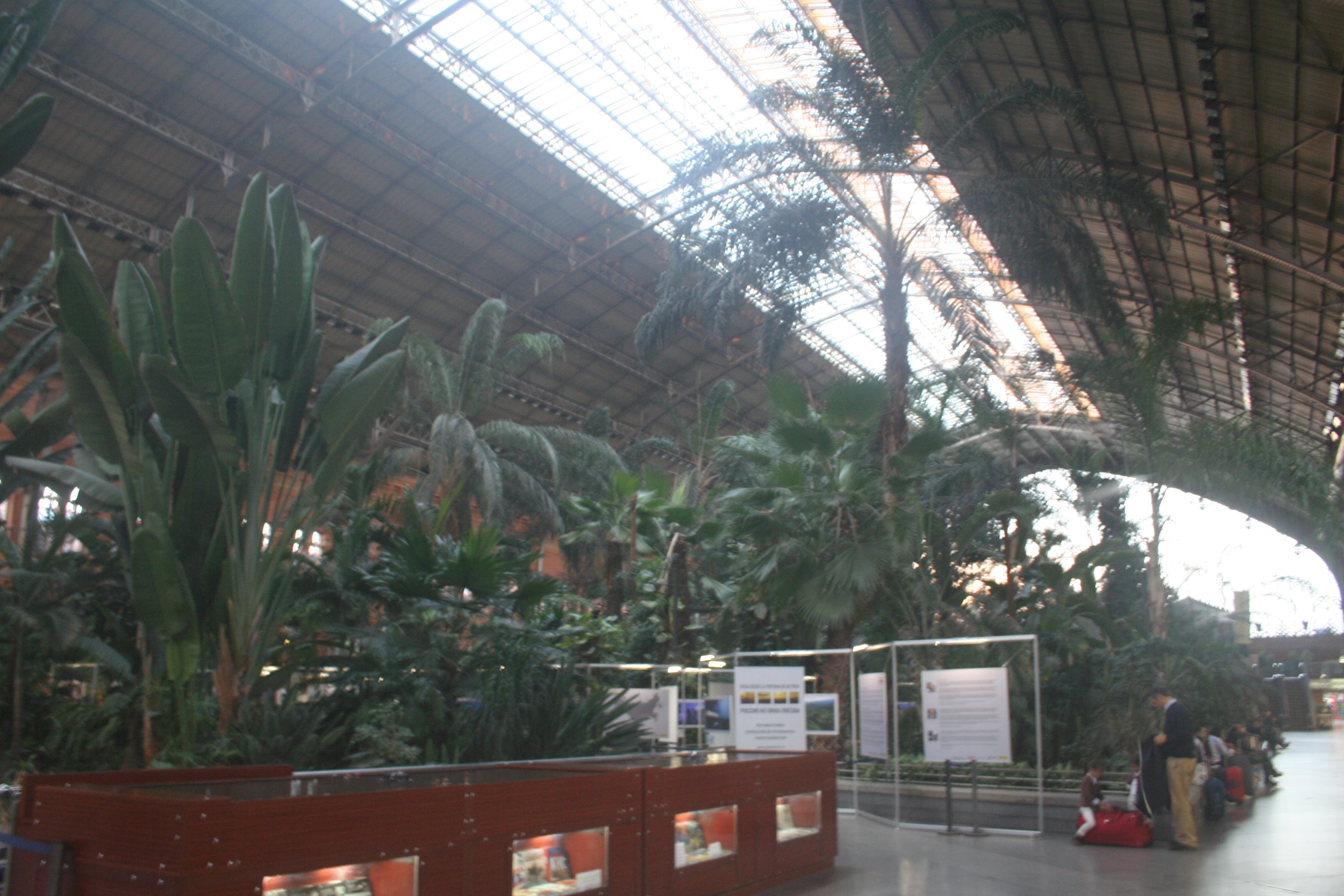
 Last breakfast with the wonderful gang we traveled with. Sat at table with couple from Vancouver who are on their way from here to Barcelona to catch a cruise ship which will take them down the Med, past Gibraltar, and across the Atlantic, docking finally in New Orleans, from which they will fly home. Everybody else heading home. Said our farewells, then rolled our bags a few blocks to the Metro, where we caught train back to Atoche and the Hotel Mediodia. As expected, room would not be ready until 2, so with minimal assist from very rude clerk we stowed luggage behind the desk and crossed over to the great Atoche Train Station to hitch ride to Toledo. Alas, trains were full until early afternoon, when we’d hoped to be back. Still much to see in Madrid. So, with a new plan, we got back on the Metro and rode up to Plaza del Sol for look at Cathedral and the Convent.
We found the Madrid Cathedral, and went in briefly. It is a beautiful structure, but quite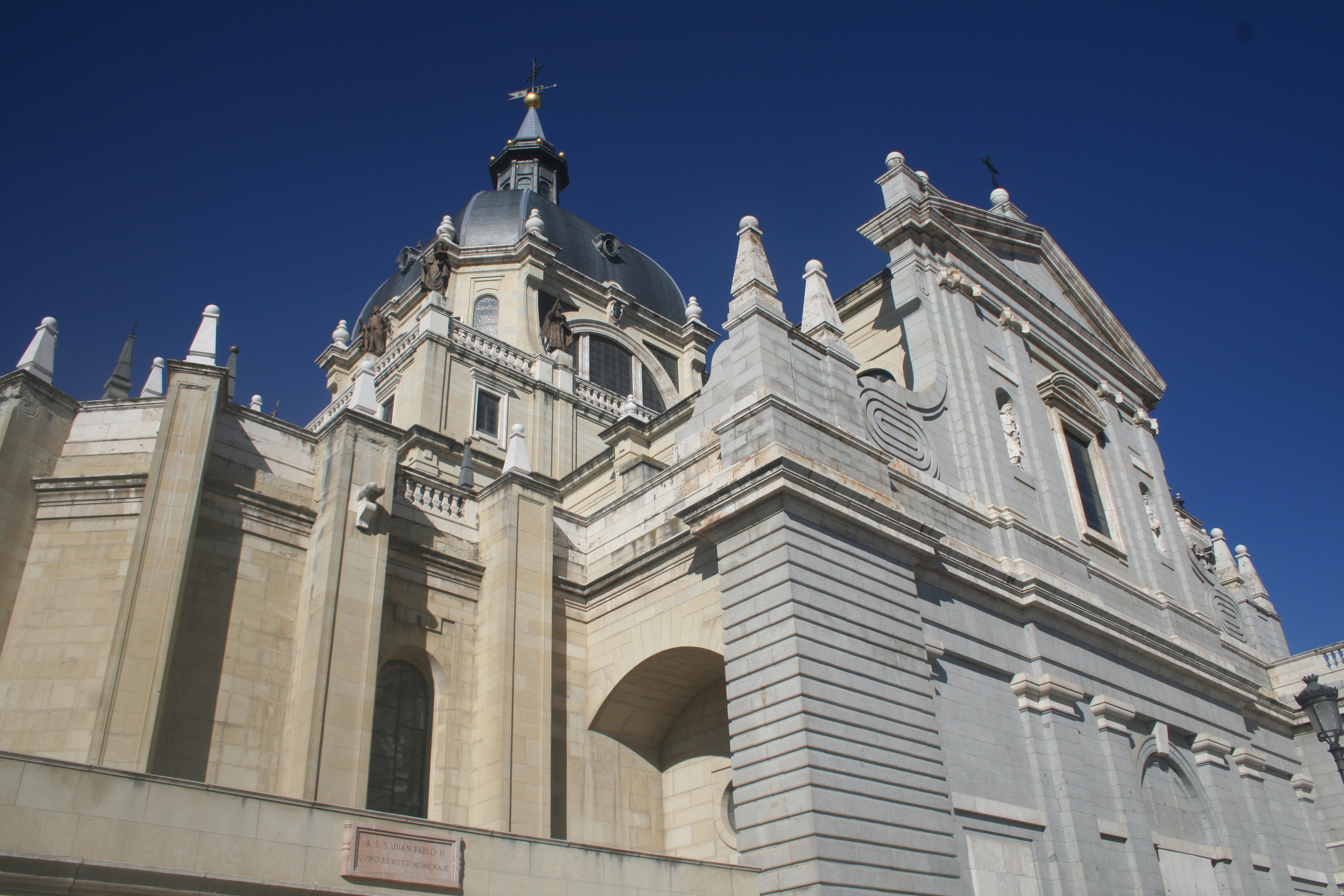 recent, compared to most of the other churches and buildings we’d seen. When the capital of Spain moved from Toledo to Madrid in 1561, the seat of the church remained in Toledo. The capital had no cathedral until construction began on this one in 1879. Work ceased completely during the Spanish Civil War, and the project was then abandoned until 1950, and it was not
  completed until 1993. Too new to really be of much interest. We wandered down to the Convent de las Descalzas, and got tickets for an English tour starting in a half-hour. Just enough time for a coffee at a cafe a short distance away. Saturday morning, and the streets off Plaza del Sol, and Plaza Mayor were starting to fill. We went back to the convent and met our guide, a lovely Spanish
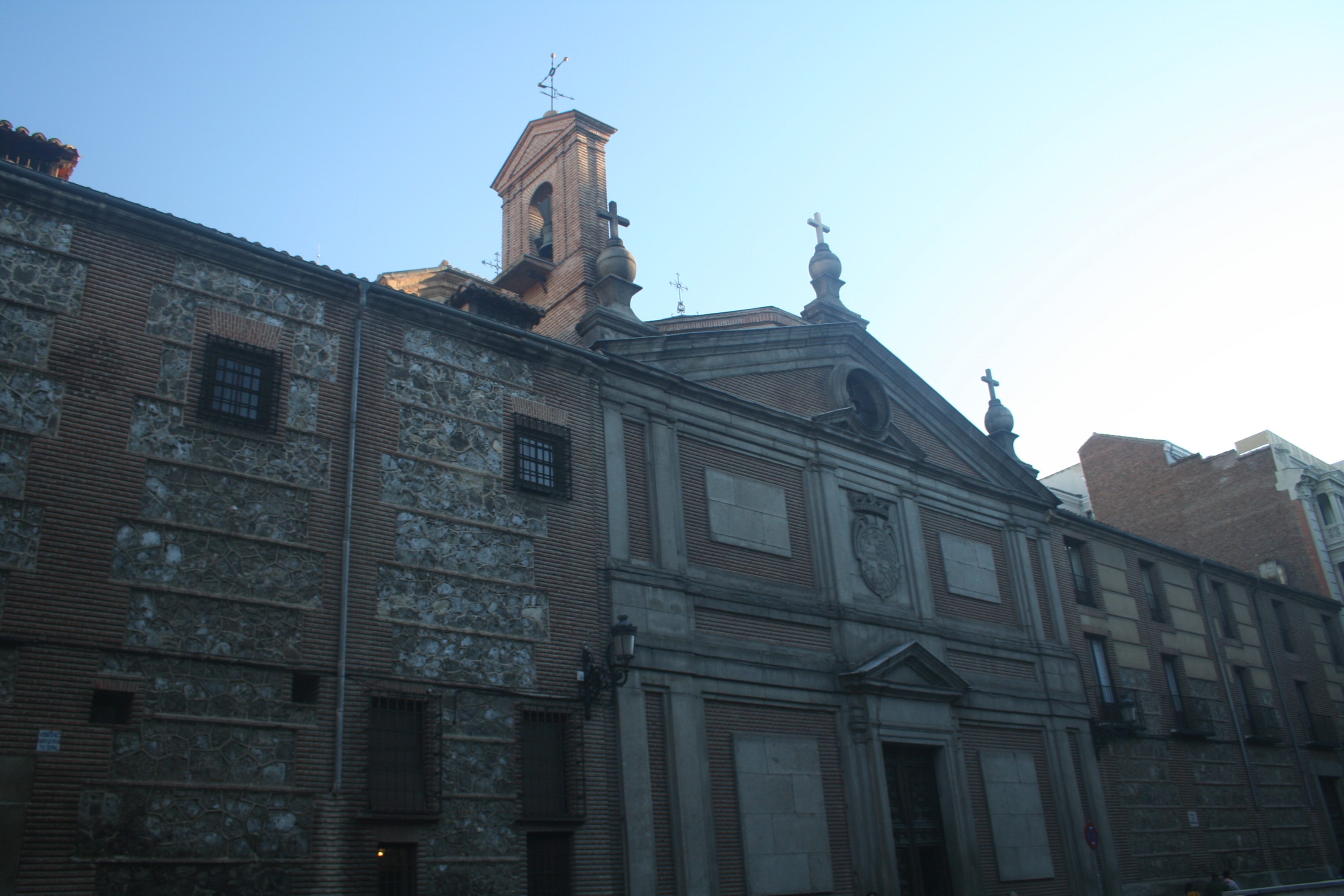 woman who spoke English in a rich, textured accent. We sat in a small ante room inside while our group filled (more evidence of how uneducated we Americans are; the rest of our tour, in English, were Germans and Spaniards; don’t think we could have done the German tour) and then we were off for a walking tour through this remarkable place. The building is the former palace of Charles I of Spain and Isabel of Portugal. Their daughter, Joan of Austria, founded this order of the Poor Clare (Franciscan) nuns in 1559. That’s interesting enough, but through the end of the 16th and into the 17th century the convent attracted young spinster or widowed noblewomen, who each brought with her a pretty hefty dowry. The result being that the convent became one of the richest in Europe, with many of the dowries invested into relics and bejeweled exhibition pieces. Some of the relics housed at the convent include purported pieces of Christ’s cross and the bones of St. Sebastian. Among the priceless works of art on display are Titian’s Caesar’s Money, Tapestries woven to designs by Rubens, and works by Hans de Beken and Brueghel the Elder. Over time the demographics of the residents changed, and by the 20th century all the sisters were in poverty. Nineteen cloistered still call the convent home, and utilize the extraordinary chapels we were able to see when the building is closed to visitors. As we saw in the Seville Cathedral, there are dozens of small chapels lining the corridors, each dedicated to a particular saint, and most containing great works of art, or significant relics. The architecture and construction of the building reflects, of course, its role as a palace, with tile and marble everywhere, including long stair case bannisters carved from single chunks of marble. Unfortunately, no photographs were allowed. We thoroughly enjoyed this place, and though we heard bells from time calling them to various tasks and offices, we did not see any of the secretive nuns.
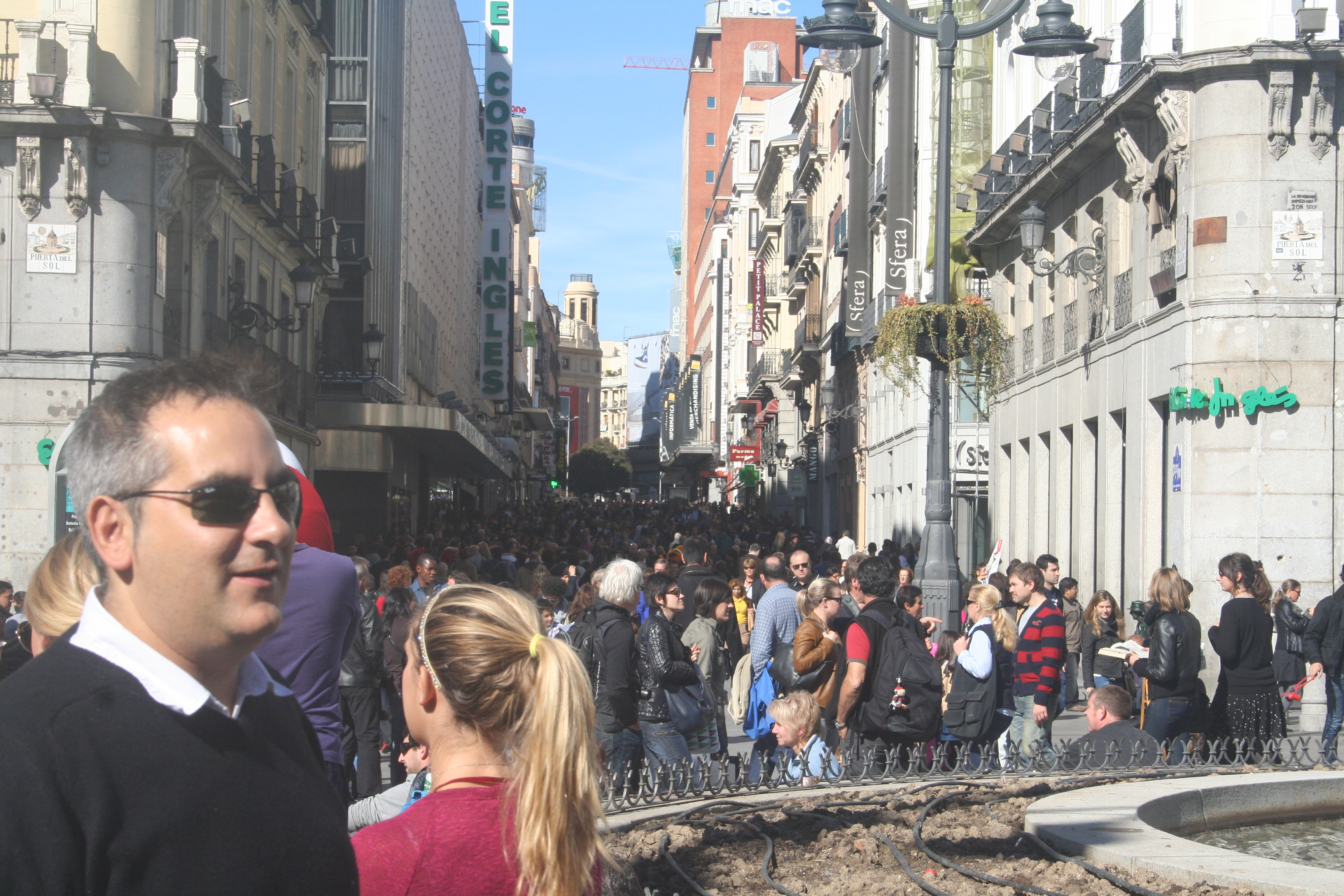 Back out into the street and squares then, the Saturday crowd at full force. Truly a remarkable sight. With a little luck and a great deal of perseverance we found one of the last places on our must-see list, a restaurant called Sobrino de Botin, established in 1725, which the Guinness Book of Records lists as the oldest eatery in the world. Besides that amazing distinction,
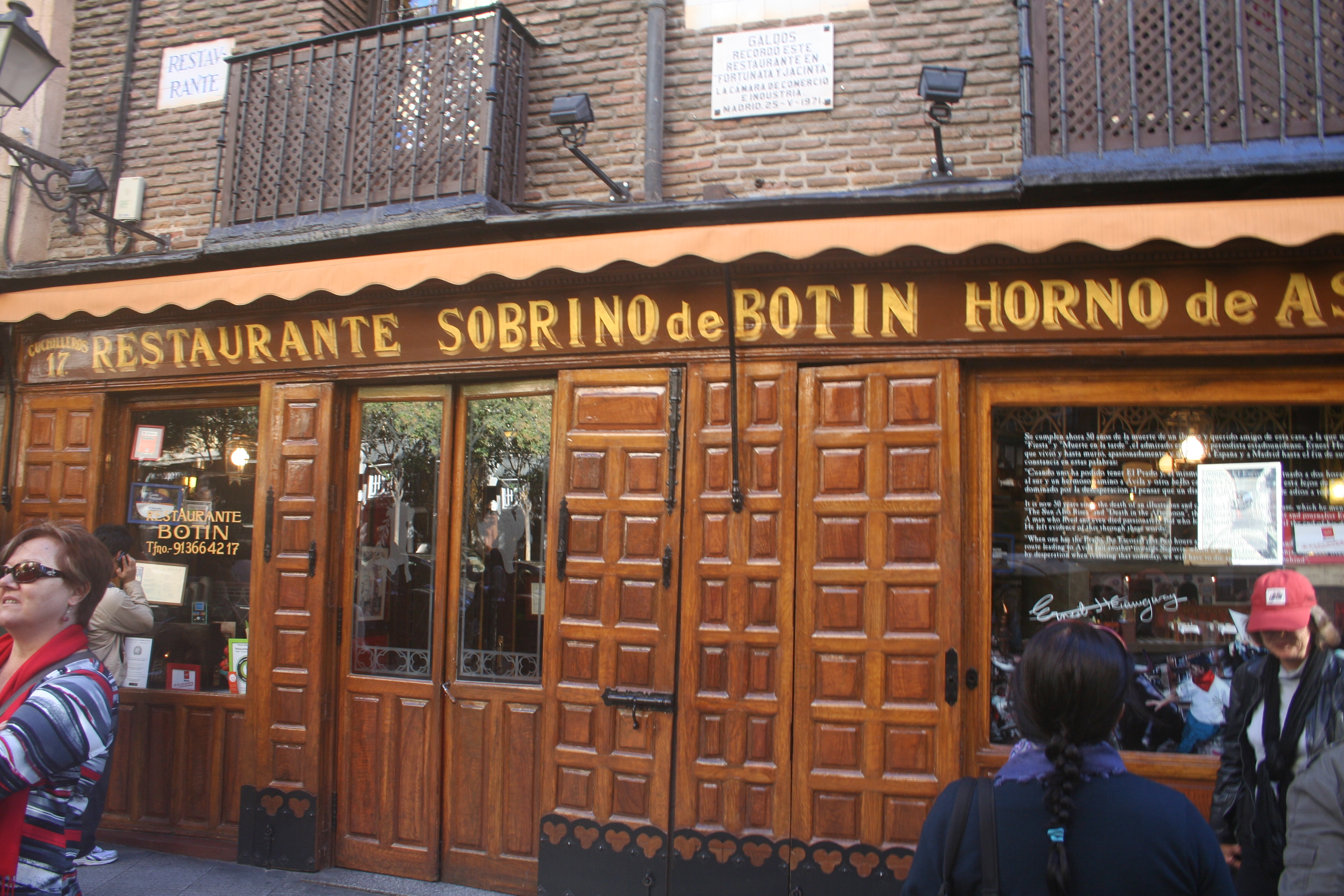 Francisco de Goya worked there as a waiter while waiting to be accepted into the “Royal Academy of Fine Arts,” and, as attested on the front window, it was Hemingway’s favorite restaurant in Madrid. It is the place where Brett and Jake have lunch at the end of “The Sun Also Rises.” When Brett, to paraphrase, says they could have had such a wonderful time together, Jake replies, “Isn’t
 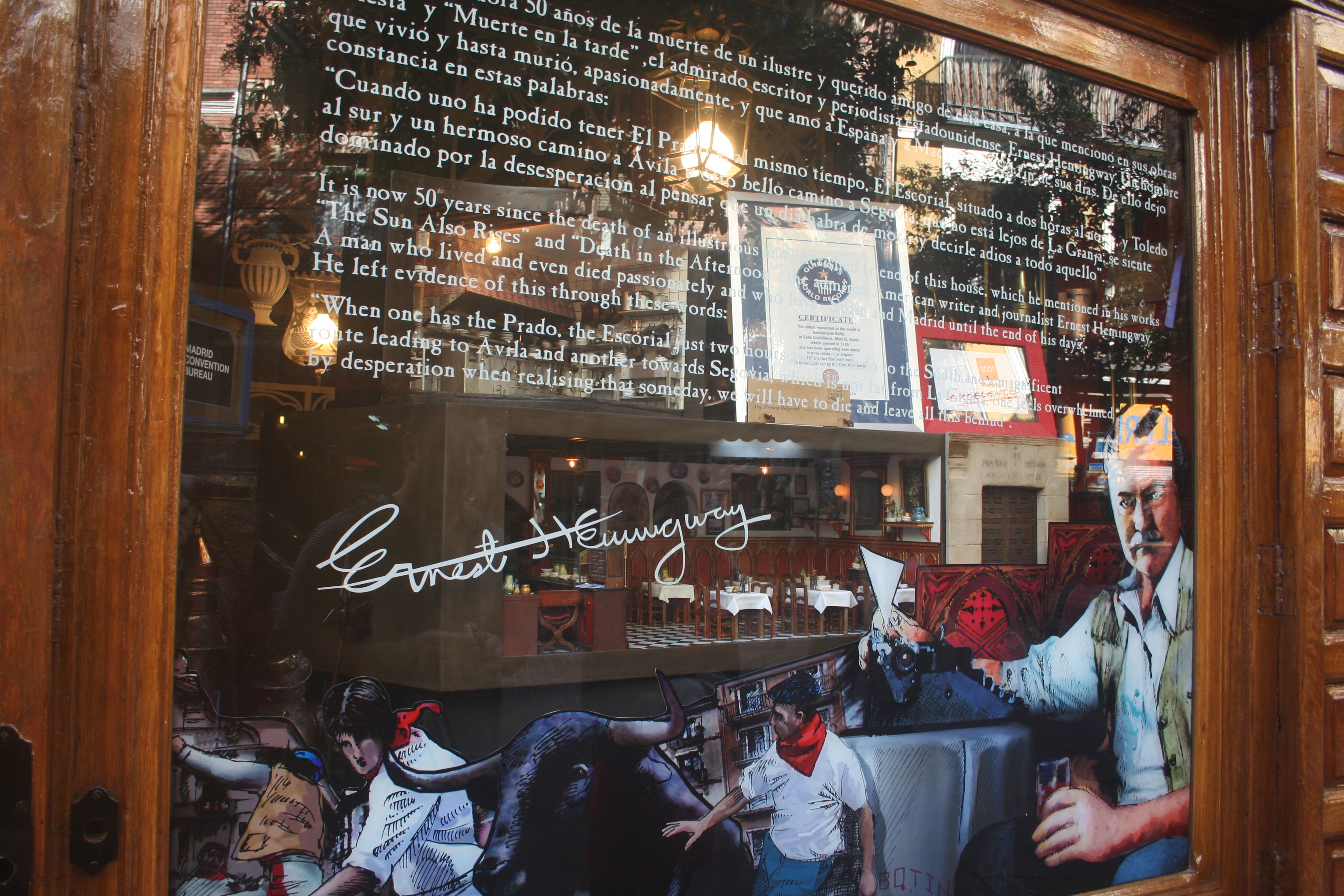 it pretty to think so?” One of the great last lines in all literature. It opened for lunch at one and we got there at quarter til. I went in and asked if we could get a table, and the very kind gentleman said, yes, he would hold one for me in the small front room just off the entrance, where there were but six table. We went out and waited, and then were promptly seated at one. We could see
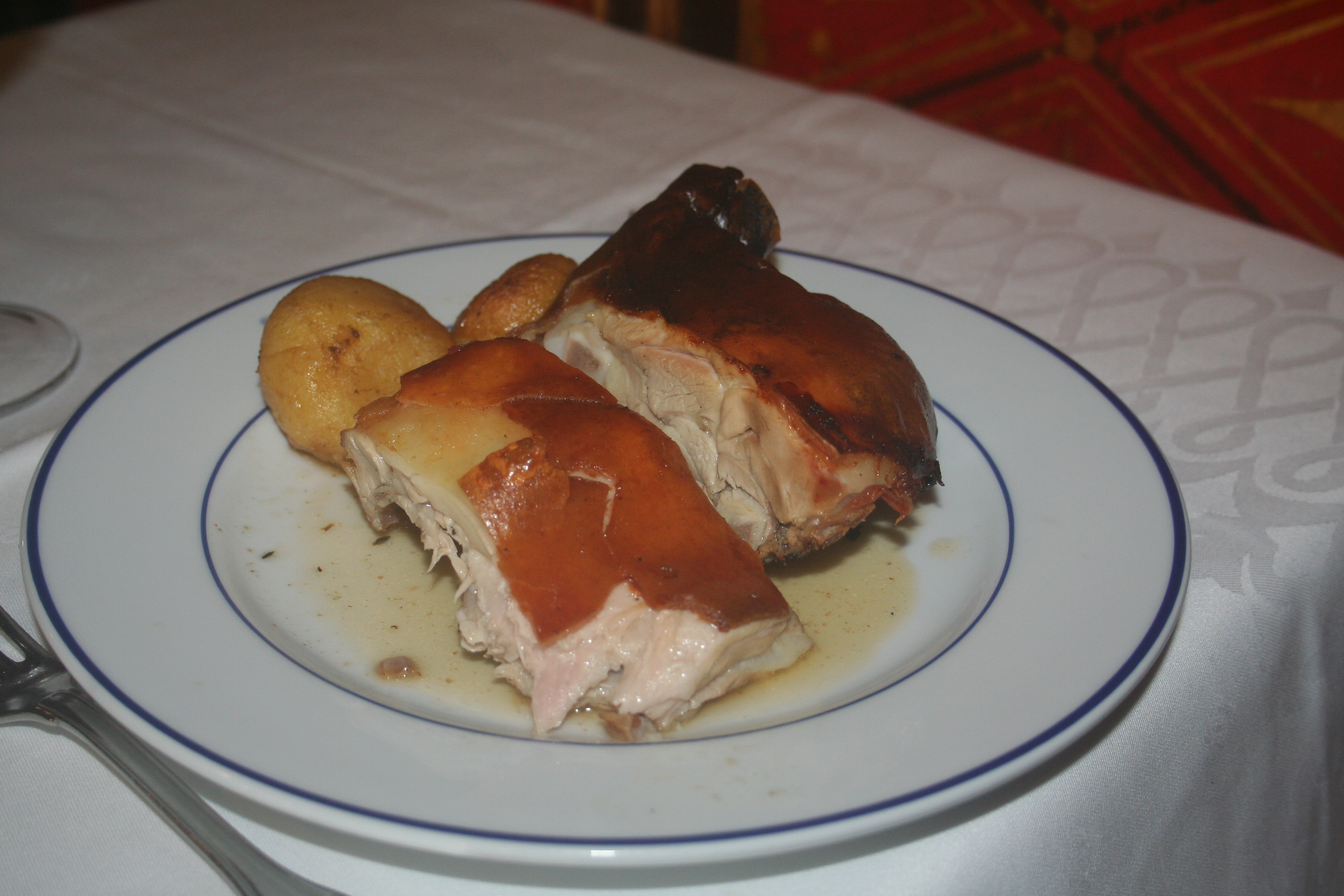 the doorway and all the people trying to get in, and we quickly realized how lucky we had been. Right away, our little room filled, and after that, if you didn’t have a reservation, you weren’t seated. The specialty of the house is roast suckling pig, so that’s what we ordered, (sorry vegans) and a pitcher of Sangria. One little pig is plenty for two people, and came with roast potatoes as well. Superb!
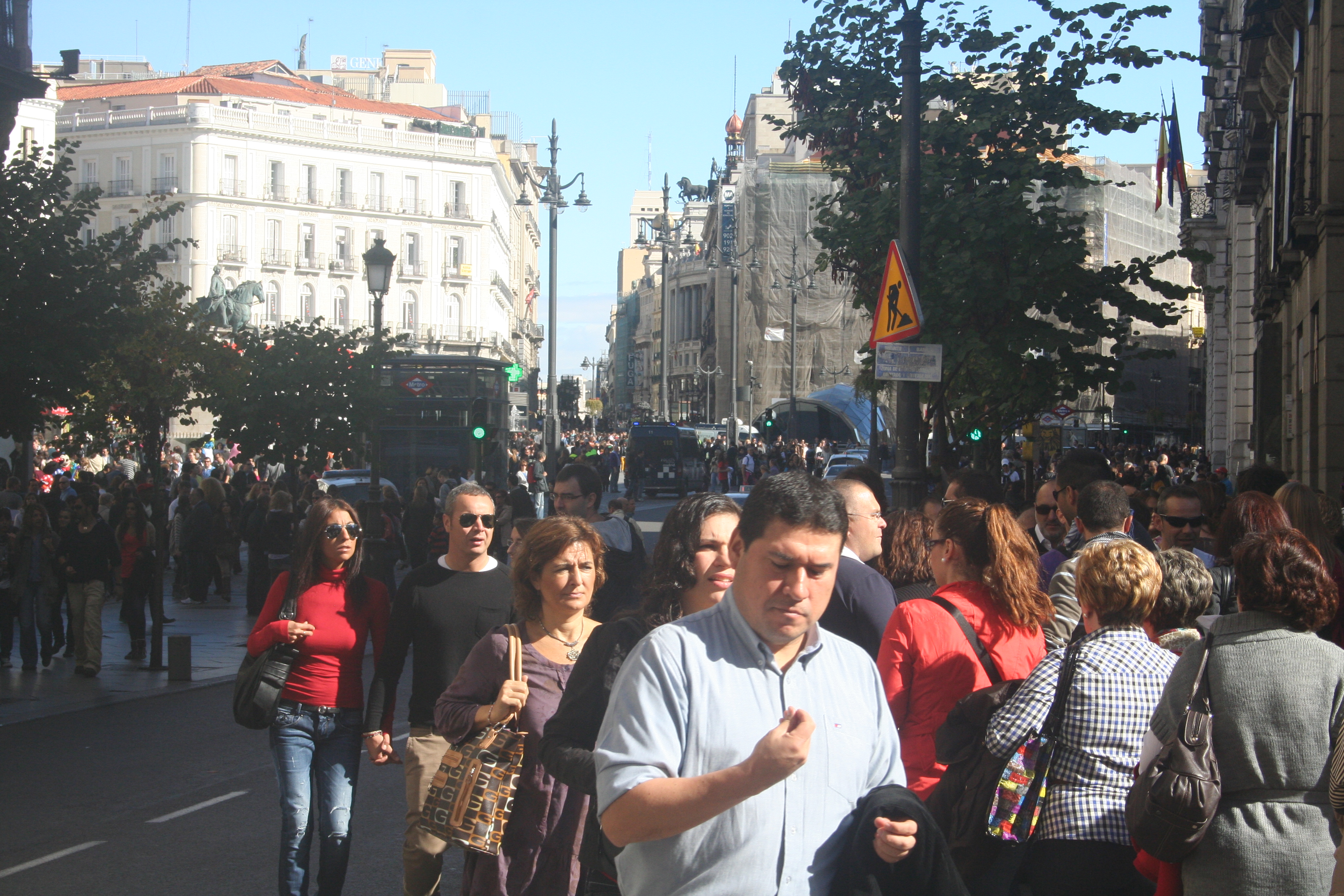 Quite satisfied after our lovely lunch, we went back out into the sun and up to Plaza de Mayor on our way back to Sol and the Metro down to Atoche. A festival atmosphere reigned. People were out with their families; young, old, everyone mingling, shopping, flowing in and out of the many tapas bars and restaurants. The square itself was just about shoulder to shoulder,
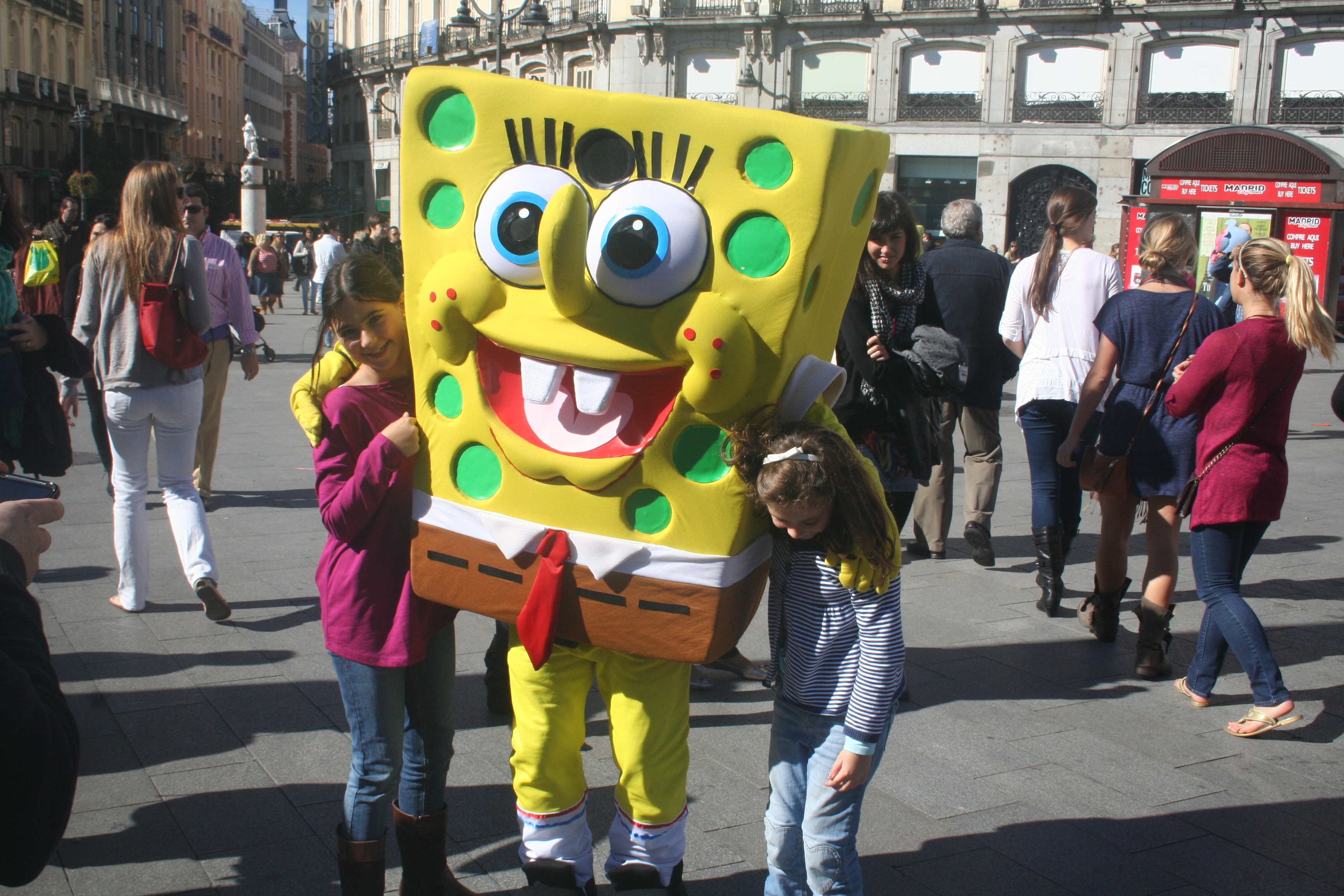 and even included SpongeBob! We Leisurely strolled through the crowd, adapting to its laid-back, happy energy, and cruised the wonderful shops on the streets between the squares. Veteran Metro riders by now, we easily negotiated the changes, and were back walking through the doors of the Hotel Mediodia in fifteen minutes. Upstairs for a much-needed nap, and then it was back out to the street for the short walk up to the Prado Museum, our last stop in Spain, and which had free admission after six p.m.
Apparently, every teenager in Madrid had found their way to the great round-about at Atoche while we slept. It was absolutely amazing! The boulevard up to the Prado is one of the most beautiful in Madrid, with a tree-lined walkway down the middle between the 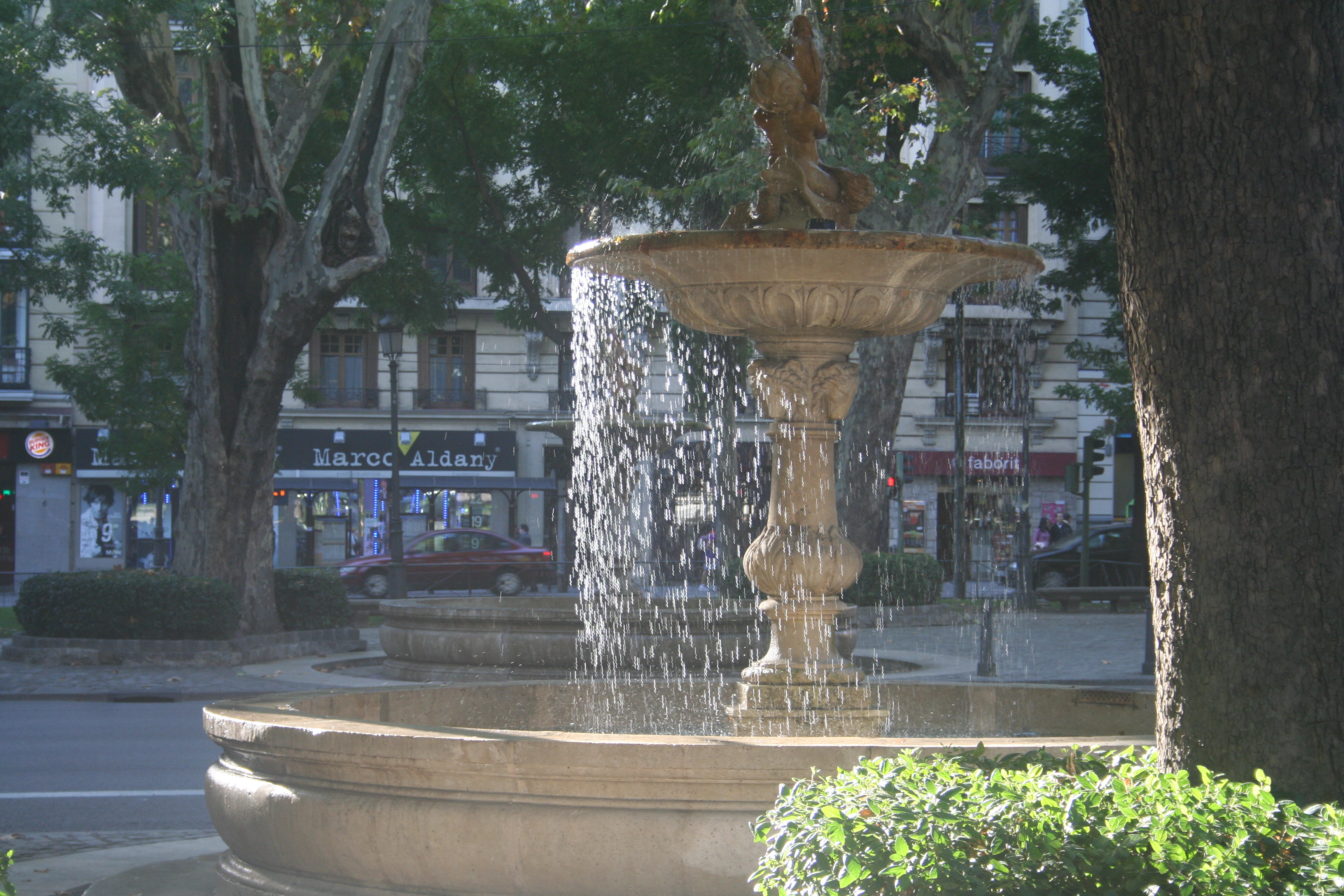 traffic lanes, and many trees on both sides, as well as shops and restaurants until the ample grounds of the Prado. Another wonderful walk. We were almost an hour early but a line for the free admission quickly formed, and we joined it early, enjoying the people watching. Inside, we picked up a map and decided to limit ourselves to seeing as many of the masterpieces conveniently highlighted as we could before we dropped. The Prado is
 enormous, and houses one of the finest collections of European art, from the 12th to the 19th centuries, and is known for its many Goyas, as well as Valezquez, Titian, Rubens, and Bosch. In all, there are some 7600 paintings, and thousands of sculptures, drawings, and prints. Many of the paintings, in the Spanish style of the 15th and 16th centuries, are absolutely enormous, and even the limited tour we allowed ourselves, (it would take days to see it all,) was overwhelming. It was incredible to be standing ten feet away from paintings we had seen in art history and humanities books, and this visit pretty much completed our tour of the world’s great museums.
Back to our hotel room for a light supper of bread and cheese, needing nothing more after that wonderful lunch, then early to bed to be up in time to get across the square for our 6 a.m. ride to the airport. It is done, but allow a few impressions.
 This was a trip we had long wanted to take, and we are very glad we did it the way we did, as part of a tour group. It was fast-paced, and we didn’t get to stay in one place as long as we might have liked, but we saw a lot of both countries as a result, and it was way more relaxed than trying to find our way alone. The architecture, art, landscape, food, and music were so rich, and the people, while we didn’t really get to know them, seemed amazingly resilient, happy, and potentially friendly, had we been able to slow down and make the effort ourselves. It is a strong, deep, and exceptionally vibrant culture, and we were saddened to learn, in our conversations with our guide, Luis, how difficult times have become for both the Spanish and Portuguese people. Both are on the verge of financial
  collapse, and Portugal is losing population. A way of life that has spanned many centuries seems on the brink. But they continue, and revel in their unique traditions. Most people live in the cities, but even there they shop at fresh food markets every day, eat and drink very healthily, and walk everywhere! There is no obesity problem, that we could see, in Spain, and, in fact the people were quite thin and handsome. It became something of a joke with us– all the women were size 4 or 5! It was like they were stamped out of a machine in that respect, and most remained quite lovely into old age. But there were also disappointments. Spain has become very expensive. As recently as ten years ago it was possible to find an apartment or small villa in Spain for the equivalent of a few hundred dollars a month. Food and services were cheap. We have long entertained a romantic notion that, on retiring, we might spend a few months a year in Spain, immersing and learning the culture, living that good life. We’ve let go of that now. Like so much of the world, it isn’t like that anymore, but hey, isn’t it pretty to think so?

 The Skinny Island Post