
We took off on our own this morning for a walking exploration of old Seville. Luis had warned us that all maps of Seville are notoriously incomplete; that there are hundreds of streets that do not appear on any map, and that streets may change name from one block to the next in the labyrinths that make up the old city. We had good directions from our hotel to our first stop, the Seville Cathedral, but we still managed to get turned around and missed it the first time by several blocks. Came across this unique, very modern pedestrian bridge near the main square. We asked directions, and eventually found the main drag, where the big church was located. It was still closed. We had more than an hour before it opened, so we crossed the square and entered the Alcazar, another of the must-sees on our list. Right away we were mesmerized. The Seville Alcazar is truly one of the world’s wonders, and one of the best remaining examples of mudejar architecture. Originally a Moorish fort, it has
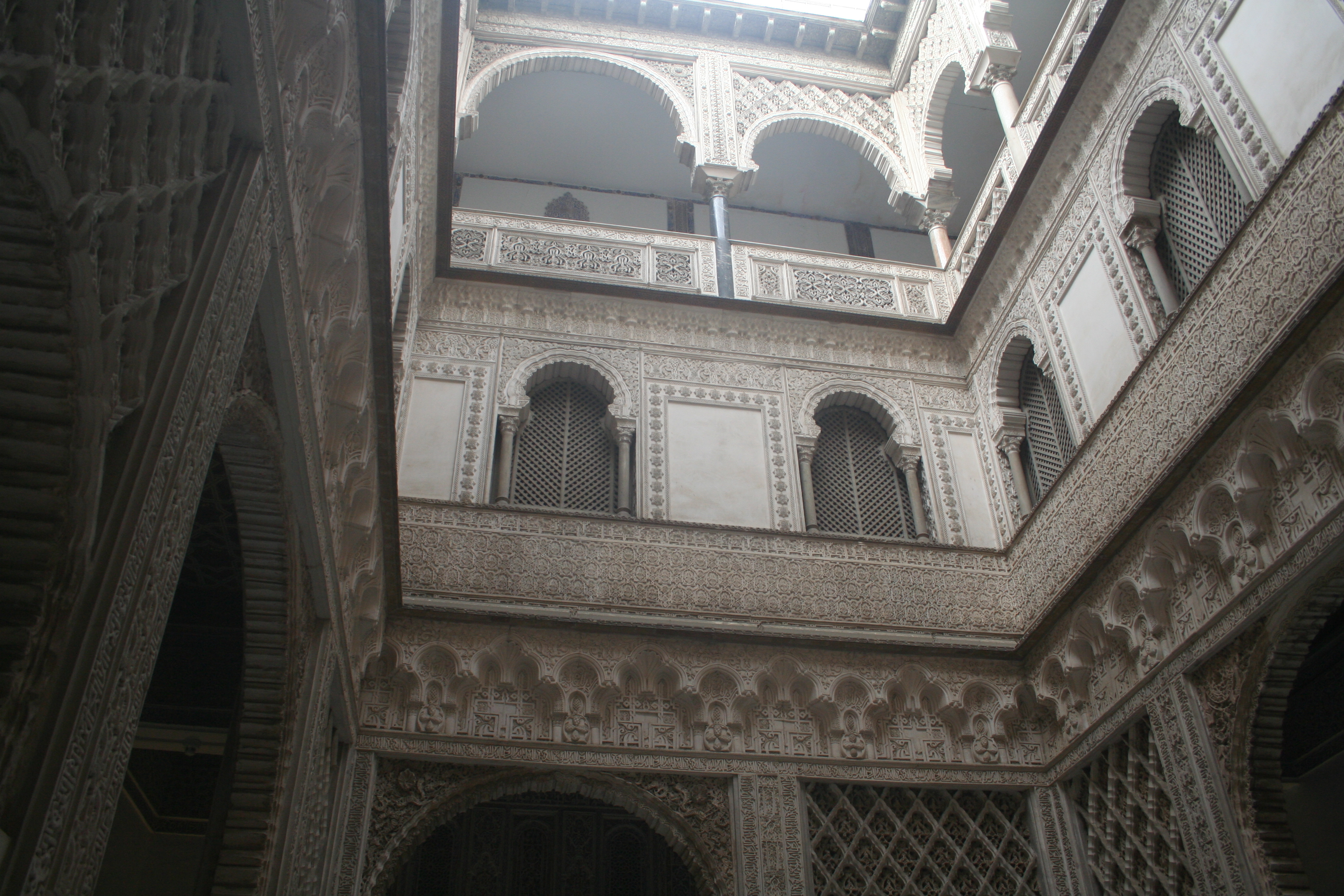 been expanded and amended over many centuries, becoming an extraordinary palace in multiple architectural styles, the upper levels of which is still the official Seville residence of the Spanish Royal family. Many stories can be told of the various rooms. The Casa de Contratacion lies off the la Monteria, one of the great, lush patios. Built in 1503, The Casa regulated trade with the New
  World, and included a chapel where Columbus met with Ferdinand and Isabella after his second voyage. It contains the painting The Virgin of the Navigators, one of the first painting to depict Columbus. We walked the floor where that rascal Columbus stood. Amazing.
We spent an hour and a half in the Alcazar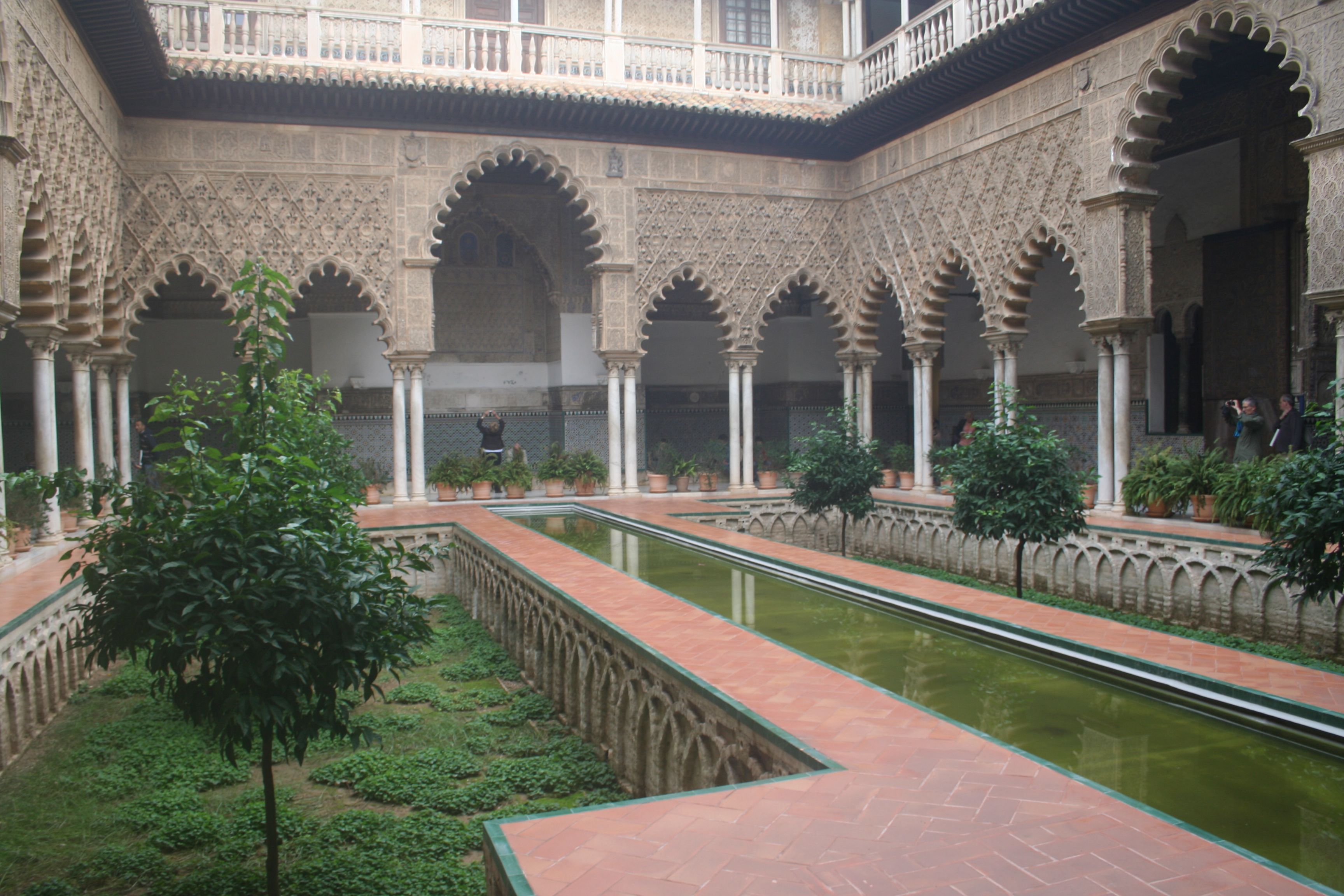 and would have stayed longer had we not wanted to cross over to see the Cathedral. Room after incredible room, garden after garden, pool after pool, all with elaborate tile work and fine marble carving, plaster work and filigree arches. Not space enough here for all the amazing photographs. We finally dragged ourselves out of the Alcazar, (I could easily live there,) and crossed the
 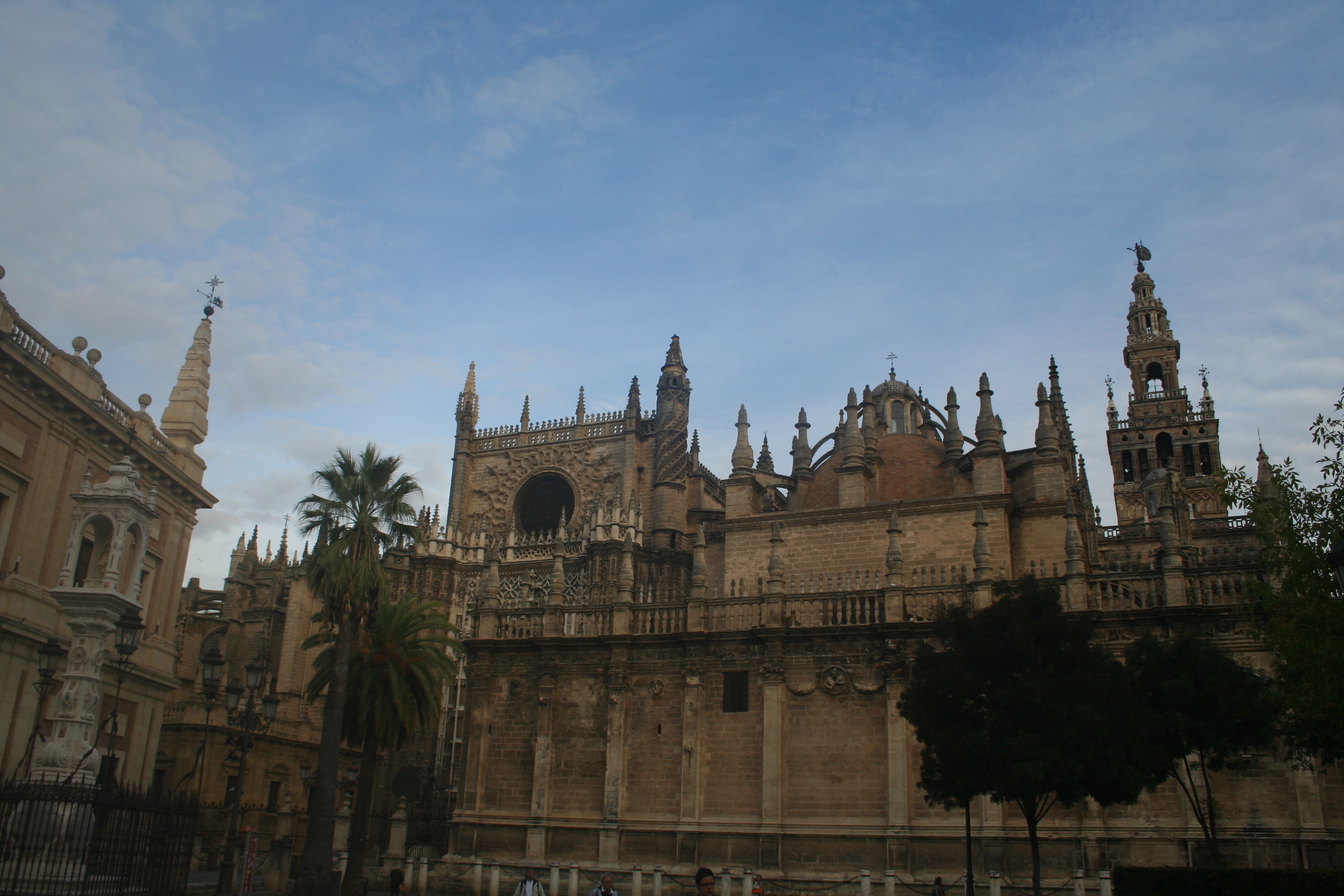 square to the Seville Cathedral. A good-sized crowd had already gathered,but we were able to gain entry in only a few minutes. Among other prized antiquities, the Cathedral houses the tomb of Christopher Columbus, although officials in Santo Domingo contest that assertion. They claim Columbus is buried on their island. Anyway, there is a tomb of Columbus in the Cathedral, whether or not Chris himself is buried there. It is the largest Gothic Cathedral
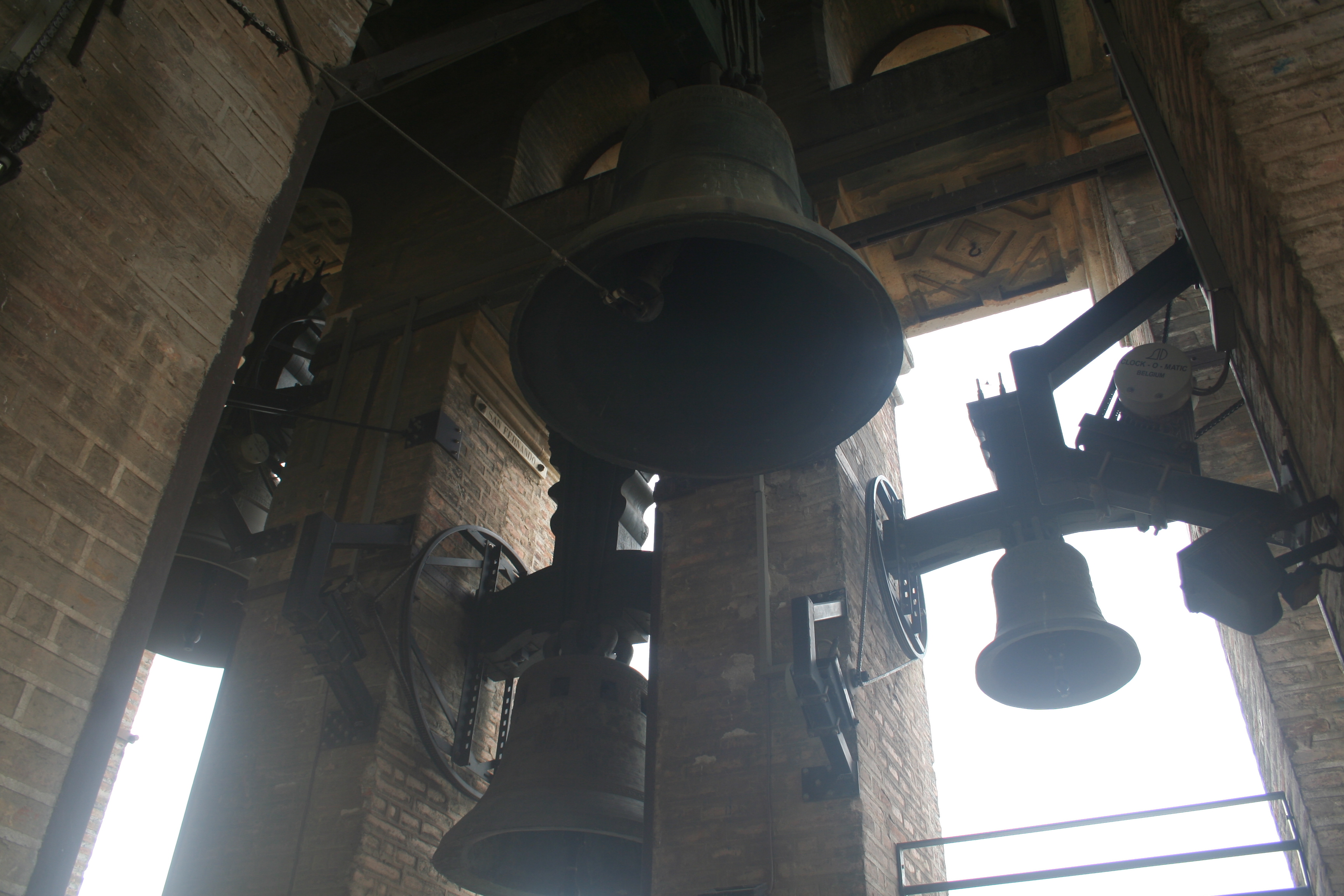
 in the world and the third largest church. Begun in 1402 and completed in 1506 the cathedral was built to demonstrate the wealth of Seville on the site of an old Moorish mosque. Some of the columns and other elements of the mosque were incorporated into the construction of the church, most famously the Giralda, a minaret converted
  into a bell tower. It is 105 meters tall and Seville’s most famous landmark. A ramp of some 42 switch-backs takes you to the top, affording a wonderful view of the city.
Inside, one is certainly struck by the opulence of Seville at the time of the construction, owing, in no small part, to the gold and silver being shipped back to Spain from the conquests in the New World. The central dome is lavishly decorated with gold and silver, and there are gold and silver crucifixes and statues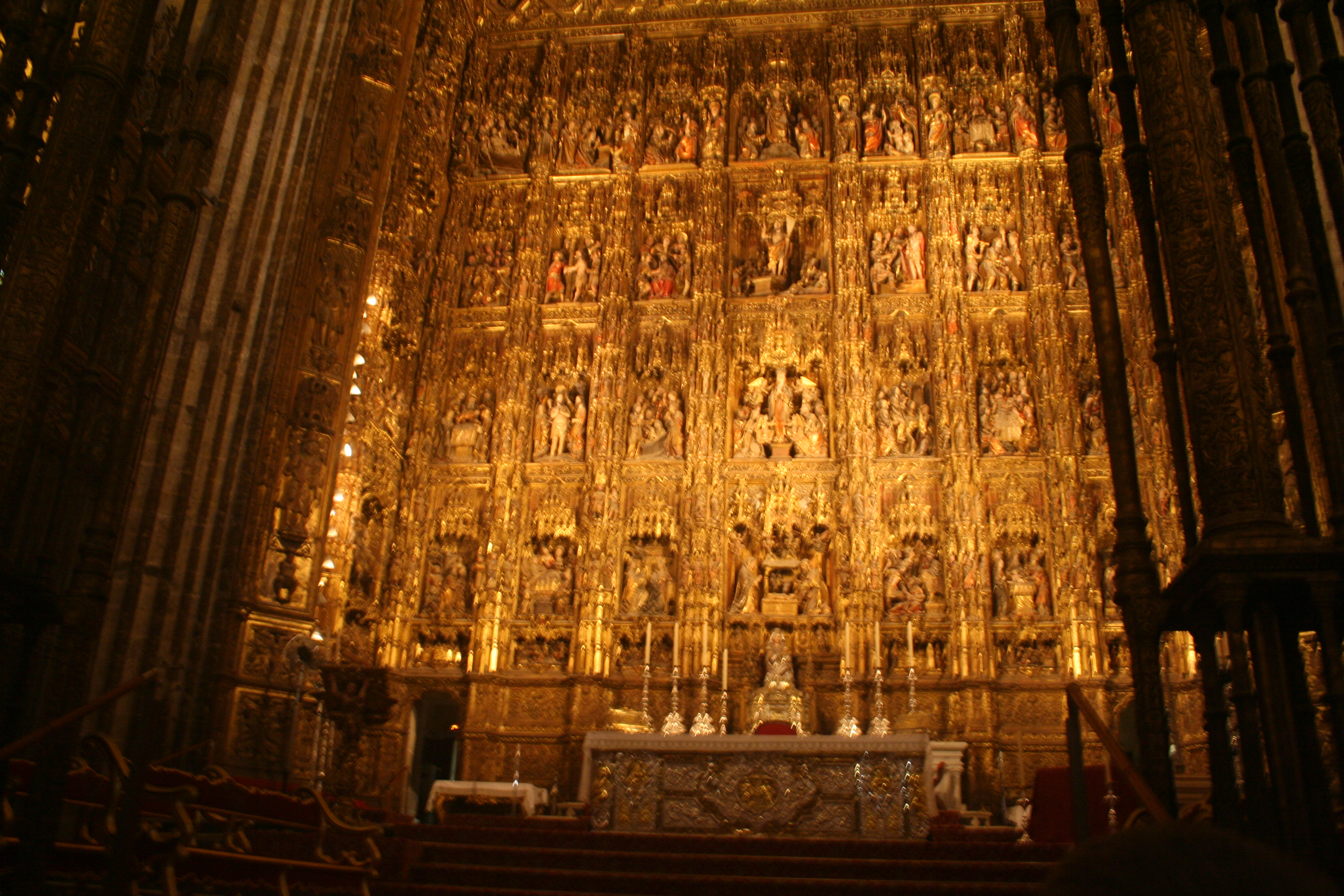 throughout. The amazing altarpiece was the lifetime work of a single craftsman, Pierre Dancart. There are 80 small chapels dedicated to and depicting the lives of Saints around the inside perimeter, and it was said in 1896 that as many as 500 masses were said daily. It is an awesome place, but feels more museum than church, and the opulence and grandeur of the relics (the
 chalices alone are priceless) leaves one, a Protestant, anyway, with an uncomfortable sense that things had gotten badly off track, theologically speaking, that the place was built on the backs of an enslaved and ultimately exterminated people, and that the Reformation, while still a work in progress, was one of man’s greatest achievements.
 Leaving the cathedral, and with a good feel for where we were going we walked only a few
 minutes and found the Plaza de Espana, which we had visited briefly with Luis the night before. It is another grand, spacious place, and we took a casual, relaxed tour of its beautiful structures and tile works. Along the curved wall facing the vast open area are small alcoves depicting, in elaborate tile work, each of the Spanish provinces. They are very beautiful and most photogenic.
  Now a great place for a casual stroll, or to take a lunch, the plaza was built in 1928 for the 1929 Iberio-American Exposition, it is a combination of Art-Deco and “mock” Mudehar styles. The buildings themselves now house government offices. We continued out the open end of the plaza and into a beautiful park, part of the redevelopment of the entire south side of the city into park space and grand boulevards at the time of the exposition. There are wide
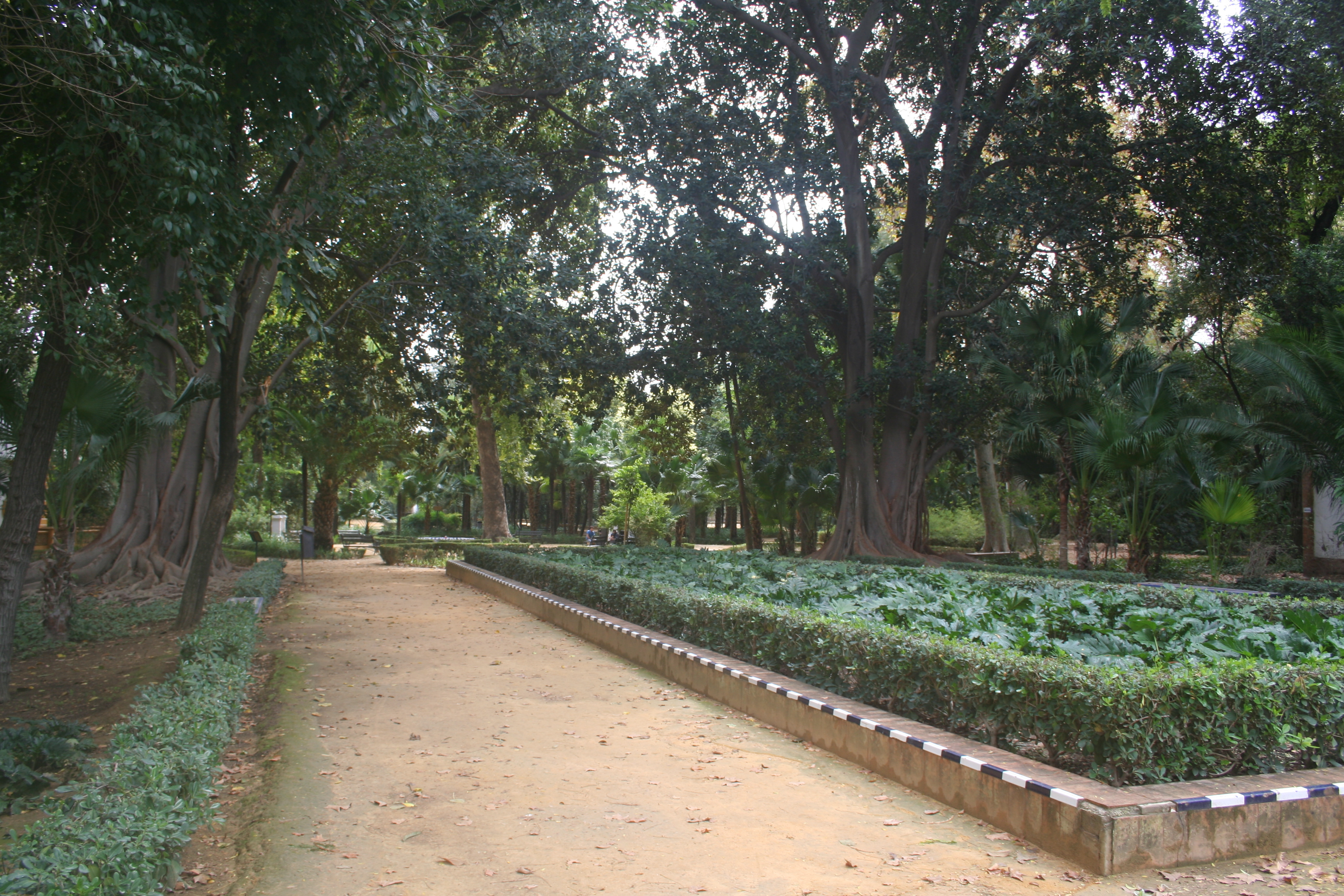 foot and bike paths, many trees, and a path for the horse-drawn carriages that carry tourists on extended tours of the old city. Continuing through the park you come out on the busy boulevard bordering the river Guadalquivir, where you also find another famous landmark, the Golden Tower, a surviving part of an extensive wall and tower system built to fortify the city by the Moors in the 11th century. We walked out onto one of the river bridges, then, using the
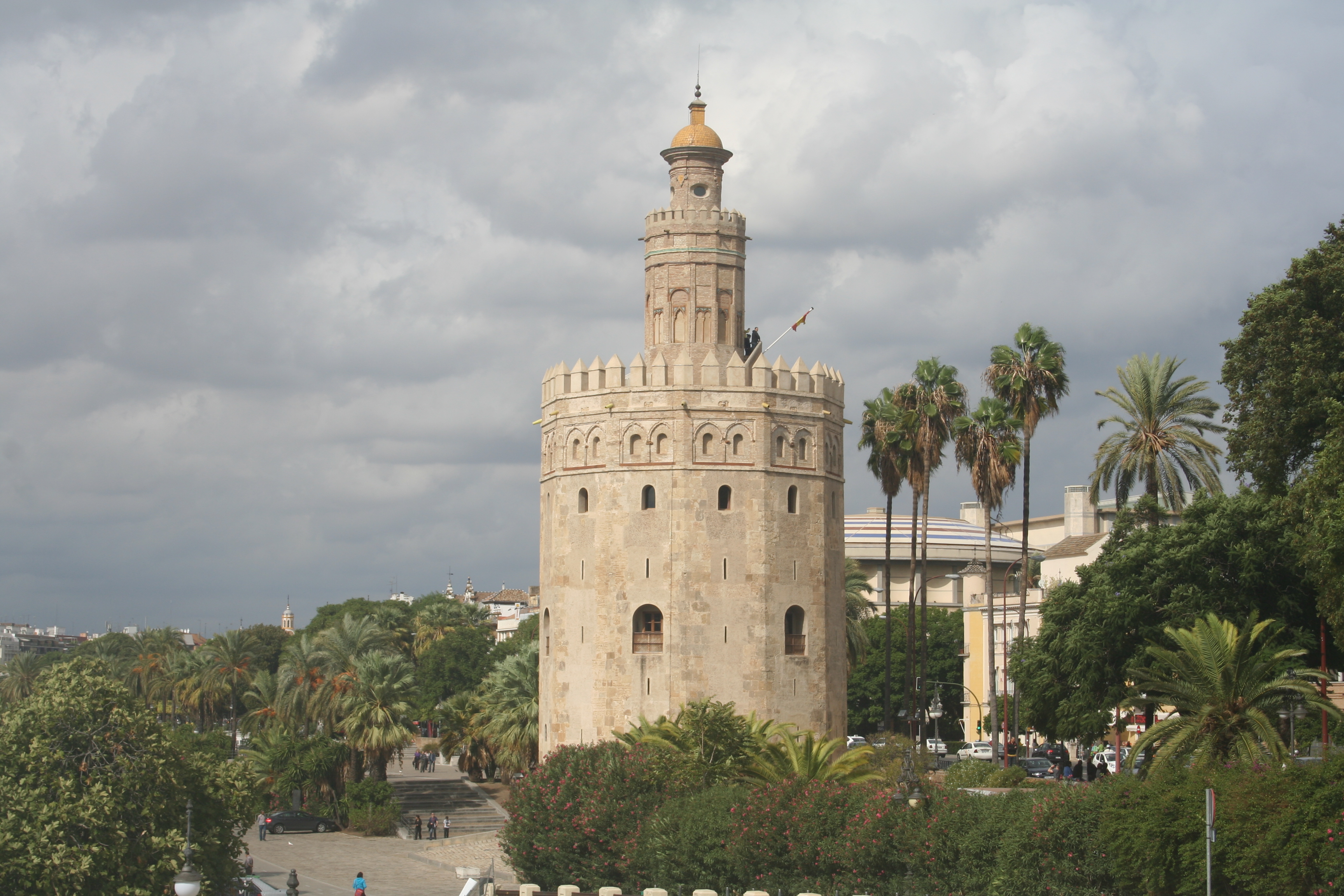 cathedral tower as our guide, headed back up into the city to find our hotel. We once again found the streets of Seville to be a bit challenging. Several wrong turns ensued, but we could tell from the map and landmarks that we were getting close. Luckily, a nice tapas bar appeared on our way on one of the narrow, twisting streets, which, by the way was heavily trafficked by both pedestrians and cars, and we enjoyed some fine chorizo tapas and an excellent draft at a sidewalk table, precariously close to the street. Sufficiently fortified, we trudged on, got further lost, and stopped in a shop to ask directions. “What would you like,” a kindly patron responded, “German or English?” We settled for English, he gave us clear directions, and in a few minutes, we found ourselves in the square where our hotel was located. We stopped in a grocery store next to the hotel and bought a bottle of Spanish red wine, then went to the room for a much-needed nap.
Haven’t said too much about the accommodations, but they were consistently excellent,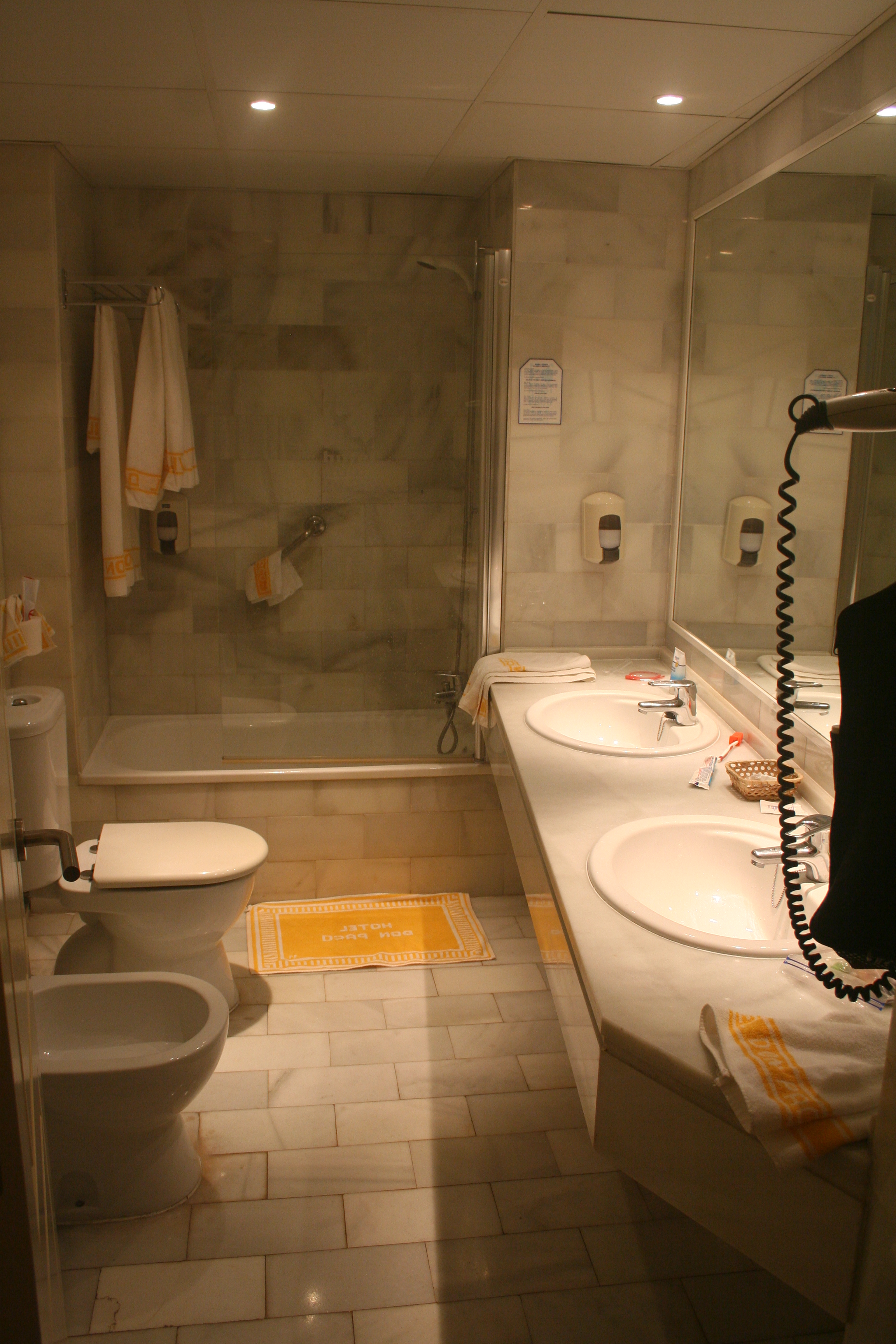 although the showers weren’t always full enclosed, the soap seemed to get smaller with each stop, and they do not believe in wash cloths in Spain. Here’s a little peek at our bathroom in Seville, way too nice for us beach people. And of course, there was the ubiquitous bidet, great for washing out socks and underwear.

Happy hour in the room with our very excellent wine, then down to dinner, a badly prepared amalgamation of American-style food, then up to the roof with some of our traveling companions to finish the wine. The bar was closed, we sat and talked for a time in the dark, and then were told to vacate the roof by hotel staff. Bummer. But a wonderful stay in Seville. Off to Cordoba, La Mancha, and Madrid tomorrow.

 The Skinny Island Post