
Been listening a couple of days now to Toumani Diabate play the Kora, an extraordinary West African instrument. The Kora, a kind of cross between a harp and a lute, is a complicated double-bridged thing with 21 strings, made from half a Calabash gourd attached to a long wooden neck. Cow hide is stretched over the hollow to create a resonating board. It is played with only the thumb and index fingers of both hands, the rest used to hold the instrument. The left hand plays 11 strings, the right 10. Apparently the only thing more difficult than playing a Kora is keeping one tuned. Traditionally this is done with leather tuning rings, but more frequently now with machine heads like a guitar. In the hands of a virtuoso like Diabate, though, it is capable of producing music of exquisite range, texture, and mood. Unfamiliar and strange, yet universally soothing and comfortable, It will take you places you’ve never been.
* * *
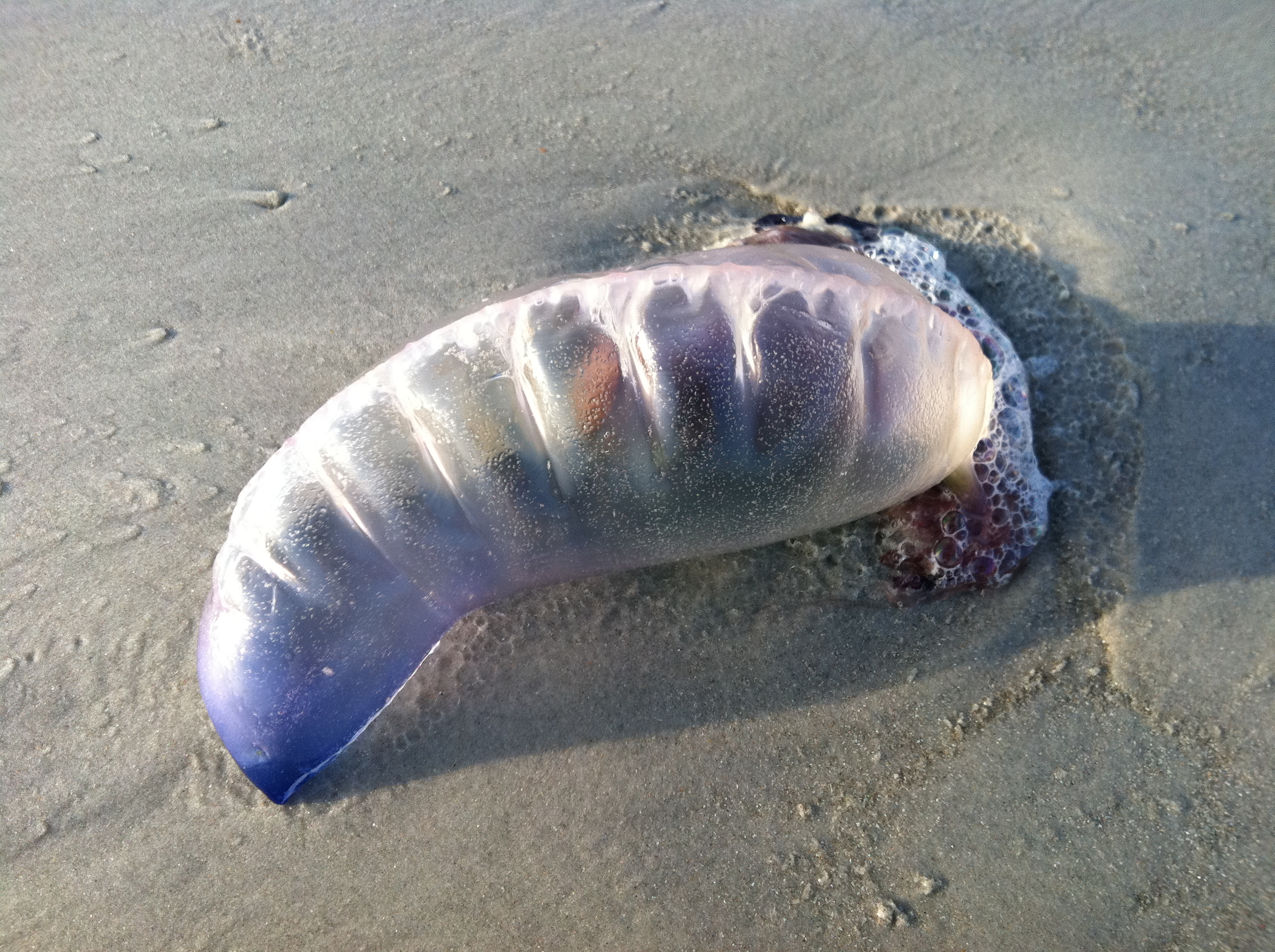
Portuguese Man-of-War
This is a friendly neighborhood Portuguese Man-of-War, we found on the beach this morning, tentacles detached. When there are several days of on-shore winds, as we’ve had lately, they get blown in from the Gulf Stream to litter the beach. On their way in, of course, you run the risk of a little encounter if you’re in the water. The tentacles of a large one can reach 50 meters, but most fall into the ten to twelve meter range. Even when detached, probably by the rough surf, the toxin in the tentacles can remain potent for days and, lacking the gas-filled sail, which is carried ashore by the wind, they tend to stay in the water much longer. I’ve been stung by these rascals, and it’s no fun. In fact, it hurts like hell! Years ago, one of my son’s surfing pals had an anaphylactic reaction to being stung. The tentacle toxin is used to paralyze or outright kill small fish and shrimp, the animal’s main foods.
Because they sting, lots of folks think the Portuguese is related to the jellyfish. They’re not; they’re a siphonophore, a colonial organism made up of a bunch of tiny individuals called zooids, each highly specialized but incapable of surviving independently. A very complex organism. The food it stuns with the tentacle toxins is passed to digestive polyps for breakdown. Amazing. All that, and the creature has no independent means of mobility. It doesn’t swim, it sails on the wind. The sack on top, which does resemble a full sail, hence the name, (after Portuguese warships,) along with ocean currents, are its means of getting around. Oh, and don’t put vinegar on the sting site; that’s for a jellyfish sting, a wholly different toxin, and will only make it hurt and redden more. Rub it with salt water. That dilutes the effect.
* * *

Gulfweed
The same winds that blow in the Portuguese also blow in tons of this stuff over a matter of days, Sargassum, or Gulfweed. It is a brown to yellowish seaweed of the class Phaeophyceae, and free-floating, meaning it is capable of reproducing on the move and never attaches to bottom. The famous Sargasso Sea (700 miles wide by 2000 miles long), in the middle of the Atlantic, is mile after mile of this stuff. Like the Portuguese, it just gets blown about and carried with currents. What’s neat about Gulfweed are the little hundreds of little berry-like, gas-filled bladders each clump contains, that keep the thing afloat. You can pop them with your fingers to amuse your friends. More adventurous folks can make a medicinal tea of the leafy part. The Chinese say it removes phlegm. Don’t have much phlegm, so haven’t tried this. Happy sailing.
* * *

 The Skinny Island Post