
 With the sun tracking north on the horizon towards its summer apogee, we are finding the little hacienda once again, after a long absence, washed with extraordinary light for a few minutes just after sunrise. It’s a direct hit now through the end of September, when the sun, well into its southerly track, is well to the southeast on rising, and we get only diffuse, refracted light, welcome, but lacking the intensity of these encounters.
It is horizontal and direct, and lasts but a few minutes, changing even as you watch.
* * *
Starting to see many more Coquina Clams on the beach. For the uninitiated, uninformed, or just plain slow, Coquina Clams, Donax variabilis, are a tiny (usually less than 2.5 cm) bivalve found in abundance on many beaches, especially in the southeast. Its presence is indicative of a healthy inshore ocean. A filter feeder, it is an important link in the food chain, consuming small organic particles and algae, then consumed by fish like whiting, and shore birds. They are more 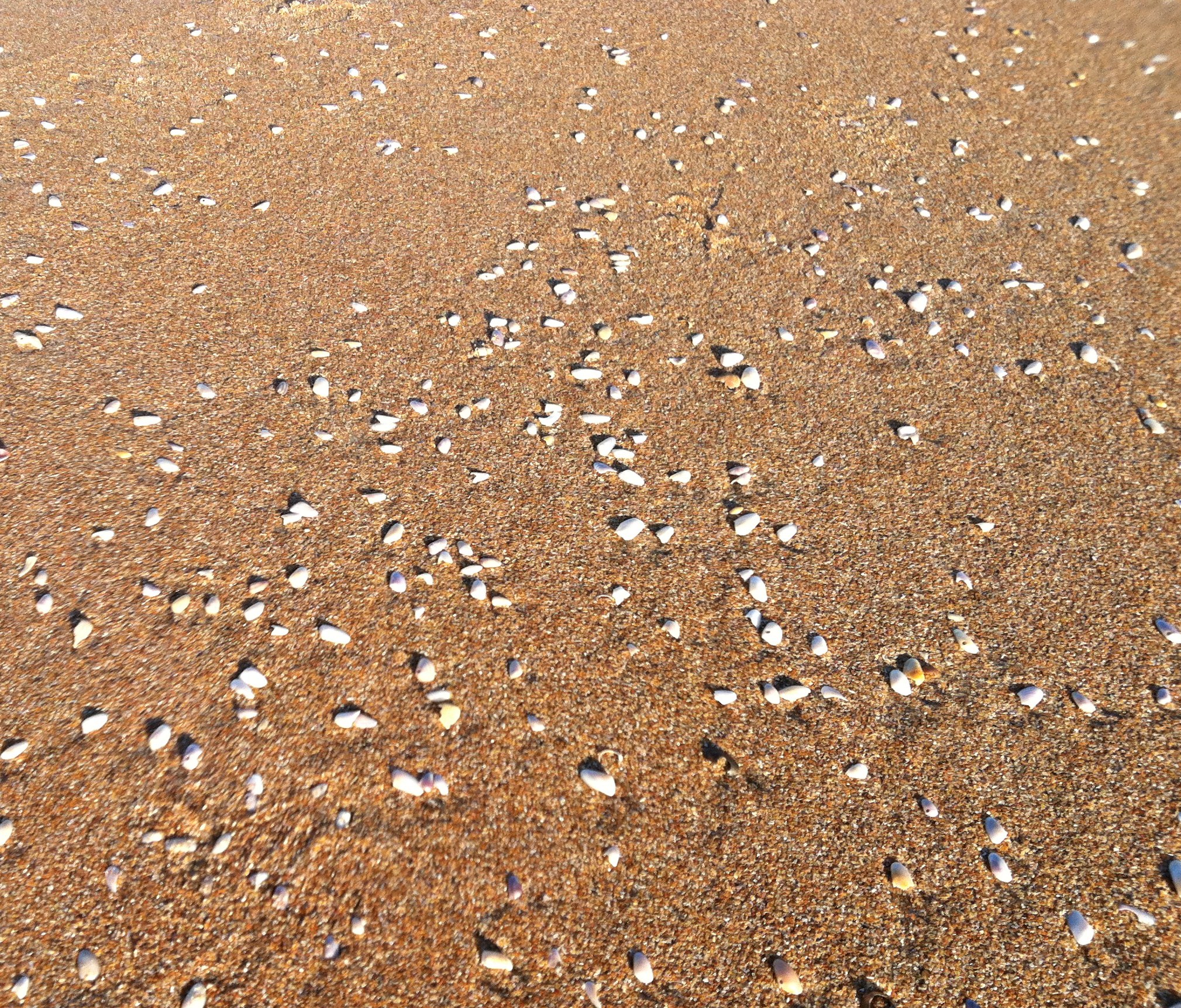 active and abundant in the warmer months, when a single wave may uncover thousands in a ten-square-foot area. They present in a variety of colors, from orange to blue, some with striping, and are quite mobile, burrowing quickly back into the sand once exposed. And fresh, they make an excellent soup. There’s obviously not much meat, but very flavorful. You can make a quite simple soup or stew, or add white wine, cream, potatoes, just about anything. Since it is a tiny clam you need a hefty amount to get flavor and substance, but there it is, right in the surfline. Add some whiting chunks, onion and garlic, and you’ve got a marvelous stew.
So seeing and thinking about Coquinas got me thinking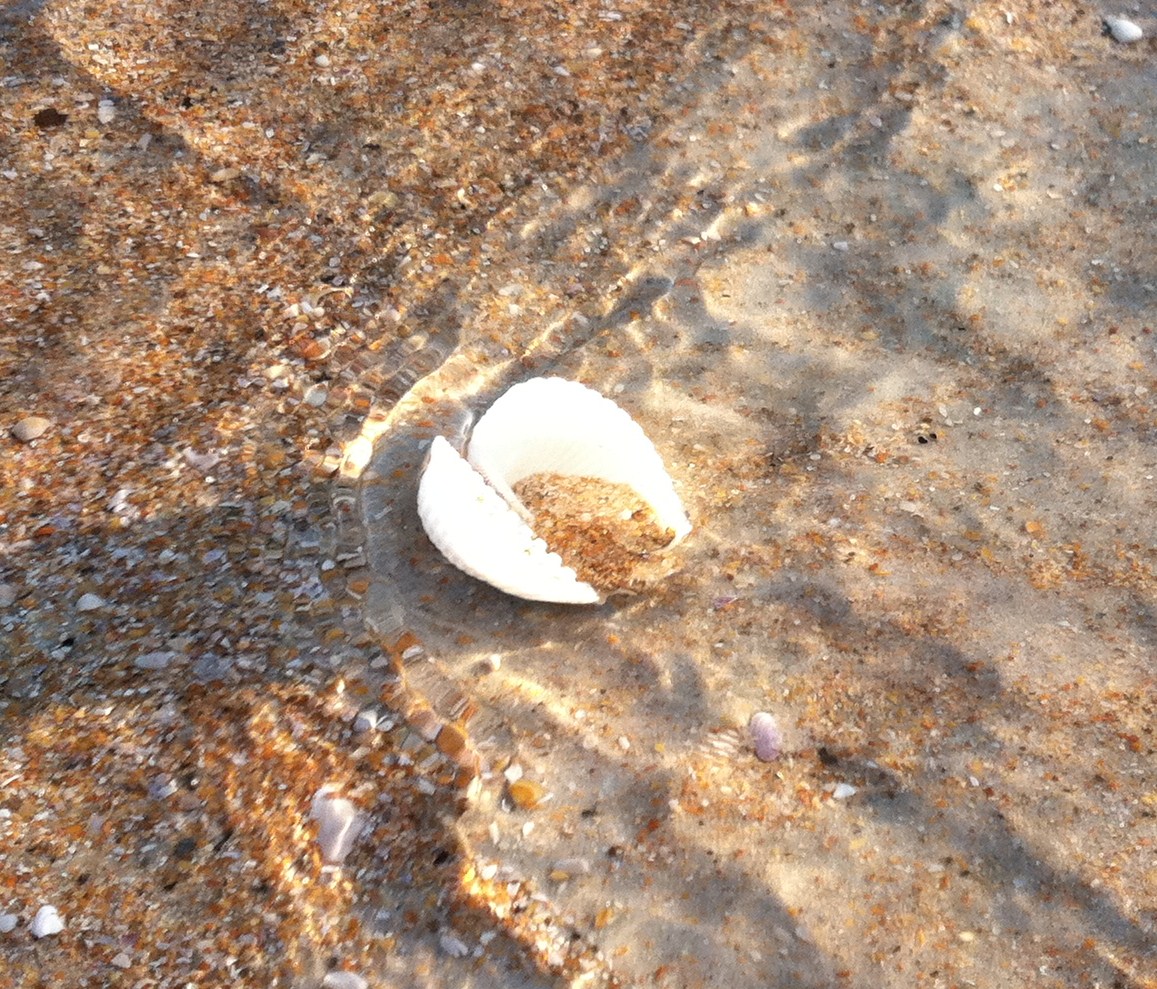 about bivalves in general this morning. Virtually every shell you find on the beach, with the exception of the conch, murex, and whelk families, which are a kind of spiral construction, are bivalves, meaning there are two nearly identical halves, connected by a flexible ligament called a hinge. There are more than 9000 species of bivalves. Some attach to surfaces, some move with currents, some have a digging foot, and some, like scallops, can swim. Every now and then we find a bivalve (pictured) with the hinge still intact, but by far what you find is one or the other half of one, constituting everybody’s sea shell collection. I am amazed by the variety and sheer numbers of bivalves in the oceans of the world, and right here on the beaches of Skinny Island. Everywhere you look in the little hacienda, and even outside are shells. We’ve got some pretty exotic-looking things, and lots and lots of common but beautiful representatives. We’ve got jars of shells, boxes of
  shells, shells laying about on tables, shells to trip over, shells in plastic bags awaiting some disposition, or other. There was something alive, mobile, and hungry in each and every one, and much of the beach itself is crushed shells, the carapace of these super abundant, ancient creatures. Oh, and did I mention how beautiful they are? An infinite variety of color, texture, and design. Bivalves rule, man.

 The Skinny Island Post
Nanokeratin locks onto the hair, forming a
fine, smooth coat of keratin. My hair doesn’t always look good when I’m going to attend openings
and red carpet events. Soon after this, use curl lotion all more than
your hair, and make use of mousse and squeeze this in your hair to that
your curls seem flawless.