
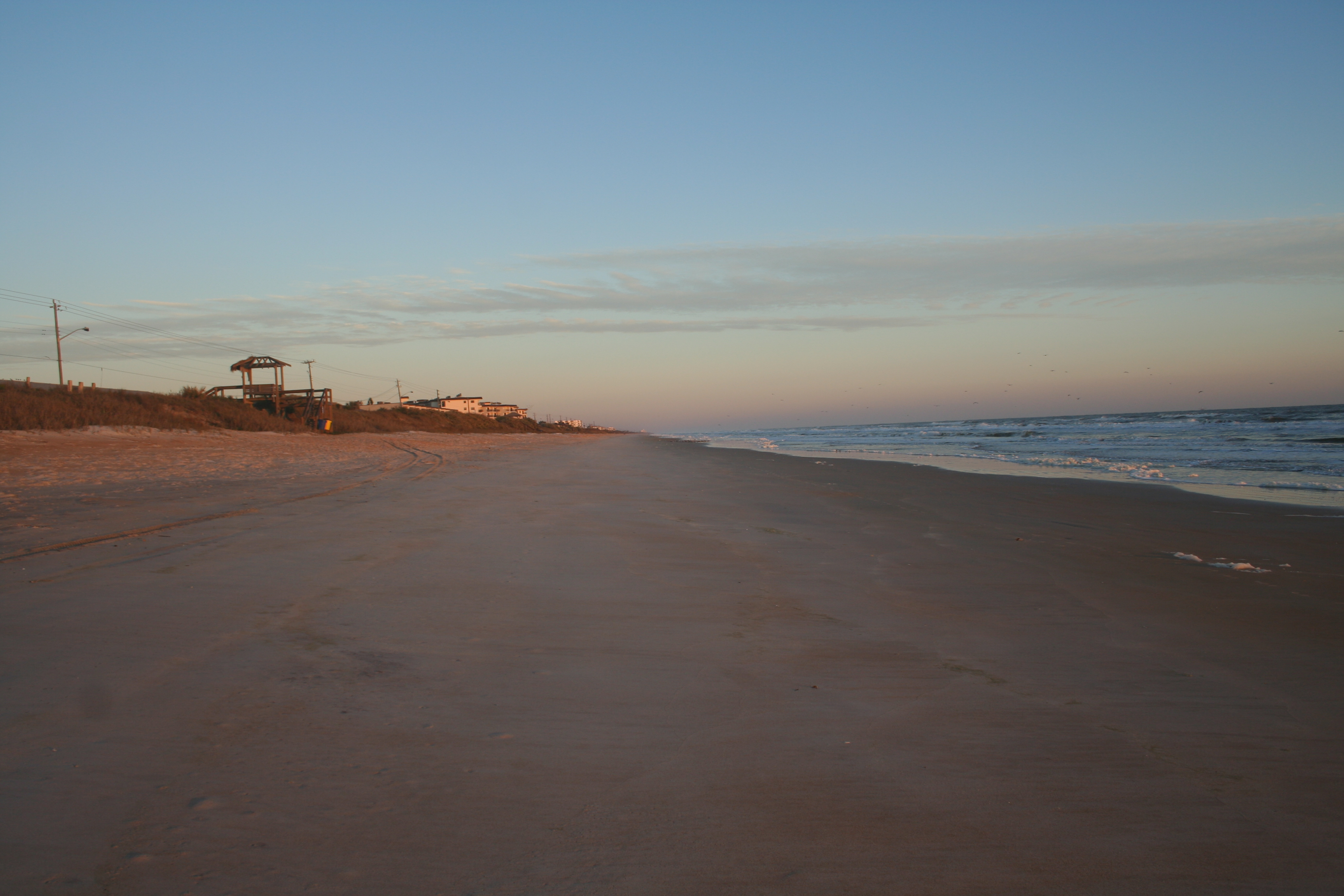
Low Tide Beach
Cool and clear this morning; brisk walk on wide, low-tide beach, nobody else out but a few birds. In spring and summer the beach is home to a wide variety of shore birds: Sanderlings, Stilts, true Sandpipers, Egrets, Ibis, Great Blue Heron, Night Heron, and three kinds of Plover. It’s fun to watch how their different adaptations dictate their feeding techniques. The short legs and short beaks of the diminutive Sandpiper only allow him to hunt for little crustaceans in very shallow water, generally in a retreating, spent wave. The Stilts, with much longer legs and a long, somewhat upturned beak, can go deeper in both water and sand, and get the bigger stuff, like fat sand fleas. Other larger waders, like the Herons, generally found in salt marshes and estuaries, apparently somewhat lazy, like to hang on the beach when fishermen are around and snag bait shrimp, mullet, and hand-outs. The egrets are amazing fishers, stalking small prey in the shallows with their heads tilted to one side to see into the water, then striking with amazing speed and agility. But the Night Herons are the real treat. Half the size of an adult Great Blue Heron, they have shorter legs, neck and beak, and are a beautiful greenish gray. You have to be out early to see them; they’re gone as soon as the sun pops out of the ocean; but in the dusky morning light you find them standing statue-still, facing away from the ocean, just before the soft sand the tide doesn’t reach. They love ghost crabs, and are extremely patient hunters. They’ll stand in one place for ten or fifteen minutes, having located crab holes, just waiting for one to come out, (and come out they do; it’s crab nature to venture out to feed in the morning,) and when the do relocate, they do so very slowly and gingerly, so as not to create vibrations in the sand. They move very quickly when needed though, catching the crab in their beak on the dead run, then manipulating it to the right position to swallow, a process that can take ten minutes or more. It is a delight to watch.

Skimmers in Flight
In winter, all the aforementioned birds are absent. In their place are a variety of gulls, and for the past three years, a fairly substantial colony of Skimmers, though this year their numbers seem to be smaller. Last year they stayed together as one unit; this year they are mixed in with the gulls for greater numbers. They are clearly unmistakable, though, one of the most elegant, beautiful birds you can see.
I came upon two separate groups of them on my walk this morning, ten or so in each group mixed in with a larger number of gulls, and got some good photos of them in flight. They have black feathers on top of the wing, with white undersides and bellies. There is a black hood around the eyes and a black and orange beak. The wing-span is huge for the size of the bird, enabling a kind of hover while making forward speed, and the bottom half of the beak is longer than the top, which acts as a scoop for small fry and other little creatures as they fly just inches above the water’s surface. They skim for food, a remarkable sight.
Because the different species are generally after different foods, they pretty much coexist without incident on the beach. There are scraps between members of the same species though, especially the sandpipers. They are extremely territorial and get in terrible snits when another piper encroaches on their sand. I have yet to determine how large these territories are, but they are defended enthusiastically, the little birds squawking shrilly, their little backs arched and feathers bristling. It’s a hoot. The gulls chase each other off too, but for the most part, there is little hostility between species. Adaptation made room for cohabitation. Interesting. There’s a lot going on out there. Just wait, when the water warms up things really get crazy.

Sailing Pelican

 The Skinny Island Post